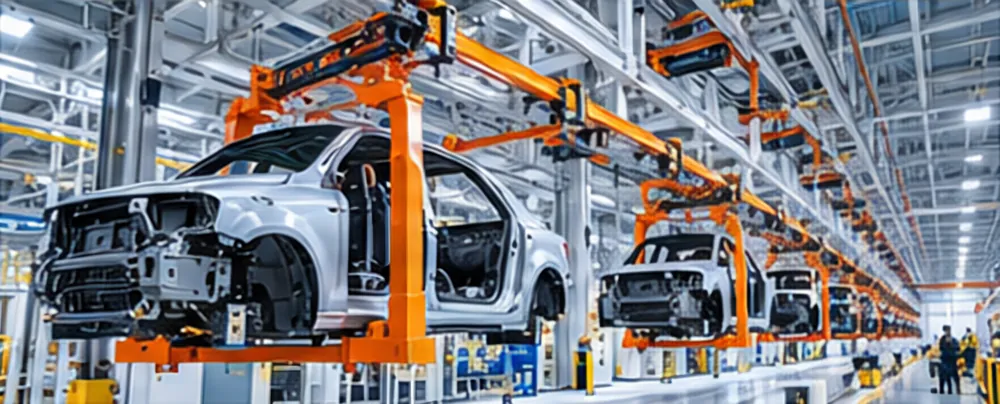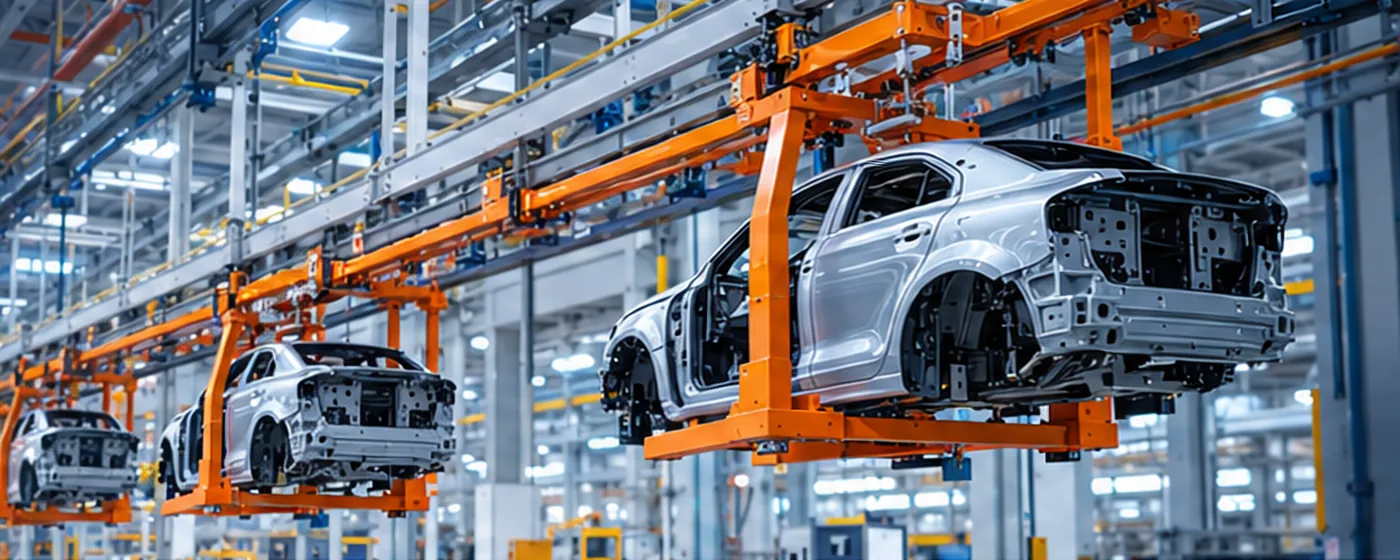
From the first welded body to the finished vehicle, conveyors set the takt of an automotive plant. They carry bodies between robots and operators, buffer them between shops, and present them at the right height and position for every operation.
Conveyors in each shop
| Shop | Main tasks | Common conveyor technologies |
|---|---|---|
| Body in white (BIW) | Move bodies between welding cells, lines and storage | Skid conveyors, EMS, overhead power and free |
| White body storage | Buffer and sequence bodies before paint | Power and free lanes, skid lanes |
| Paint shop | Pretreatment, e-coat, sealing, booths, ovens | Power and free (often inverted), skids, dip systems |
| Painted body storage | Buffer and resequence before assembly | Power and free lanes, skid lanes |
| Trim and final assembly | Present the body at working height for each step | EMS with hoists, skillets or plate conveyors, overhead conveyors |
| Sub-assembly | Doors, cockpits, engines, axles, battery packs | EMS, overhead conveyors, AGVs |
Body shop
Body shop conveyors move bodies between robotic welding cells, framing stations and storage. Speed between cells and precise positioning at each robot station matter most. Electrified monorail systems and skid conveyors are typical; overhead systems keep the floor free for robot cells and logistics.
Paint shop
The paint shop has the harshest conditions: chemicals, overspray and heat. Power and free conveyors and skid systems are the main technologies, with special dip systems for pretreatment and e-coat. Our paint shop conveyor guide goes zone by zone.
Storage buffers between shops
Body shop, paint shop and assembly do not stop at the same moments. Storage buffers decouple them and restore the build sequence when paint repairs take bodies out of order. See painted body storage.
Trim and final assembly
In assembly, operators and tools work on the body for most of its time on the conveyor. EMS carriers with hoists adjust the body height for each operation, from roof lining at low height to underbody work overhead. Floor conveyors such as skillets carry the vehicle once it stands on its wheels.
EV and battery production
Electric vehicles add battery module and pack assembly, with heavy, high-value products and precise positioning. Read conveyors for EV battery pack assembly.
What to specify for an automotive conveyor
- Vehicle models, body dimensions and weights, now and planned
- Jobs per hour and shift model
- Process list with work content per station
- Required working heights and body tilting or rotation
- Buffer sizes between shops
- Interfaces to robots, AGVs, MES and plant safety systems
See HITREE automotive conveyor solutions or send us your project data.
How automotive conveyor systems connect
The shops are linked by transfer stations: from overhead carriers to skids, from skids to assembly carriers, and from carriers to floor conveyors once the vehicle stands on its wheels. Each transfer needs precise positioning and a clear hand-over of the vehicle identity, so the next system knows what it carries.
Planning for model changes
Plants rarely build one model for its whole life. Carriers with adjustable or exchangeable fixtures, conveyor layouts with space for extra stations, and controls that select programs by model all make the next model launch faster and cheaper.
Worked example: takt and carriers in final assembly
A final assembly line builds 50 vehicles per hour, a takt of 72 seconds. With 6 m pitch, a continuous line runs at 6 ÷ 1.2 = 5 m/min. A 300 m assembly line therefore holds 50 vehicles on carriers at any time, plus carriers in buffers and the empty return.
- Define the takt from planned output and available time
- Fix the pitch from vehicle length and safe gaps
- Count carriers on the line, in buffers and on return
- Plan transfer points and identity hand-over between shops
Automotive conveyor systems are long-term investments, so involve the conveyor supplier early in plant planning.