
Solutions
Accumulation & Buffering
Buffers decouple processes with different cycle times or downtime patterns, so a short stop in one area does not ripple through the whole plant.
Why Buffers Matter
Every process stops sometimes: a robot fault, a paint colour change, a missing part. Without a buffer, the stop travels upstream and downstream within minutes.
A correctly sized buffer stores enough carriers to bridge typical stoppages. We size buffers from your takt time and the length of stoppages you want to absorb.
Buffer carriers ≈ stoppage time to bridge ÷ takt time
Example: to bridge a 10-minute stop on a line running a 60-second takt, you need about 10 carriers in the buffer, plus a margin for refilling.
How We Do It
Buffer Types We Build
Inline accumulation
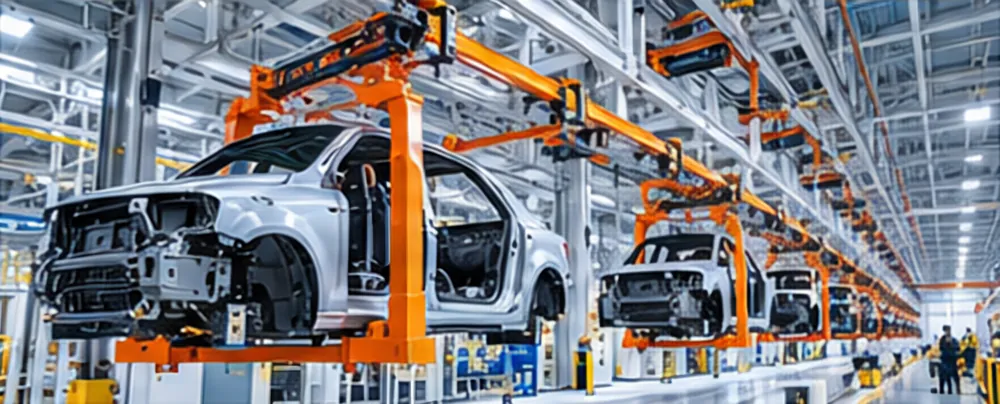
Power and free zones where trolleys queue on the main line.
Storage lanes
Parallel lanes for sequencing, colour batching or model mix.
EMS buffers
Software-controlled queues at any rail position, with no mechanical stops.
Empty carrier storage
Return-side storage so loading stations never wait for carriers.
Repair loops
Rework lanes that take products out of flow and return them in sequence.
Sequencing
Selective release from lanes to restore a required build sequence.
FAQ
Frequently Asked Questions
How large should a production buffer be?
Size it from the stoppages you want to bridge and the takt time. A 10-minute stop at a 60-second takt needs roughly 10 carriers, plus margin to refill the buffer after the stop.
Which conveyor is best for buffering?
Power and free conveyors offer low-cost mechanical accumulation. EMS systems buffer under software control at any position, which is useful when buffers must also sequence or re-route.
Can a buffer be added to an existing line?
Often yes. Overhead buffers use space above the floor, so lanes can be added above existing processes.
Explore
Related Solutions


Planning a New Production Line?
Let our engineers design the right conveyor solution for your application.
WhatsApp Us Discuss Your Project