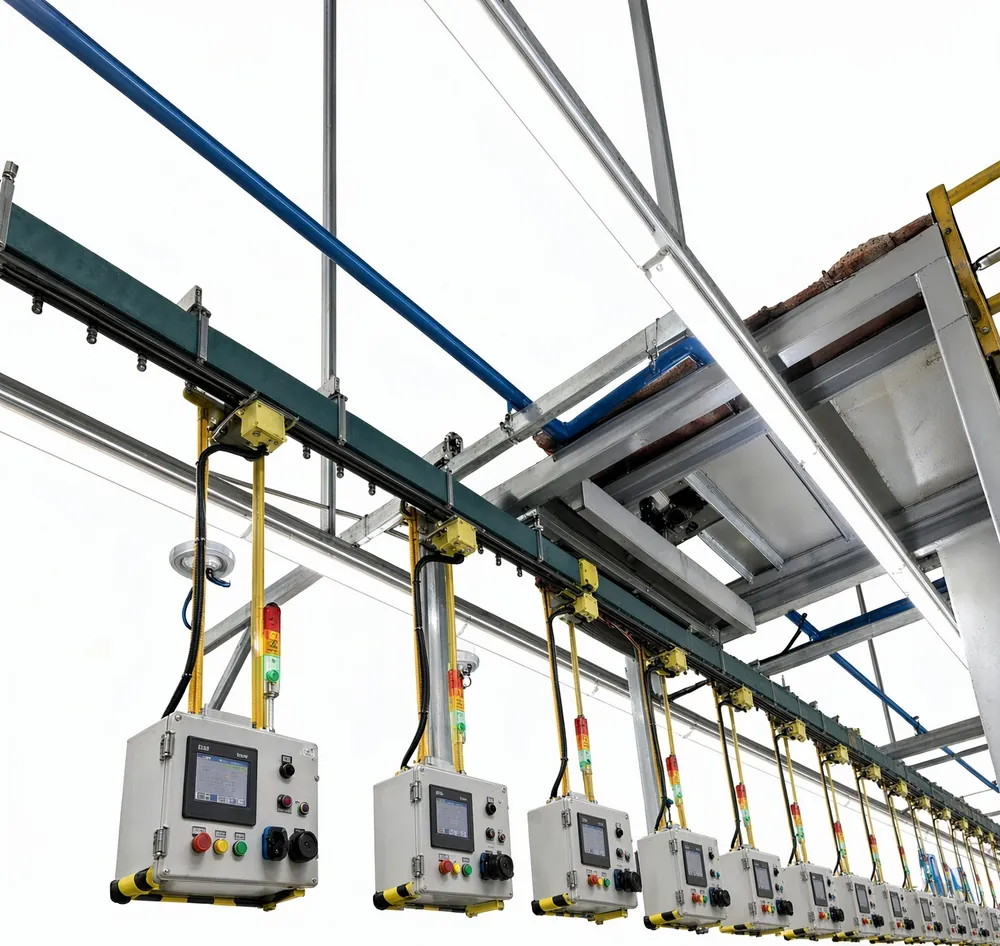
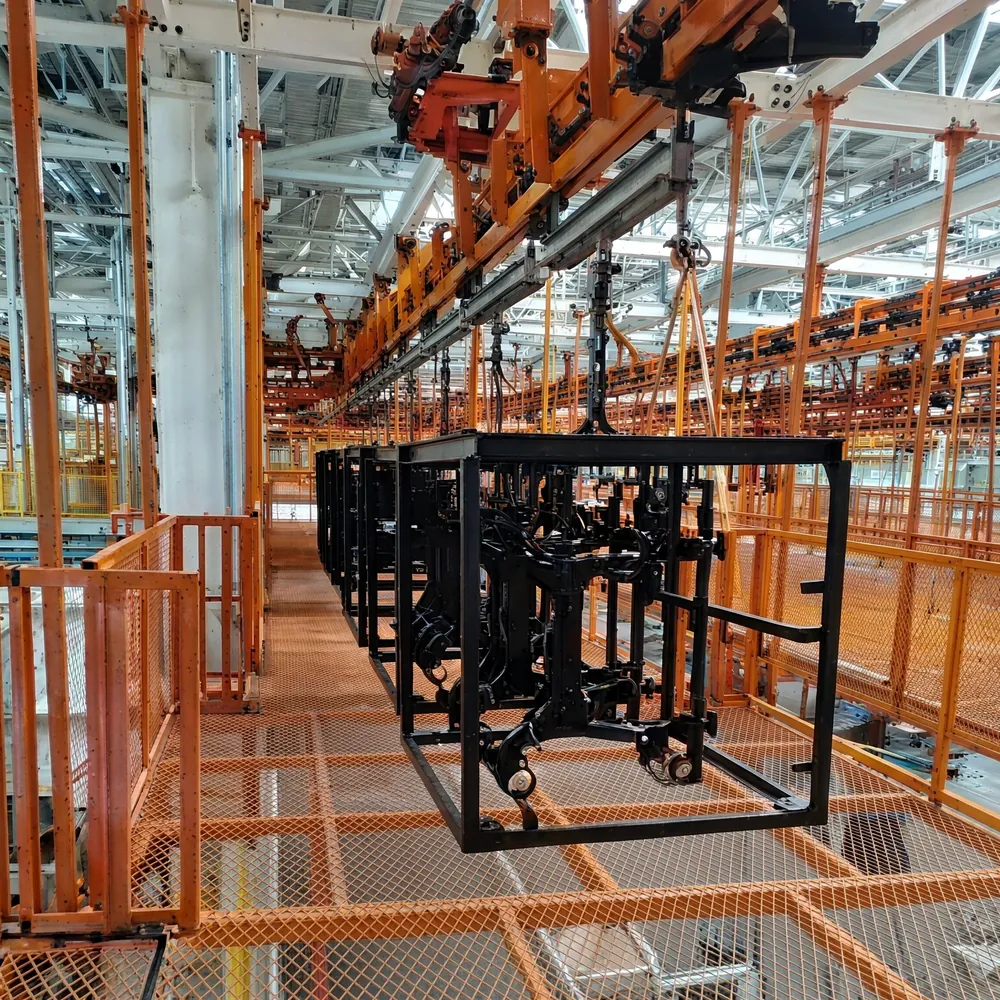
An electrified monorail system, usually shortened to EMS, is an overhead conveyor in which every carrier has its own electric drive. Power and control signals reach the carriers through a conductor rail built into the track.
Because carriers are not tied to a common chain, each one can accelerate, stop, change speed and take its own route. That makes EMS a natural fit for automated assembly lines.
How an EMS works
The rail profile carries the weight and guides the carriers. A conductor rail along the profile supplies power to each carrier's drive. The line controller sends commands to the carriers, and each carrier's onboard controller executes them: travel, stop at a position, slow down in a work zone, or wait in a buffer.
Carriers keep a safe distance from each other through zone control and anti-collision logic, so a stopped carrier does not cause a collision behind it.
Main components
| Component | Function |
|---|---|
| Rail profile | Aluminium or steel track that carries and guides the carriers |
| Conductor rail | Supplies power, and on many systems data, to each carrier |
| Carrier (trolley) | Drive unit, idler units, onboard controller and load-bearing frame |
| Load attachment | Hanger, load bar, C-hook or product-specific fixture |
| Switches and turntables | Route carriers between lines, parallel stations and buffers |
| Lift stations or hoists | Change the product height for work or transfer |
| Line control | PLC, positioning, carrier identification, HMI and safety circuits |
| Maintenance section | A track section where carriers can be removed and serviced |
Advantages of EMS conveyors
- Individual speed per carrier: fast in transport, slow and steady in work zones
- Precise stop positions for robots, tightening tools and inspection
- Flexible routing through switches to parallel stations and repair loops
- Software-controlled buffers at any rail position
- Integrated lifting for ergonomic working heights
- Low noise and no lubricated chain overhead
- Easier to extend or re-route than chain conveyors
Limitations to consider
- Higher cost per carrier, because every carrier has a drive
- Onboard electronics are not suited to high-temperature ovens
- More controls engineering and a maintenance team trained on drives and electronics
For long lines through ovens and paint areas, power and free conveyors are usually the better choice. Our EMS vs power and free comparison goes into detail.
Typical applications
| Application | Why EMS fits |
|---|---|
| Automotive trim and final assembly | Height adjustment per station and precise positioning |
| Body shop transport | Fast transfers between welding cells and storage |
| EV battery and powertrain assembly | Clean, quiet, precise handling of heavy, valuable parts |
| Machinery and appliance assembly | Variable work content and model mix |
| Distribution and logistics | Overhead transport and buffering above busy floors |
How to specify an EMS
Start with product weight and dimensions, target output, station list with work times, required heights and the building layout. From these, the supplier selects rail profile, drive size, carrier design, number of carriers and the control concept. See HITREE EMS overhead conveyors or send us your data.
EMS terms explained
| Term | Meaning |
|---|---|
| Carrier | The vehicle running on the rail: drive, idlers, controller and load frame |
| Conductor rail (busbar) | The live rail that supplies power to each carrier |
| Zone control | Dividing the rail into blocks so only one carrier occupies each block |
| Positioning | Measuring carrier position so it can stop precisely at stations |
| Turntable / switch | Track elements that change a carrier's route |
| Lift station | A section that lowers or raises the rail with the carrier on it |
Worked example: sizing an EMS assembly line
An assembly line must produce 40 units per hour, so the takt time is 3,600 ÷ 40 = 90 seconds. The line has 12 work stations and the carriers travel at high speed between stations and stop during work. If transport between stations takes 10 seconds, each station has about 80 seconds of work time per unit.
With 12 stations occupied, a buffer of 6 carriers before end-of-line test and 4 carriers in transport and return, the line needs around 22 carriers. Because each carrier in an electrified monorail system has its own drive, this carrier count drives a large part of the cost, so buffers are sized carefully.
Questions to ask an EMS supplier
- Which rail profile and drive size, and what load margin do they give?
- How is carrier position measured, and how precise is the stop?
- How are carriers removed for maintenance without stopping the line?
- Which spare parts should be on site: drives, controllers, collectors?
- How is the electrified monorail system integrated with plant safety and MES?