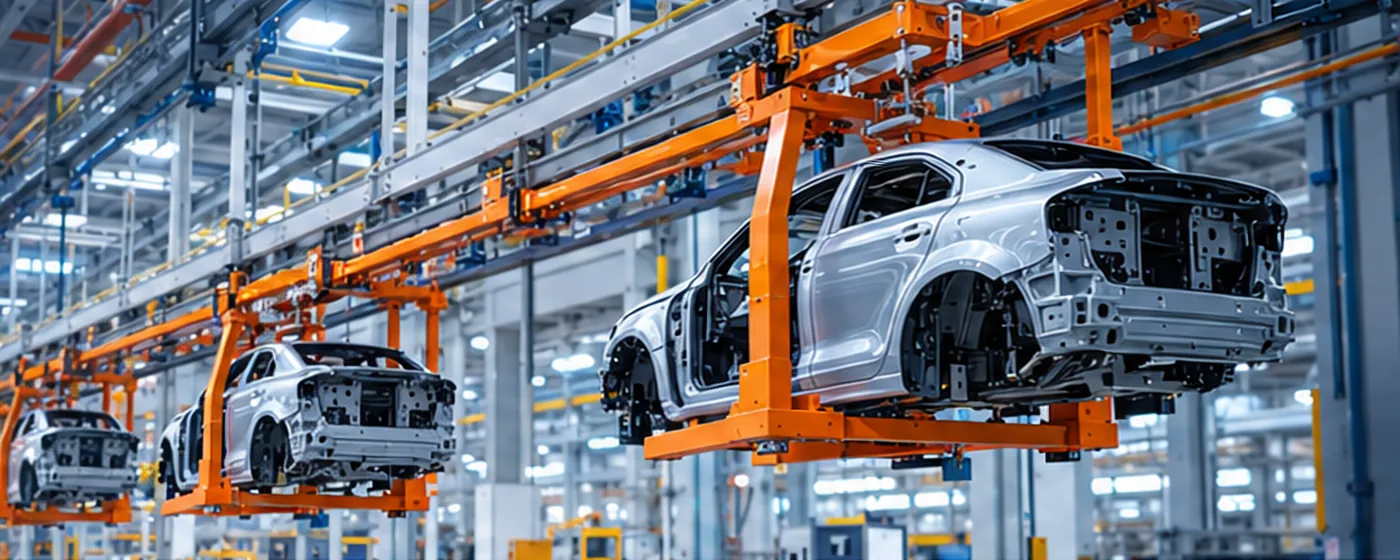
Final assembly is where a painted body becomes a car. Hundreds of parts are installed in sequence: wiring, interior, glass, powertrain, wheels. Overhead conveyors carry the body through the chassis and underbody areas, often at changing heights.
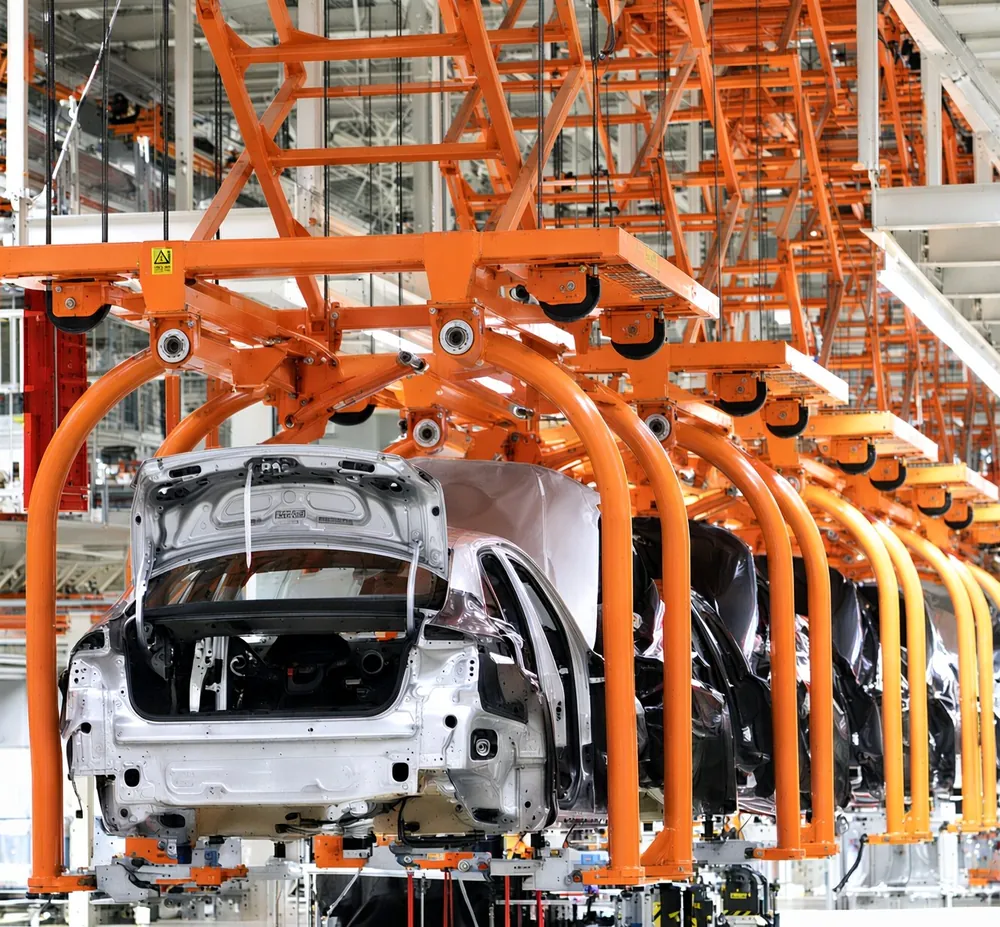
Conveyor types along the assembly line
| Zone | Typical conveyor |
|---|---|
| Trim lines | Floor plates or skillets, or overhead carriers with low body height |
| Chassis and underbody | EMS or overhead carriers with C-hangers and height adjustment |
| Marriage (body and powertrain) | Overhead carrier with precise positioning above an AGV or floor pallet |
| Final lines | Floor conveyors once the vehicle stands on its wheels |
Why C-hangers and EMS
- The underbody is open for fuel lines, exhaust, brakes and powertrain
- Hoists lower or raise the body for each work step
- Carriers stop precisely for automated tightening and filling
- Individually driven carriers allow buffers and model mix
- The floor stays free for operators, parts racks and AGVs
Ergonomics
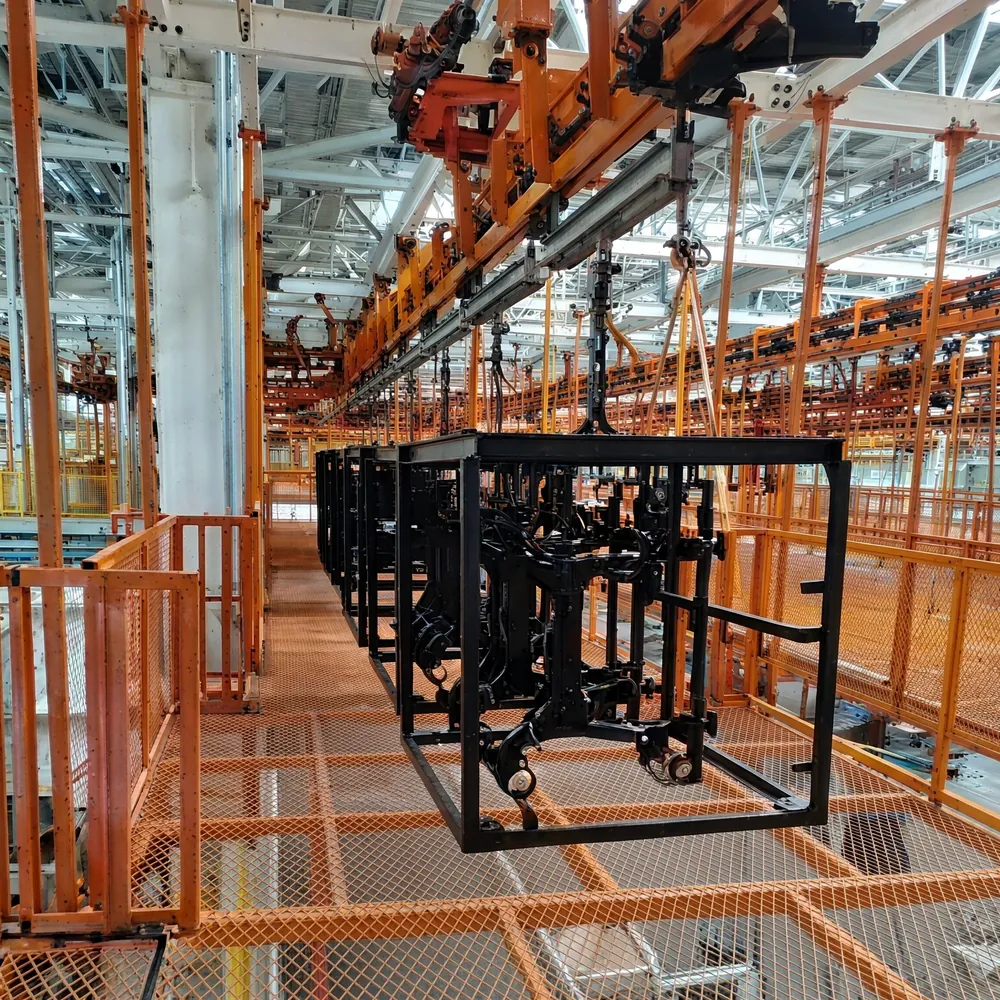
Each station has an ideal working height. Underbody work is done with the body raised above head height; work on doors and interior is easier with the body lower. Carriers with hoists, or lift stations at fixed points, set the height station by station. Tilting carriers can improve access further.
Worked example: takt and line length
A plant builds 45 cars per hour, a takt of 80 seconds. The chassis line has 24 stations at 6.5 m pitch, about 156 m long. A continuous line runs at 6.5 m ÷ 80 s ≈ 4.9 m/min. If one station needs 100 seconds of work, it is split into two stations or given a parallel station.
Questions to ask your supplier
- How is body height set at each station?
- How precise are stop positions for automated stations?
- How are model changes handled on carriers and controls?
- How does the body pass to the marriage station and floor conveyors?
- What buffers protect the line from short stops?
See automotive conveyor systems, EMS overhead conveyors and our automotive solutions.
Common mistakes to avoid
- Fixed body height where operators need different heights
- No buffer before stations with variable work content
- Carriers that block access to areas needed for later models
- Identity of the body not passed reliably between conveyor systems
Final assembly conveyor terms
| Term | Meaning |
|---|---|
| Trim line | Interior and wiring installation, body without powertrain |
| Chassis line | Underbody work: lines, exhaust, suspension |
| Marriage | Joining body and powertrain |
| C-hanger | Carrier holding the body from below and at the sides |
| Skillet | Floor plate conveyor carrying vehicle and operators |