
An electrified monorail system (EMS) runs independent carriers on a single rail. Each carrier has its own drive and controller, powered through a conductor rail. This article explains every main component. For the basics, read what an electrified monorail system is.
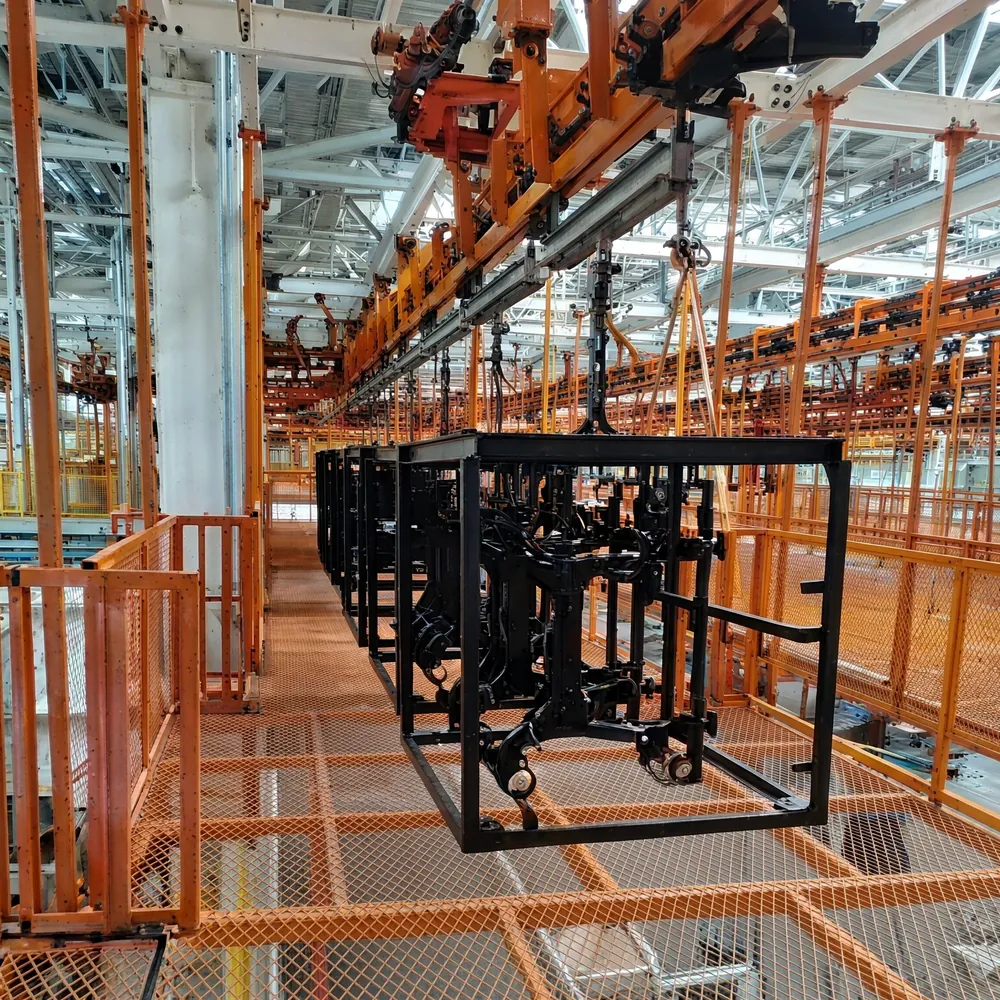
Main EMS conveyor components
| Component | Function |
|---|---|
| Rail profile | Aluminium or steel track that carries and guides the trolleys |
| Conductor rail (busbar) | Supplies power and often data along the route |
| Current collectors | Sliding contacts on the carrier that pick up power |
| Drive trolley | Motor, gearbox and drive wheel; pulls the carrier |
| Idler trolley | Supports load without drive |
| Load bar and hanger | Connects trolleys and holds the product fixture |
| Onboard controller | Executes travel, stop and speed commands |
| Hoist (optional) | Lifts and lowers the load on the carrier |
| Switches and turntables | Route carriers between lines |
| Lift and drop stations | Move a rail section with the carrier vertically |
| Positioning system | Code strip or sensors to locate each carrier |
| Line control | PLC, zone control, HMI and safety |
Power and data
The conductor rail carries power to every carrier. Commands can travel through extra conductor lines, through wireless networks or through slotted waveguides along the rail. The choice affects how quickly carriers respond and how much data can be exchanged, for example for diagnostics.
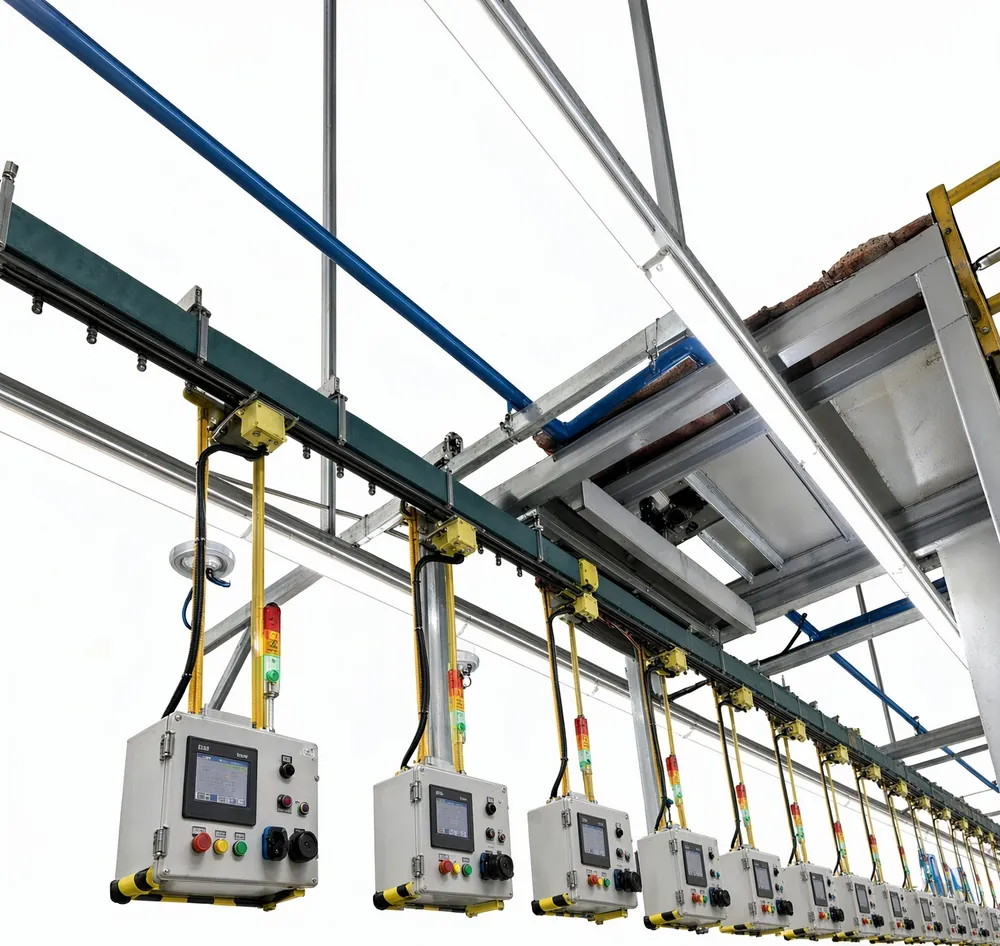
Positioning
To stop precisely, a carrier must know where it is. Common methods are barcode or code strips along the rail read by the carrier, absolute encoders, and sensors at stations. Precise positioning is what lets robots and automatic tools work on an EMS line.
Wear parts
- Drive and guide wheels (polyurethane treads wear over time)
- Current collector carbons
- Gearbox and motor brakes
- Hoist belts or chains
- Switch actuators and sensors
Questions to ask your supplier
- Which rail profile and drive size, for what load?
- How are power and data transmitted along the route?
- Which positioning method is used, and how precise is it?
- How are carriers removed for maintenance?
- Which spare parts should be stocked on site?
See HITREE EMS overhead conveyors or ask our engineers.
Common mistakes to avoid
- Choosing a rail profile with no load margin for future products
- No maintenance section to remove carriers without stopping the line
- Positioning system not precise enough for automated stations
- No spare carriers or controllers on site
Worked example: number of carriers
A 220 m EMS loop runs at a takt of 72 seconds with 16 stations, a buffer of 8 carriers before test and about 10 carriers on transport and return. The line needs around 34 carriers plus 2 spares. Because each carrier has a drive and controller, this count drives a large share of the cost, so buffers are sized from real stoppage data.
