Paint, powder and e-coat lines all end in a curing oven. The conveyor carries every part through the oven for a defined dwell time, at temperatures that are hard on chain, bearings and lubricants.
Dwell time and oven length
The coating supplier specifies the cure schedule: time at a metal temperature. The conveyor must keep each part in the oven long enough to heat up and then cure.
Conveyor length in oven = line speed × total dwell time
Ovens are usually built with several passes so that a long conveyor length fits in a compact oven. For power and free conveyors, parts can also accumulate in the oven, which changes dwell time; the control system must manage this.
Heat-rated components
| Component | Requirement in the oven |
|---|---|
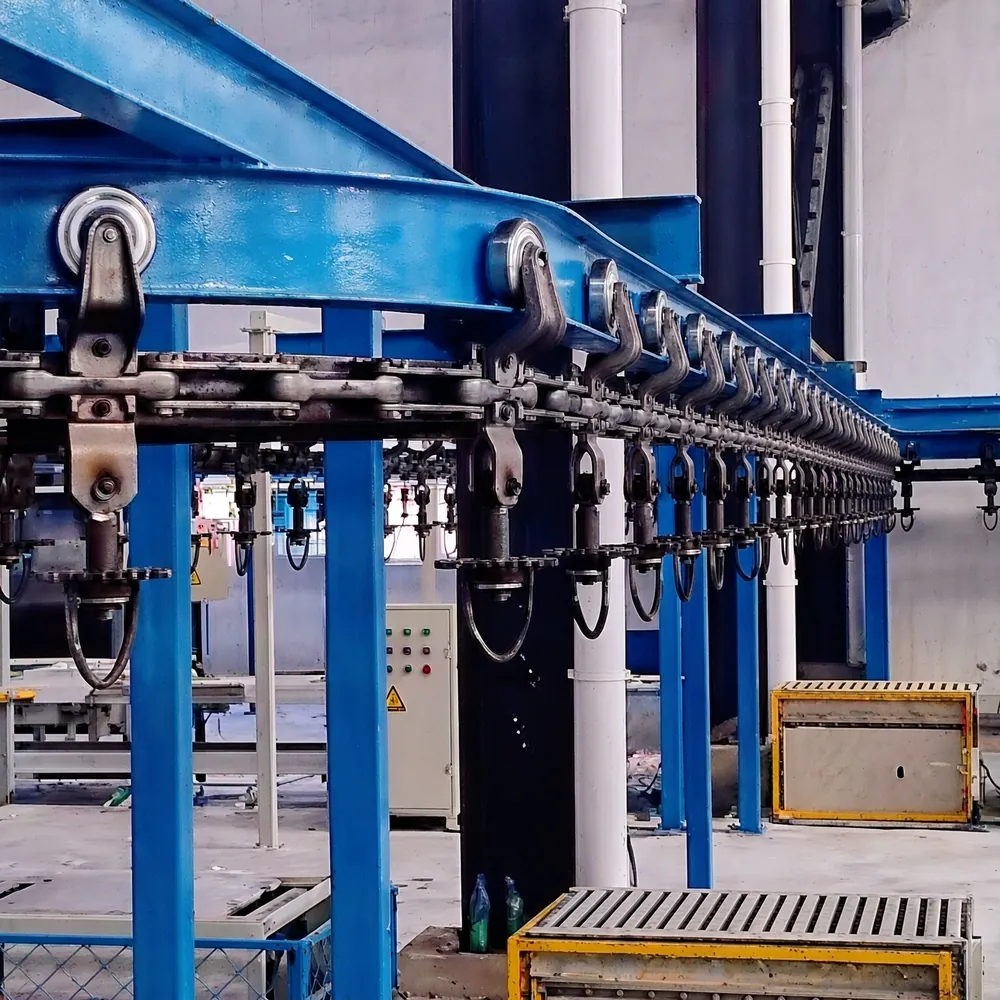
| Chain | Heat-treated chain suited to the oven temperature and load |
| Bearings and wheels | High-temperature bearings and grease, or designs that tolerate dry running |
| Lubricant | High-temperature lubricant that does not carbonise or drip onto parts |
| Track | Expansion joints to absorb thermal growth |
| Trolleys and carriers | Materials and clearances that allow for heat expansion |
Thermal expansion and take-ups
Steel grows as it heats. A long chain run through a hot oven becomes measurably longer, and the track expands too. The take-up must absorb this change between cold start and full temperature, and track sections need expansion joints. Drives and take-ups are best placed outside the oven, where they stay cool and can be serviced.
Lubrication in hot zones
- Use a lubricant rated for the oven temperature
- Apply small, regular amounts with automatic lubricators
- Lubricate outside the oven where possible so excess does not drip onto parts
- Inspect for carbon build-up on chain and wheels
Oven openings and energy
The conveyor enters and leaves the oven through openings that let hot air escape. Keep openings as small as the part profile allows, and use air seals at the entry and exit. Designs where the conveyor enters and exits from the bottom of the oven help keep hot air inside.
Cooling after the oven
Parts must cool before unloading or the next process. Provide enough cooling length, or a forced-air cooling zone, between the oven exit and the unloading station.
Maintenance checklist for oven conveyors
- Check lubricator function and lubricant level daily
- Listen for noisy bearings at the oven exit
- Measure chain elongation at regular intervals
- Check take-up travel at operating temperature
- Clean carbon and coating build-up from trolleys and hangers
See the complete overhead conveyor maintenance checklist.
HITREE builds power and free conveyors for oven duty in surface treatment lines. Send us your oven data for a proposal.
Worked example: oven conveyor length
A powder coating line runs at 1.5 m/min. The powder needs 10 minutes at metal temperature, and the parts need about 8 minutes to heat up. Total dwell is 18 minutes, so the oven must contain 1.5 × 18 = 27 m of conveyor. With a 9 m long oven, the curing oven conveyor makes three passes.
Common oven conveyor mistakes
- Ignoring heat-up time and under-curing heavy parts
- Using standard grease that carbonises in the oven
- No room in the take-up for thermal expansion
- Drives placed in hot zones where they are hard to service
- Large oven openings that waste energy
Questions to ask your supplier
- Which chain, bearings and lubricant are rated for our oven temperature?
- How is thermal expansion handled in the track and take-up?
- Where are lubricators placed relative to the oven and the parts?
- How is dwell time kept constant if carriers accumulate?