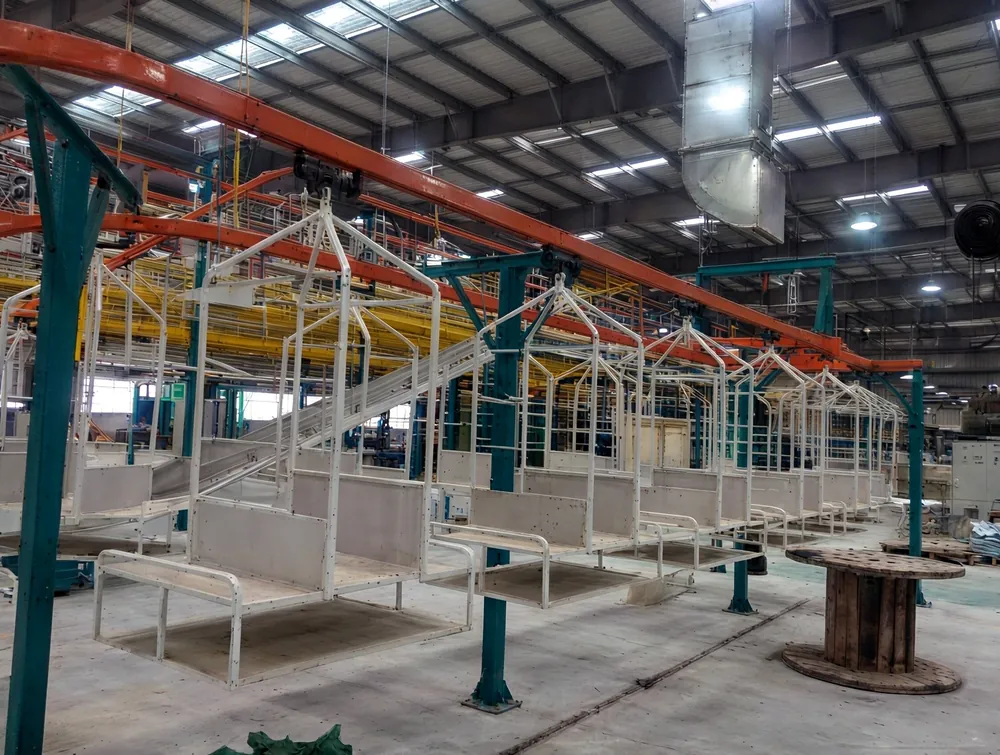
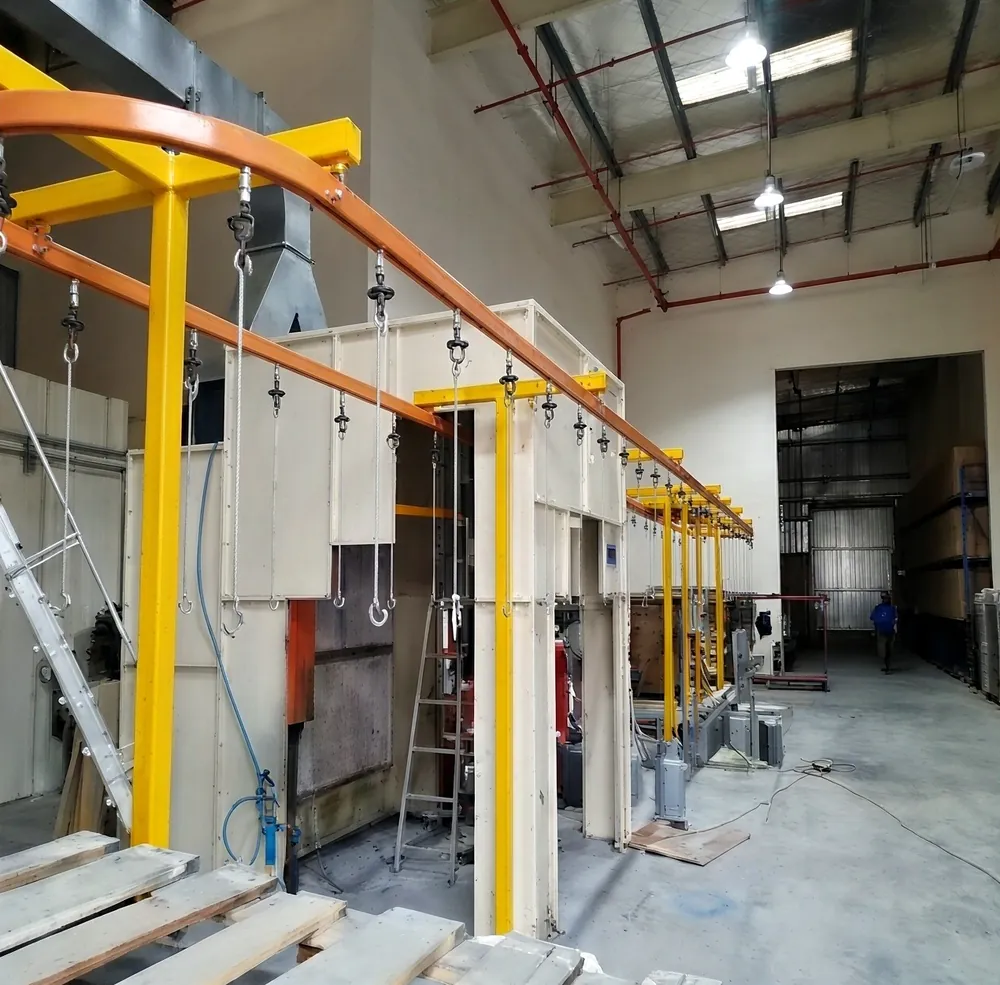
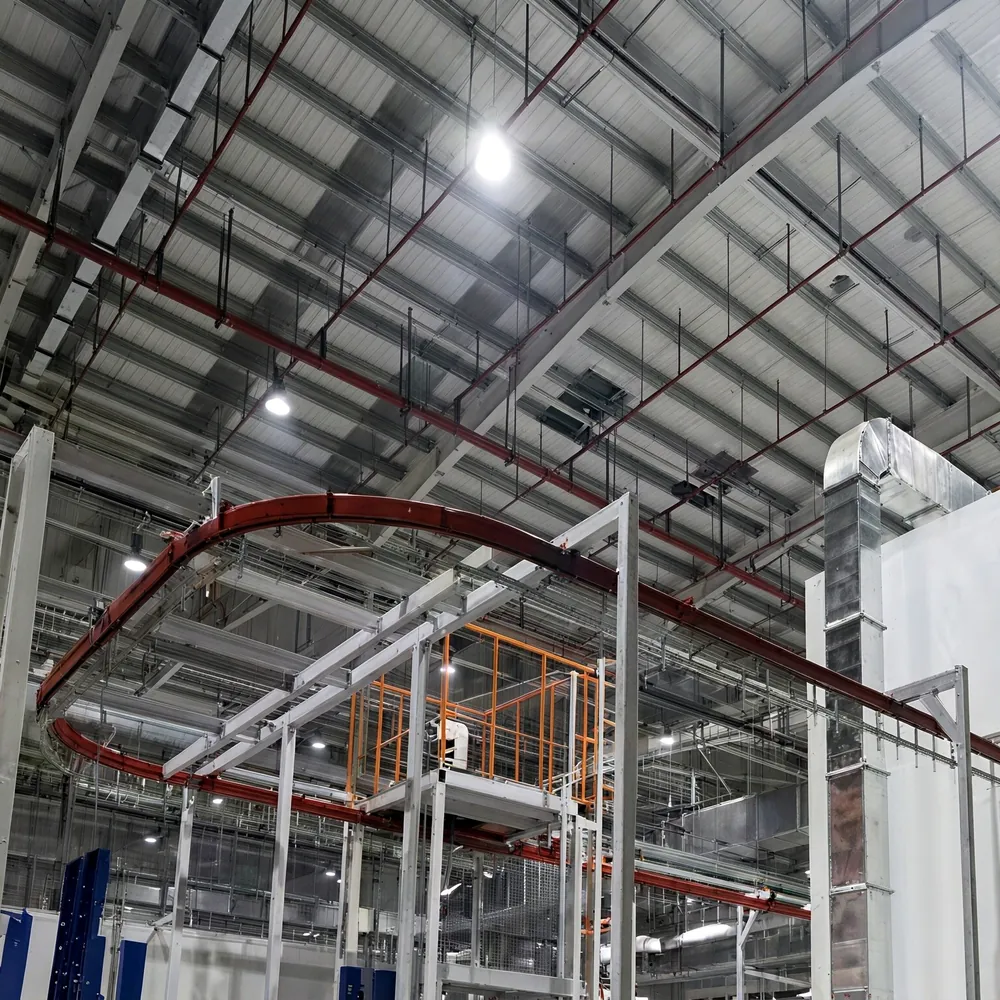
An overhead chain conveyor carries products on hangers attached directly to an endless chain. The chain runs on trolleys along an overhead track, pulled by a drive unit, and every hanger moves at the same speed.
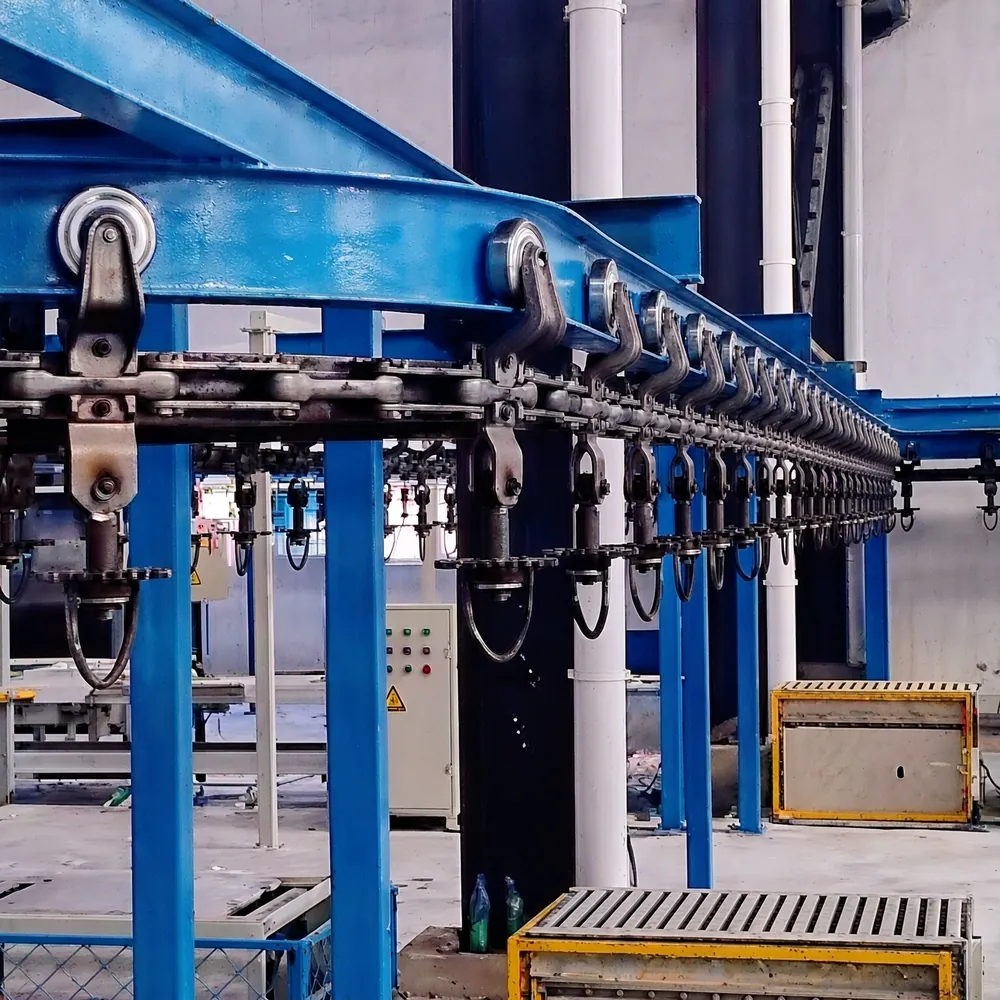
Main components
| Component | Function |
|---|---|
| Track | I-beam or enclosed track that carries and guides the trolleys |
| Chain | Rivetless or other conveyor chain that pulls the trolleys |
| Trolleys | Wheel assemblies that support the chain and the load |
| Attachments and hangers | Connect products to the chain trolleys |
| Drive unit | Caterpillar or sprocket drive that moves the chain |
| Take-up | Keeps the chain tensioned and absorbs elongation |
| Turns and curves | Roller turns, traction wheels and vertical curves that set the route |
| Lubricator | Supplies lubricant to chain and trolley wheels |
I-beam or enclosed track?
I-beam systems are robust and suited to heavier loads; enclosed track systems are lighter, cleaner and route easily through tight spaces. Our enclosed track vs I-beam guide compares them in detail.
Rotating hangers for coating
In powder coating and painting, hangers can be fitted with small sprockets that engage a fixed chain or rack at the booth. As the hanger passes, it rotates the part so the spray reaches every side. This is a simple, low-cost way to improve coverage on a continuous line.
Where overhead chain conveyors fit best
- Continuous powder coating and liquid painting lines
- Washing, pretreatment and drying
- Transport between departments above the floor
- Assembly lines with work on moving products
- Cooling and curing lines
Limits
Because hangers are fixed to the chain, an overhead chain conveyor cannot stop individual products or buffer them. When you need stops, queues or several routes, a power and free conveyor is the better choice; see overhead chain conveyor vs power and free.
Sizing an overhead chain conveyor
Line speed = hangers per minute × hanger spacing
Example: 300 parts per hour on hangers holding 2 parts each means 150 hangers per hour, or 2.5 per minute. At 0.5 m spacing, the line runs at 1.25 m/min. The chain pull, calculated from track length, loads, curves and inclines, then sets the chain size and the number and position of drives.
Maintenance
- Keep chain and trolley wheels lubricated with the right lubricant
- Measure chain elongation at regular intervals
- Check take-up travel and drive wear parts
- Inspect hangers and attachments for wear and cracks
Read our chain lubrication guide and contact HITREE for an overhead chain conveyor proposal.
Questions to ask an overhead chain conveyor supplier
- Which track type and chain do you propose, and why?
- How was the chain pull calculated, and how many drives are needed?
- Where are drives, take-ups and lubricators placed?
- What hanger spacing and line speed did you assume?
- Which wear parts should we stock?
Upgrading an overhead chain conveyor
Many plants extend an existing overhead chain conveyor with a power and free section at loading or unloading, adding buffers where operators work while the process section keeps its continuous chain. Read about overhead conveyor retrofits.