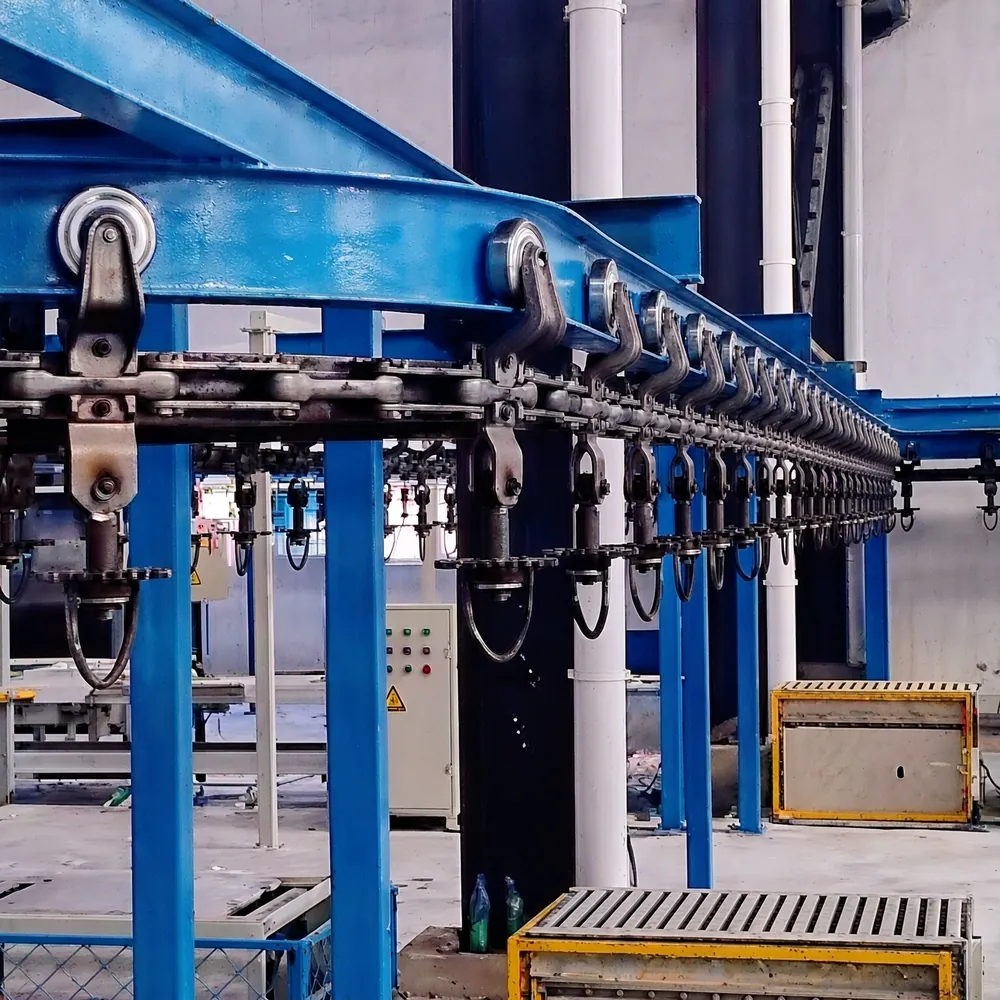
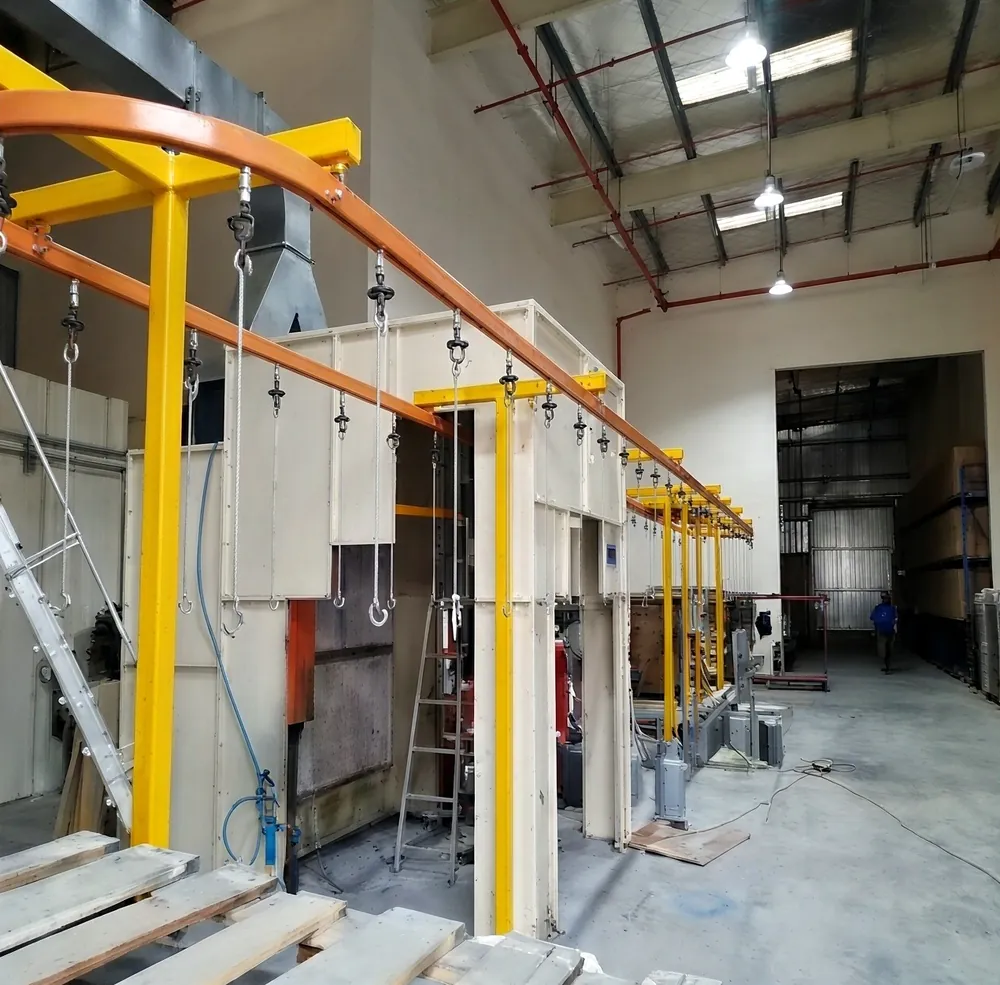
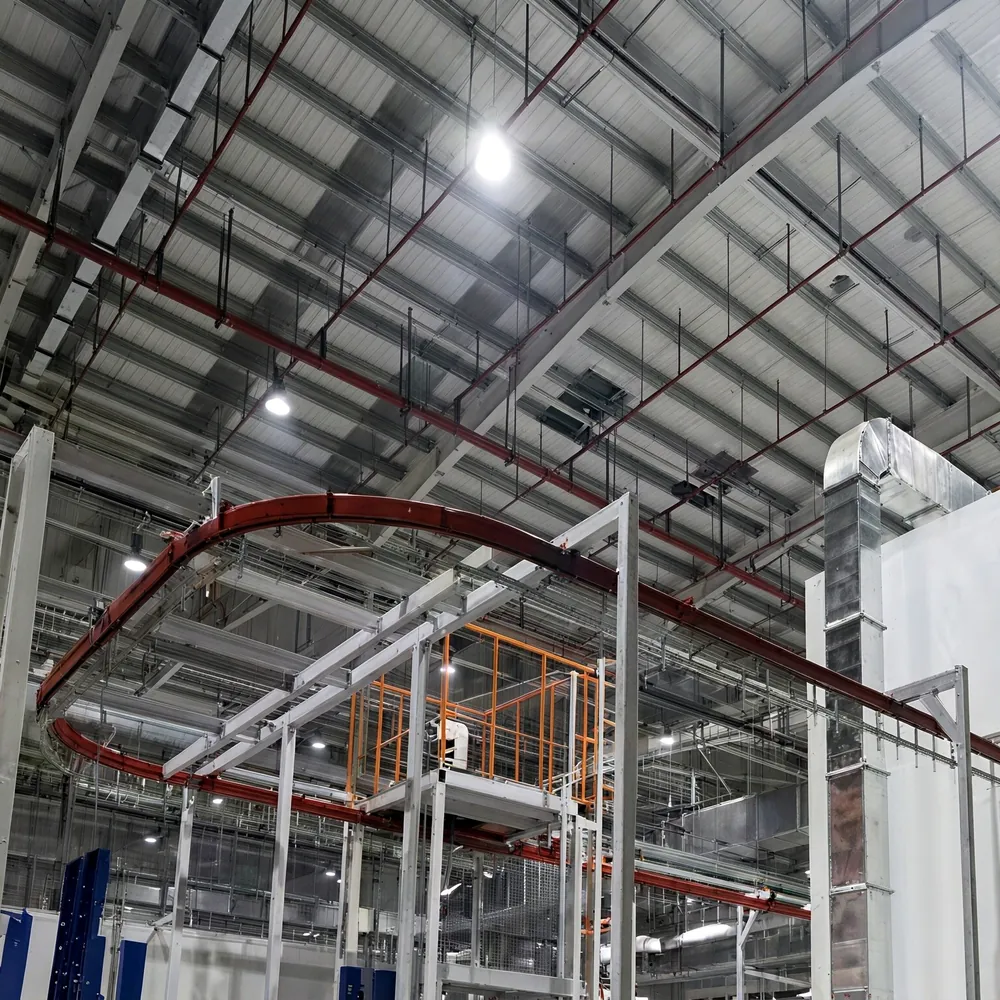
Carriers, also called hangers, fixtures or load bars, connect the product to the conveyor. They are repeated dozens or hundreds of times along the line, so small design decisions multiply in cost, weight and performance.
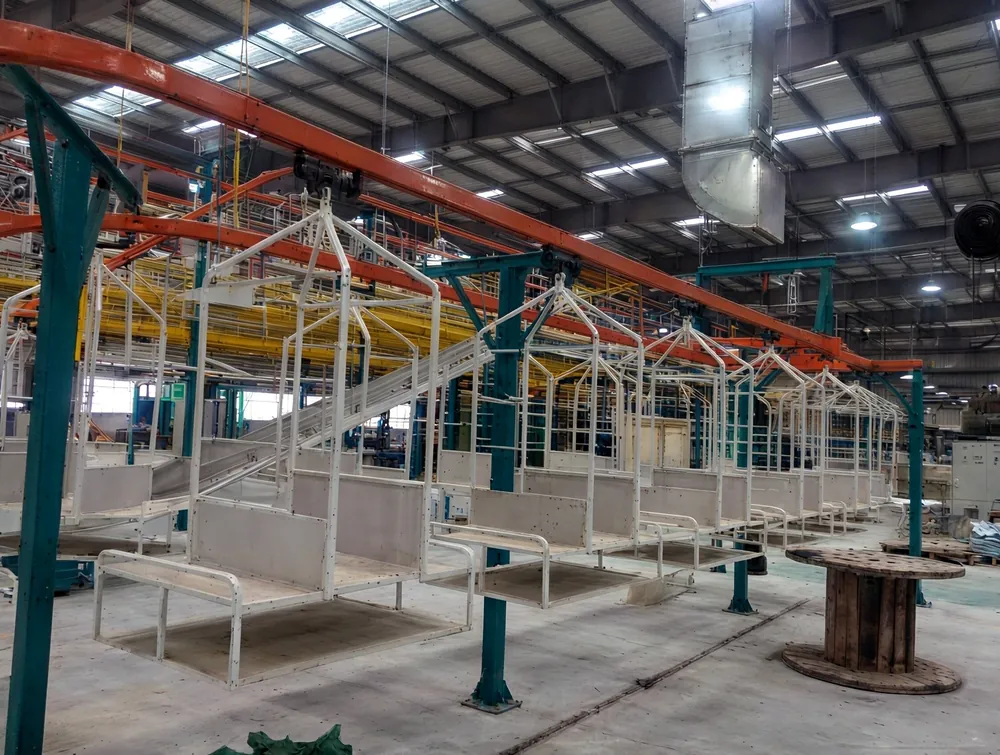
Start with the product
- Weight and centre of gravity of every product variant
- Hanging or support points that will not damage the product
- Surfaces that must stay free of contact marks
- Access needed at each station: top, sides, underbody
- Process conditions: wet zones, paint, ovens, cleanrooms
Load, balance and swing
A carrier must hang level with the product loaded, or the product will touch neighbours in curves and at stations. Place hanging points above the centre of gravity, and check the empty carrier too: an unbalanced empty carrier can swing and collide on the return run.
The trolley and load bar rating must cover the carrier and product weight with a safety margin. Heavier products may need two trolleys and a load bar.
Clearance and pitch
| Where | What to check |
|---|---|
| Horizontal curves | Carriers swing inward and outward; check the envelope against neighbours and structures |
| Vertical curves | Carrier tilts on inclines; check clearance to floor, guards and equipment |
| Accumulation zones | Accumulated length per carrier sets how many fit in a buffer |
| Stations | Operator and robot reach, tool access, safety zones |
| Oven and booth openings | Carrier plus product must pass the opening silhouette |
The pitch, the distance between carriers on the moving line, is set by product length, clearance in curves and the takt time. See overhead conveyor curve design.
Materials and finishes
| Environment | Typical choice |
|---|---|
| General assembly | Painted or powder-coated steel |
| Washing and pretreatment | Galvanised or stainless steel |
| Paint and powder lines | Steel with strippable contact points; cleanable designs |
| Ovens | Steel designed for thermal expansion; no plastic parts |
Coating lines: grounding and cleaning
In powder coating and e-coat, the carrier is part of the electrical circuit. Design defined contact points, avoid large flat areas that collect coating, and plan how hooks will be cleaned or stripped. See powder coating conveyor systems.
Ergonomics and quick change
- Load and unload at elbow height where possible, using drop sections if needed
- Use guides and stops so products locate themselves
- Design exchangeable fixtures for product families
- Mark carriers with IDs for tracking and maintenance
Test before series production
Build and test a prototype carrier with real products: load test, swing test in a curve, loading time at the station and passage through openings. Changes are cheap at prototype stage and expensive after 200 carriers are built.
HITREE designs product-specific carriers as part of every customized conveyor system. Send us your product drawings to start.
Worked example: counting the cost of a carrier change
A line with 180 carriers needs a new fixture for a new product. If each fixture change takes 20 minutes, converting the whole line takes 60 working hours. Designing an exchangeable insert that clips into the existing carrier frame in 2 minutes cuts that to 6 hours and lets the plant run both products during the changeover.
Overhead conveyor carriers: terms explained
| Term | Meaning |
|---|---|
| Load bar | Bar connecting front and rear trolleys; carries the hanger |
| Hanger | Frame or hook that holds the product |
| Envelope | Space the carrier and product occupy, including swing |
| Accumulated length | Length a carrier takes up when queued in a buffer |
| Pitch | Distance between carriers on the moving line |
Well-designed overhead conveyor carriers pay back many times over the life of the line.