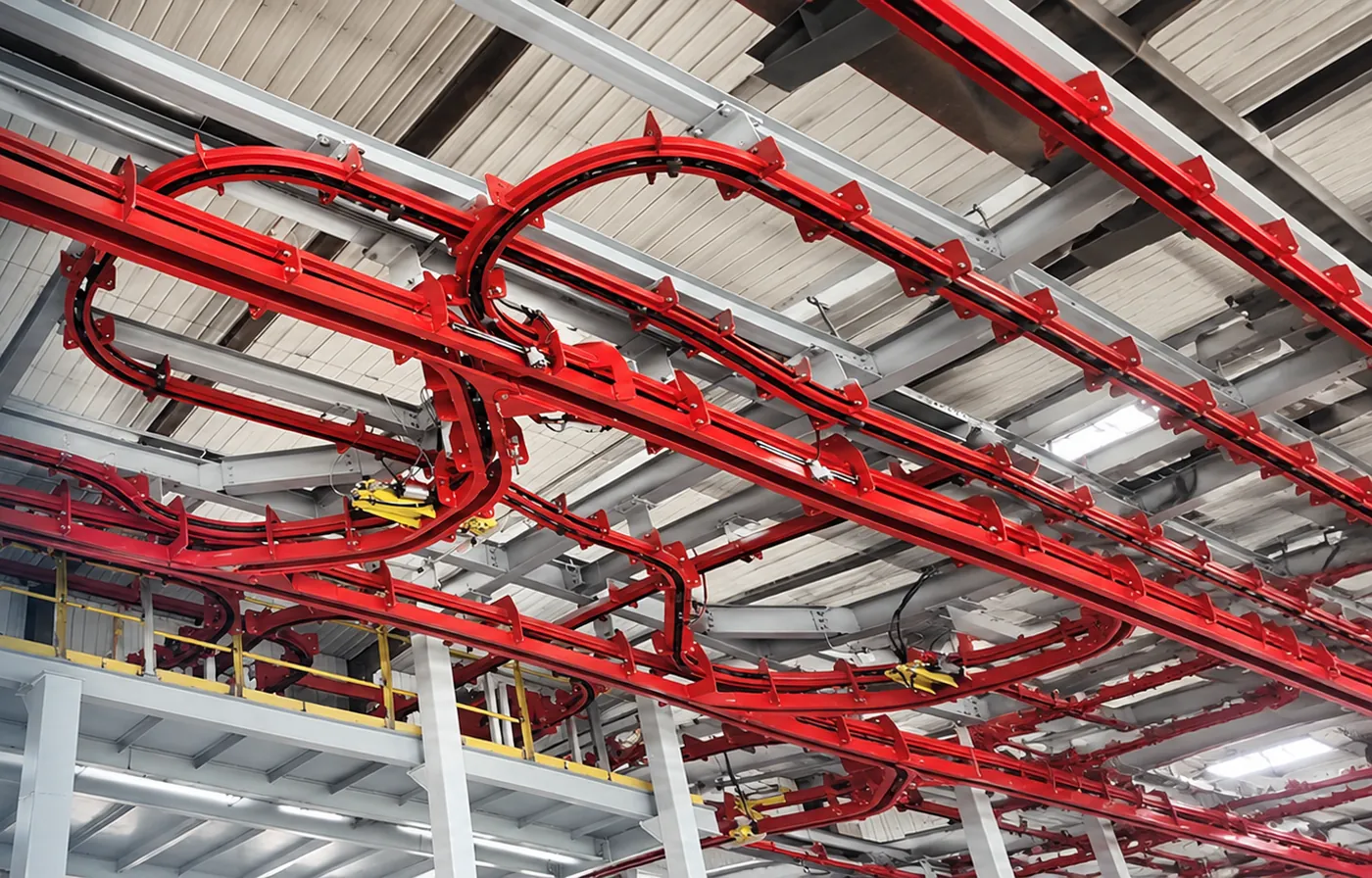
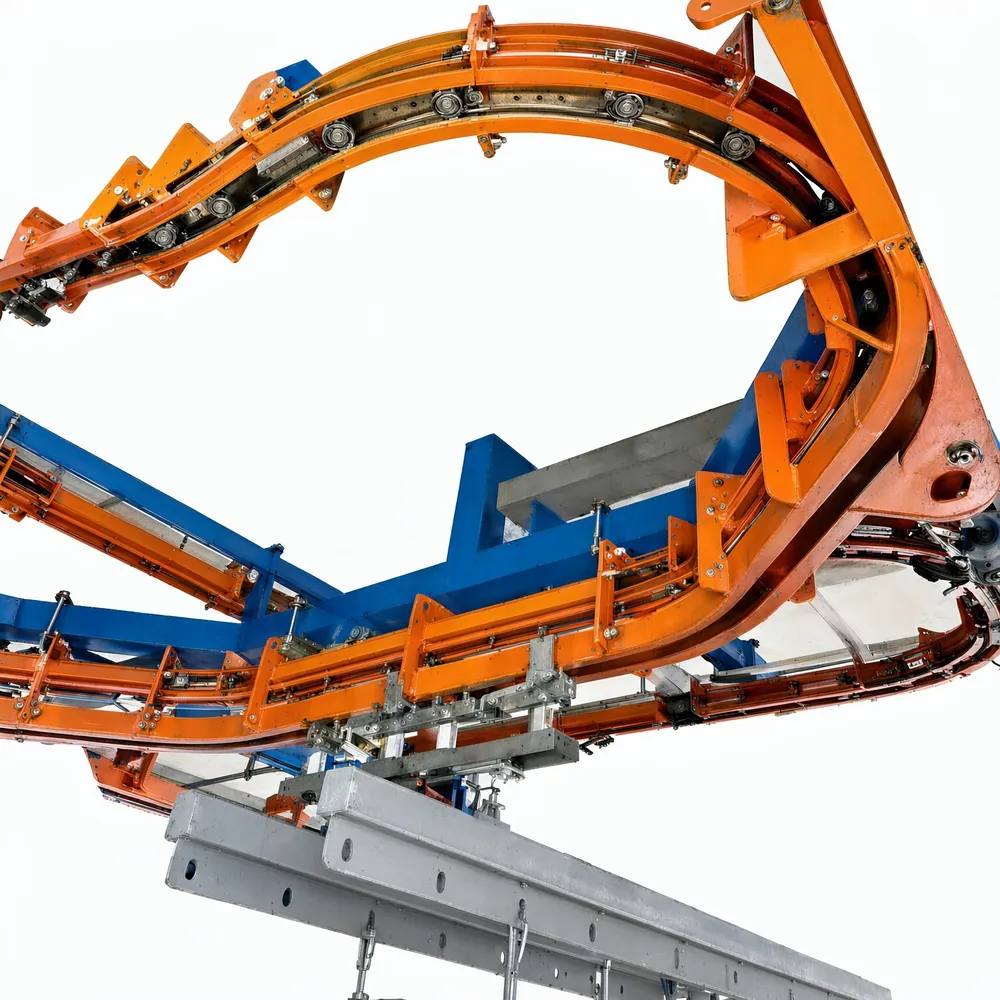
In an enclosed track conveyor, the chain and trolleys run inside a box-shaped track. In an I-beam conveyor, trolley wheels run on the flanges of a structural I-beam. Both are used for simple overhead chain conveyors and for power and free systems.
Comparison
| Criteria | Enclosed track | I-beam |
|---|---|---|
| Load capacity | Light to medium loads | Medium to very heavy loads |
| Chain protection | Chain and wheels inside the track | Chain and wheels exposed |
| Cleanliness | Contains lubricant and debris better | Lubricant and debris more exposed |
| Flexibility | Compact curves; easy to route in tight spaces | Larger curve radii; robust for long runs |
| Weight and structure | Lighter track and supports | Heavier track and support steel |
| Typical uses | Finishing lines, light assembly, light power and free | Heavy parts, automotive, long heavy-duty lines |
Choose enclosed track when
- Loads per carrier are light to medium
- Cleanliness matters, for example above coating processes
- The route has many tight curves or must fit into a crowded building
- You want lighter supports and simpler installation
Choose I-beam when
- Loads are heavy, such as frames, axles or car bodies
- The line is long and runs in harsh conditions
- You need a robust track with a long service life
- Your plant already runs I-beam systems and stocks the parts
Power and free on both track styles
Power and free conveyors use combined profiles with a power track above the free track, built either as enclosed track or I-beam style. The chain class, 3 in, 4 in or 6 in, follows the loads and chain pull; see power and free conveyor components.
Mixing systems in one plant
It is common to use enclosed track for light finishing lines and I-beam for heavy assembly in the same plant. Standardising on as few chain classes as possible reduces spare parts stock.
Need advice on track selection? Send us your loads and layout or see HITREE power and free conveyors.
Worked example: choosing track for two lines
A plant has a light powder coating line for brackets of under 20 kg per carrier, and a heavy line for welded frames of several hundred kilograms. The coating line uses enclosed track: lighter supports, tight curves around the booth and oven, and better containment of lubricant above the parts. The frame line uses I-beam: a robust track for heavy loads and long service life.
Maintenance differences
| Topic | Enclosed track | I-beam |
|---|---|---|
| Inspection | Through inspection openings | Chain and wheels visible along the track |
| Lubrication | Contained inside the track | Applied to exposed chain and wheels |
| Cleaning | Less external build-up | More exposed to dust and overspray |
| Replacement parts | Specific to track system | Widely available standard parts |
Questions to ask
- What is the heaviest load per carrier, including fixtures?
- How tight are the curves the route needs?
- What processes run underneath the enclosed track or I-beam conveyor?
- Which track system do we already use and stock parts for?