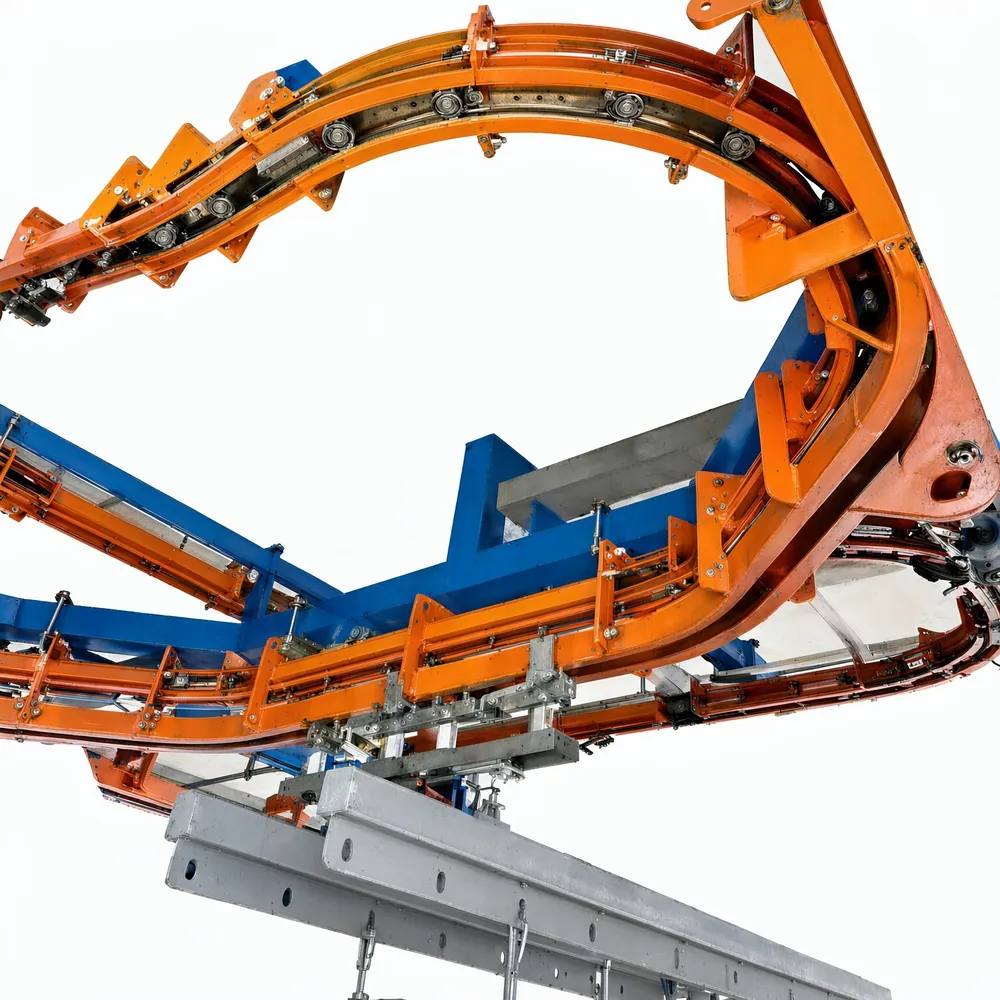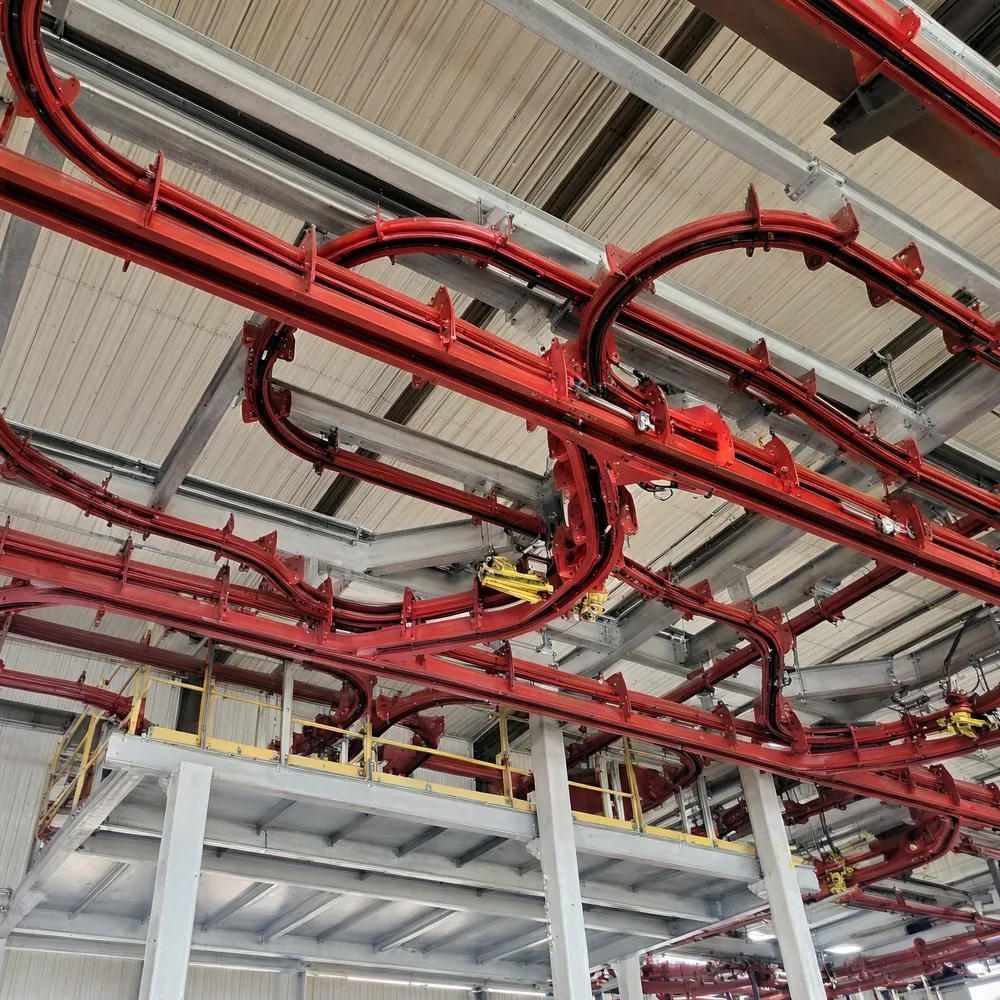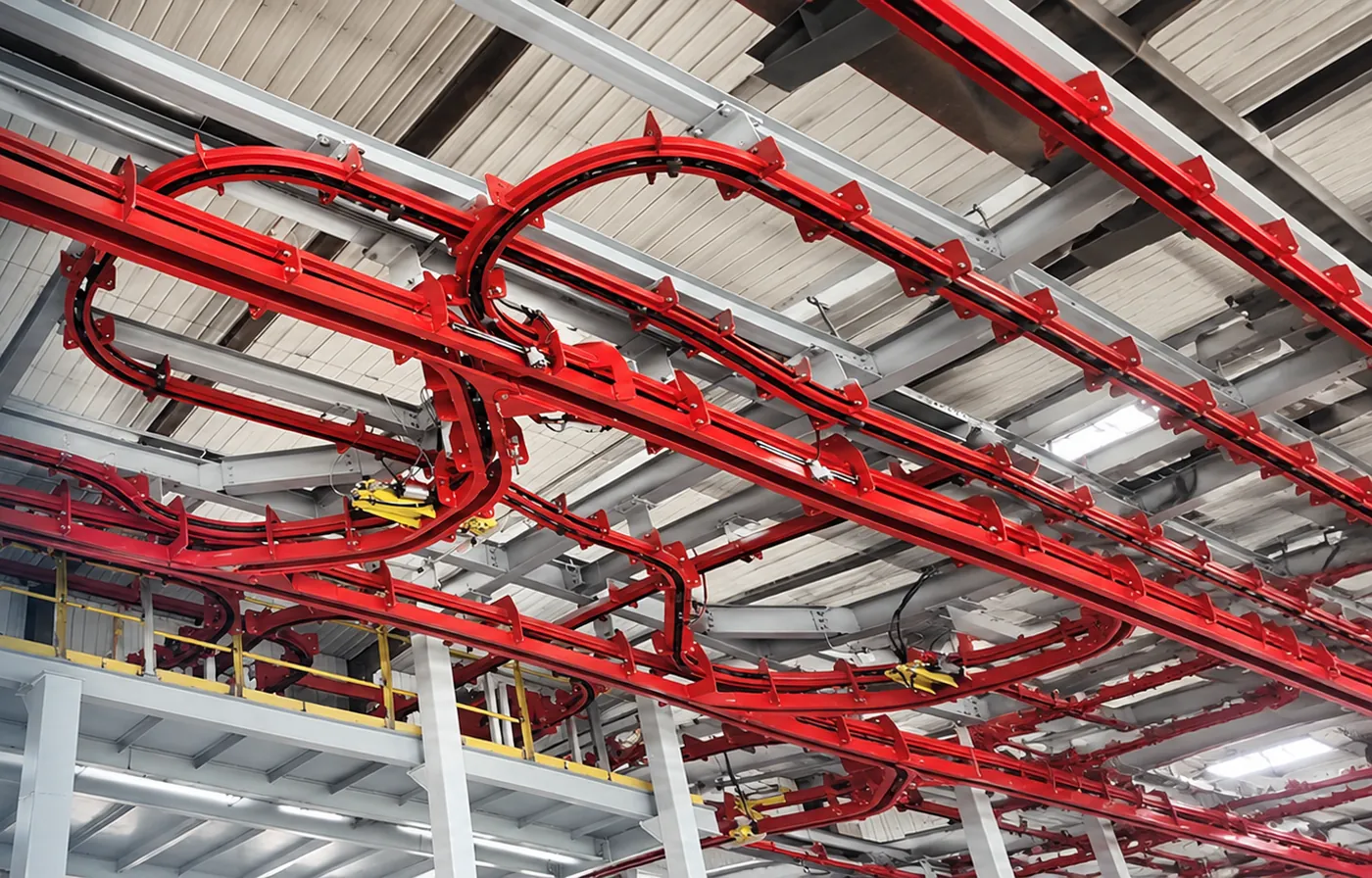
The name says it all: a power section that always moves, and a free section where carriers can stop. The trick is how the two are connected and disconnected, automatically and without stopping the line.
Two tracks, one system
A power and free conveyor has two tracks, one above the other:
- Power track: carries an endless chain that runs continuously, driven by one or more drive units. Pusher dogs are fixed to the chain at regular intervals.
- Free track: carries the load trolleys. These trolleys have no drive of their own; they roll freely until something pushes them.
Step 1: The pusher dog engages the trolley
Each carrier hangs from a set of free trolleys, typically a front and a rear trolley joined by a load bar. The front trolley has a dog that projects up into the path of the pusher dogs on the chain. When a pusher dog reaches it, the carrier is pushed along at chain speed.
Step 2: A stop releases the trolley from the chain
At a station, a stop blade swings into the path of the front trolley. As the trolley touches the stop, a lever on the trolley moves its dog out of reach of the pusher dogs. The chain keeps running, but this carrier stays put.
Step 3: Carriers accumulate
The next carrier arrives and touches the rear of the stopped carrier. Its own lever is pressed in the same way, so it disengages too. Carriers queue one behind the other, close together, with no power needed to hold them. This is accumulation, and it is the main reason plants choose power and free.
Step 4: Release
When the stop opens, the front trolley's lever returns and its dog rises again. The next pusher dog that comes along picks up the carrier and moves it on. The queue then moves forward one position at a time.
Step 5: Switching between routes
Because the free trolleys are independent of the chain, they can be diverted. At a switch, a tongue in the free track directs the trolley onto a branch line, where a different chain section picks it up. Switches create parallel stations, storage lanes, repair loops and return lines.
Step 6: Inclines, declines and lifts
On inclines, the chain pushes carriers up through vertical curves. Anti-runback devices stop carriers rolling backwards if they disengage. Drop sections and lifts change the carrier height for loading, unloading or transfer to floor conveyors.
Key parts at a glance
| Part | Role |
|---|---|
| Power chain | Runs continuously in the power track |
| Pusher dog | Fixed to the chain; pushes the trolley |
| Front (accumulating) trolley | Carries the dog and the lever that disengages it |
| Rear trolley and load bar | Share the load and connect to the carrier |
| Stop | Holds a carrier at a position by disengaging its dog |
| Switch | Diverts trolleys to another route |
| Drive and take-up | Move the chain and keep it at the right tension |
For details of each part, read our guide to power and free conveyor components.
Overhead or inverted?
In an overhead system the load hangs below the track. In an inverted power and free conveyor the track is below the load, which keeps chain lubricant away from the product.
Where it is used
Power and free conveyors run through paint and coating lines, automotive body storage, heavy assembly and long transport loops. See our power and free conveyor systems.
A worked example
A powder coating line runs at a chain speed of 4 m/min. At the loading station, a stop holds each carrier for loading. While one carrier is loaded, the next three wait behind it in the accumulation zone, all disengaged from the chain. When the operator presses release, the loaded carrier is picked up by the next pusher dog and travels to the pretreatment line, while the queue moves forward one position.
Further along, a switch sends carriers for one colour to booth A and carriers for another colour to booth B. Behind the oven, carriers queue again before unloading. The chain has not stopped once.
Why this matters for your line
- Operators work at their own pace without stopping upstream processes
- Short stops in one process are absorbed by the queue
- Different products can follow different routes on one system
- Heavy loads move with a single, well-understood drive system
Common questions from maintenance teams
A power and free conveyor has more moving parts than a simple chain conveyor, so maintenance teams should understand stops, trolley levers and switches. Typical issues are carriers that do not disengage at a stop, usually due to worn levers or stop blades, and carriers that do not re-engage, often a sign of worn dogs. Our maintenance checklist lists the routine checks.