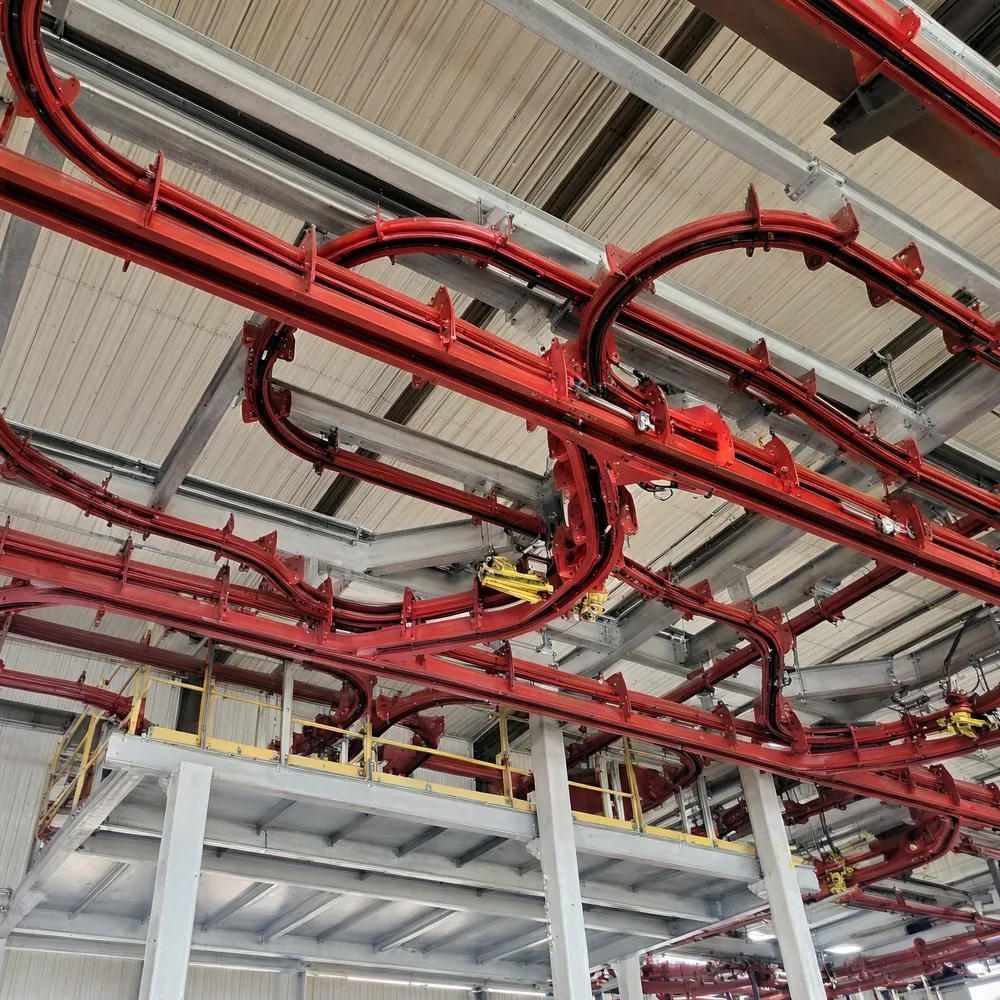
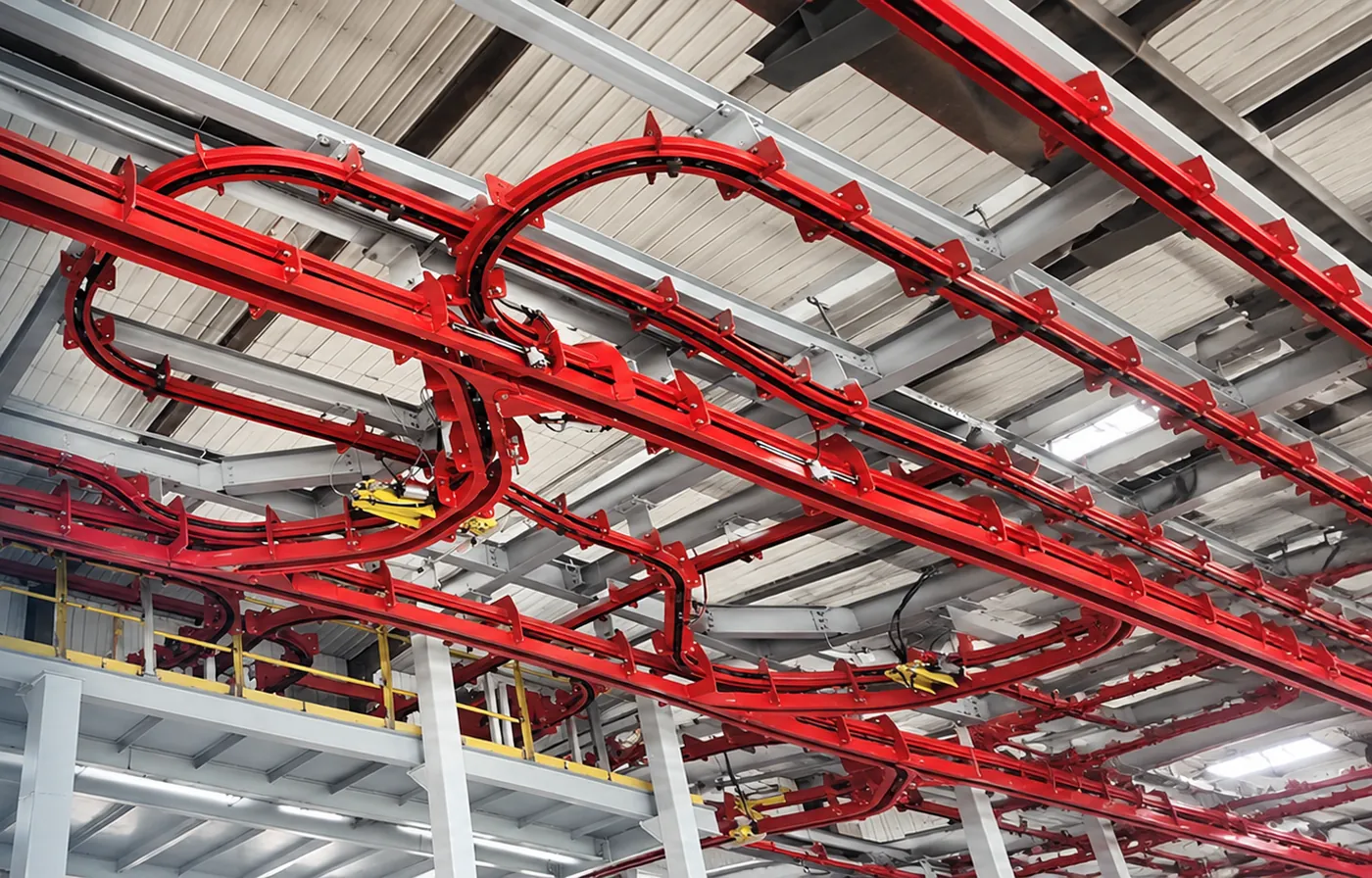
Every overhead conveyor route has horizontal curves to change direction and vertical curves to change height. Both affect the carriers, the chain and the support structure.
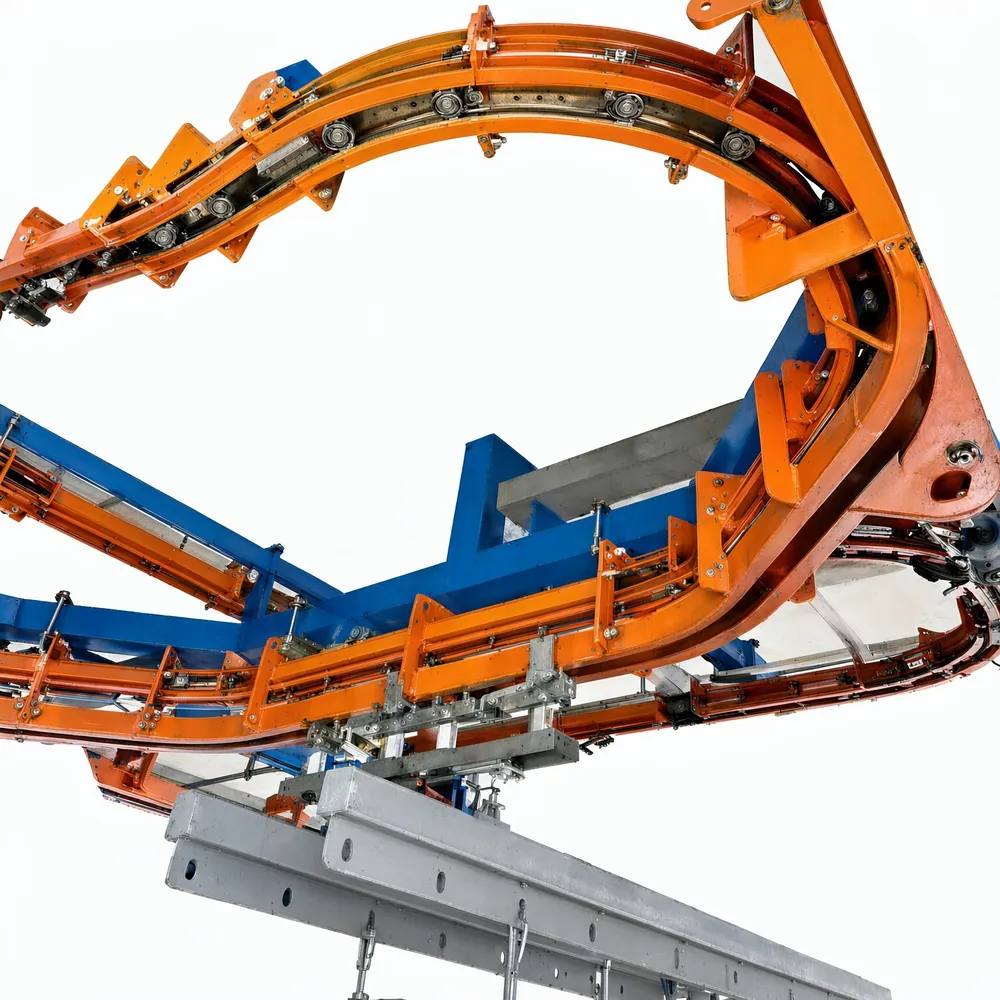
Horizontal curves
Horizontal curves turn the conveyor in plan view. On chain conveyors, the chain is guided around the curve by roller turns, traction wheels or curved track sections. Each type adds friction, so curves increase chain pull.
| Type | Description |
|---|---|
| Roller turn | A series of rollers guides the chain around the curve |
| Traction wheel | A large wheel guides the chain; low friction for heavy loads |
| Curved track section | Track bent to the radius; common in power and free and EMS |
Choosing the radius
- The minimum radius is set by the chain class, trolley design and track system
- Larger carriers and loads need larger radii for clearance
- Carriers swing outward and their ends move inward in a curve; check the full envelope
- Keep curves away from stations and stops where carriers must stand straight
Vertical curves and inclines
Vertical curves take the conveyor up or down: over aisles, into ovens, down to load stations. The incline angle is limited by the chain and trolley design and by what the carrier and product tolerate. Steeper inclines raise chain pull and the risk of product movement.
- Anti-runback devices on inclines stop carriers rolling back
- Carriers tilt on the incline; check clearance to floor, guards and other carriers
- Carrier pitch on inclines must avoid collisions at the top and bottom of the curve
- Avoid placing switches, stops and drives on or right next to vertical curves
Effect on chain pull and drives
Chain pull builds up along the conveyor with every curve and every metre of lift. The chain pull calculation adds friction in each curve and the force to lift loads on inclines, and it decides chain class, drive size and the number of drives. Fewer, gentler curves and shorter climbs mean smaller drives and less energy.
Wear and maintenance
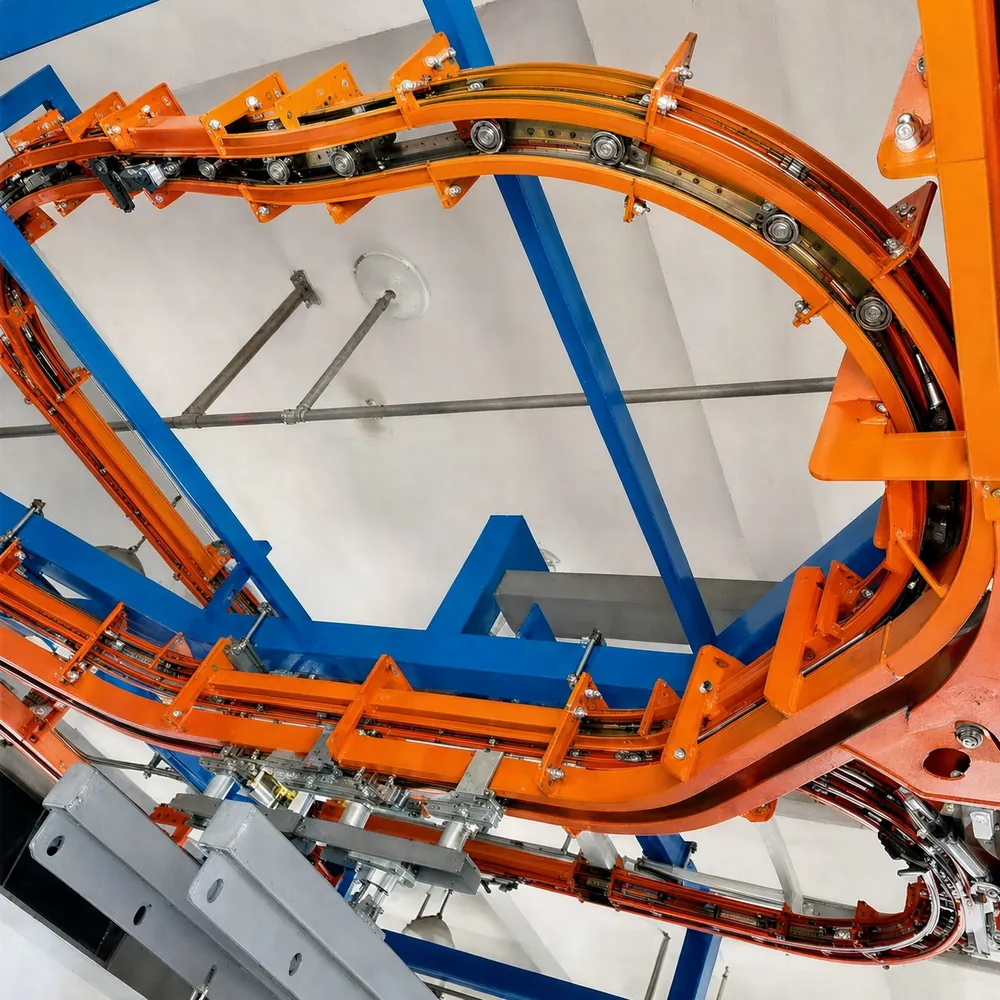
- Inspect curve rollers and wheels for wear and bearing noise
- Check track wear on the inside of curves
- Keep lubrication even through curves
- Listen for jerky motion on inclines, a sign of high chain pull or poor lubrication
See power and free layout design and contact HITREE to review your route.
Worked example: carrier clearance in a curve
A 2 m long carrier rounds a curve. Its middle moves toward the inside of the curve while its ends swing outward. On a tight radius, two neighbouring carriers can touch at the corners even if they are well apart on the straight. The design checks the full carrier envelope through each curve and either increases the radius or the pitch until there is a safe gap.
Overhead conveyor curve terms
| Term | Meaning |
|---|---|
| Horizontal curve | Change of direction in plan view |
| Vertical curve | Change of height: start or end of an incline or decline |
| Roller turn | Curve where rollers guide the chain |
| Traction wheel | Large wheel guiding the chain around a curve |
| Anti-runback | Device that stops carriers rolling back on an incline |