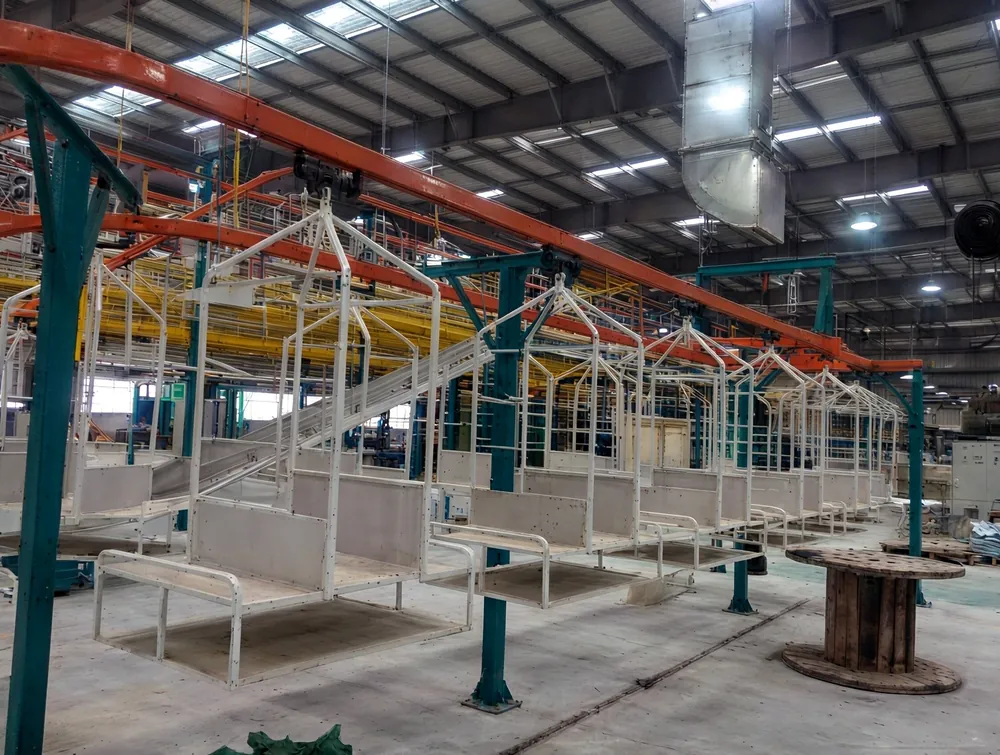
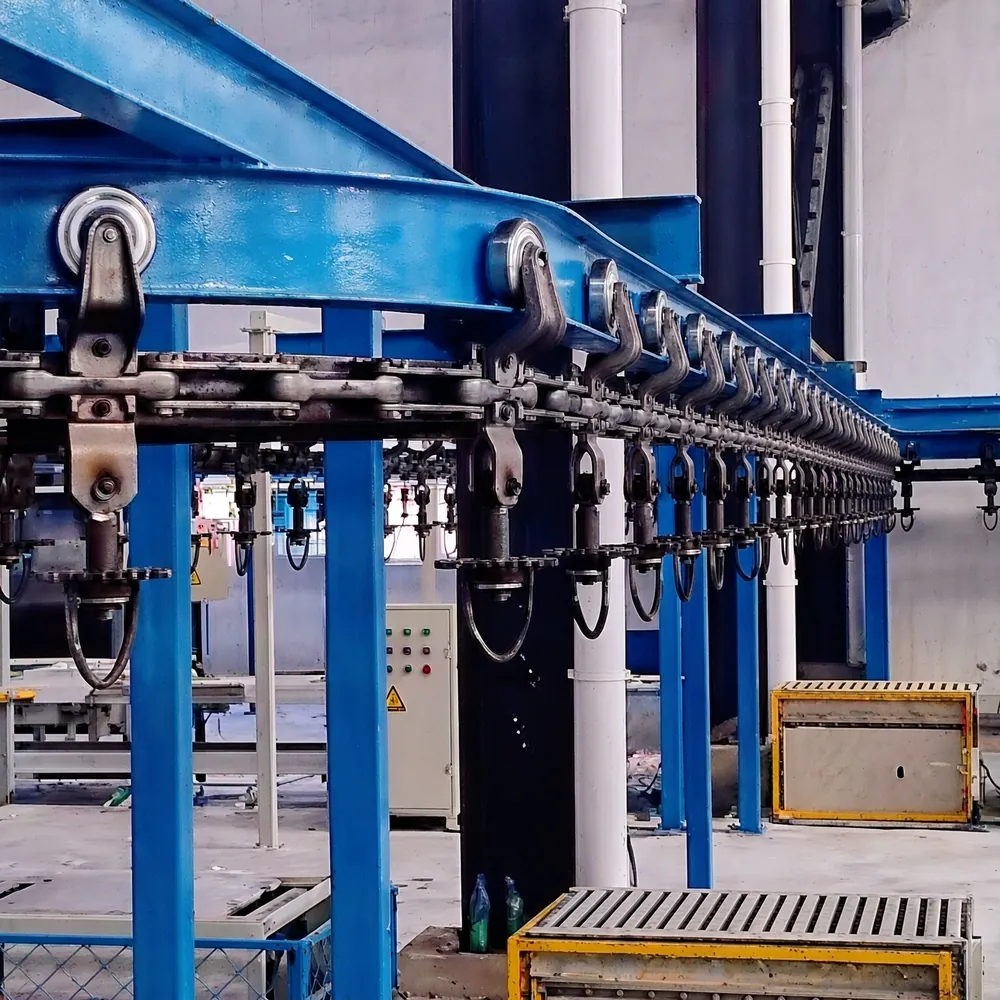
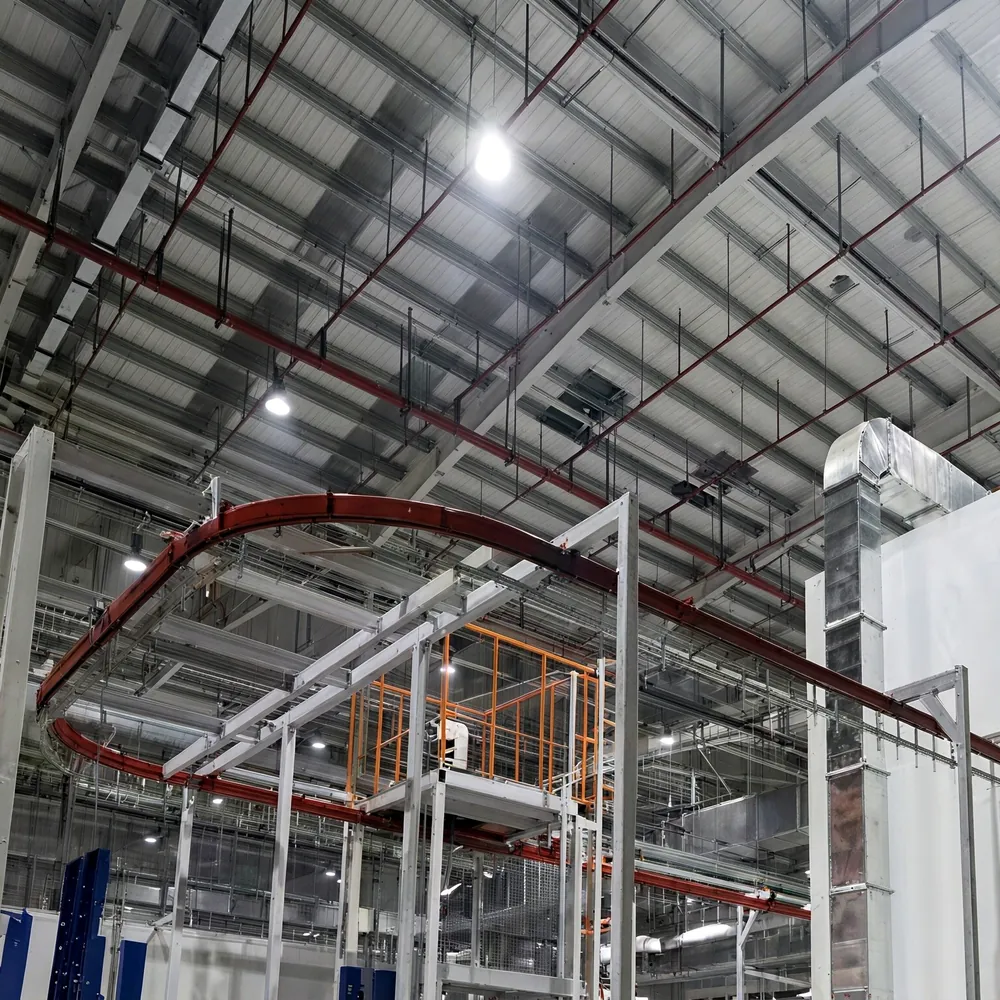
Conveyor speed is the starting point for sizing booths, ovens, pretreatment and buffers. It comes from three numbers: how many parts you need per hour, how many parts each hanger holds, and how far apart the hangers are.
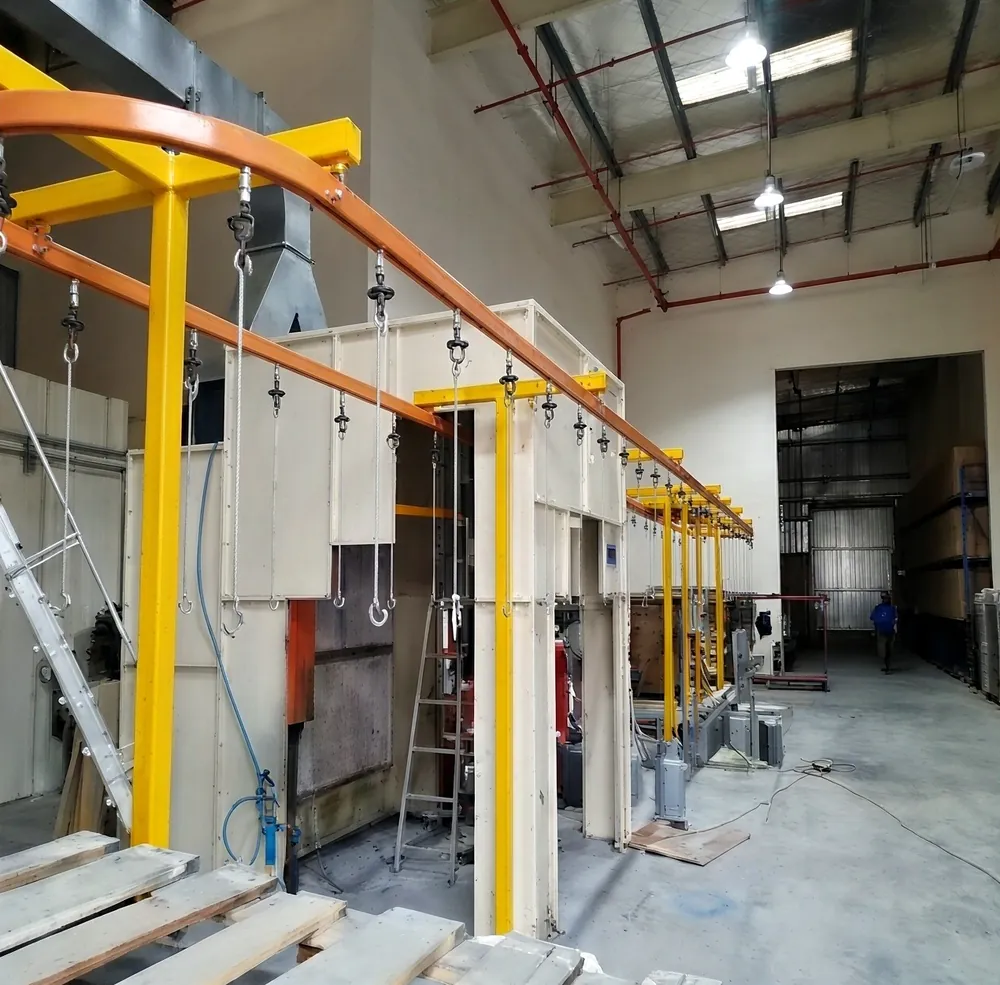
The basic formula
Speed (m/min) = parts per hour ÷ parts per hanger × hanger pitch (m) ÷ 60
Example: 600 parts per hour, 4 parts per hanger, hangers every 0.5 m. Hangers per hour = 150; speed = 150 × 0.5 ÷ 60 = 1.25 m/min.
Allow for gaps and efficiency
Lines rarely load every hanger. Colour changes, empty hangers and breaks reduce real output. Divide by a loading efficiency:
Design speed = calculated speed ÷ loading efficiency
With 85% of hangers loaded on average, the example above needs 1.25 ÷ 0.85 ≈ 1.47 m/min.
From speed to process lengths
| Zone | Time | Conveyor length |
|---|---|---|
| Pretreatment stage | 1.5 min | 2.25 m + drain zone |
| Dry-off oven | 10 min | 15 m |
| Powder booth | Set by gun layout | Booth length |
| Curing oven | 20 min | 30 m |
| Cooling | 10 min | 15 m |
Example values; real times come from the chemical and powder suppliers.
Assembly and power and free lines
For assembly, use takt time instead: speed = pitch ÷ takt. At 30 jobs per hour (takt 120 s) and 6 m pitch, speed is 3 m/min. On power and free lines, the chain often runs faster than this average so carriers can catch up after stops.
Common mistakes
- Forgetting loading efficiency and planned stops
- Using hanger pitch on the straight when curves need more space
- Ignoring heat-up time when sizing ovens
- Choosing a speed the booth guns cannot coat at
More: layout planning, powder coating conveyors and the calculator in our price guide.
Second worked example: heavier parts
A line must coat 90 frames per hour, one frame per carrier, with carriers 1.8 m apart and 90% loading efficiency. Speed = 90 × 1.8 ÷ 60 = 2.7 m/min; design speed = 2.7 ÷ 0.9 = 3.0 m/min. With a 25-minute cure including heat-up, the oven must hold 75 m of conveyor, which usually means several passes.
| Input | Where it comes from |
|---|---|
| Parts per hour | Production plan |
| Parts per hanger | Rack and hook design |
| Hanger pitch | Part size plus clearance in curves |
| Loading efficiency | Experience or current line data |
| Process times | Chemical and powder suppliers |