

Electrified Monorail System
EMS Overhead Conveyor
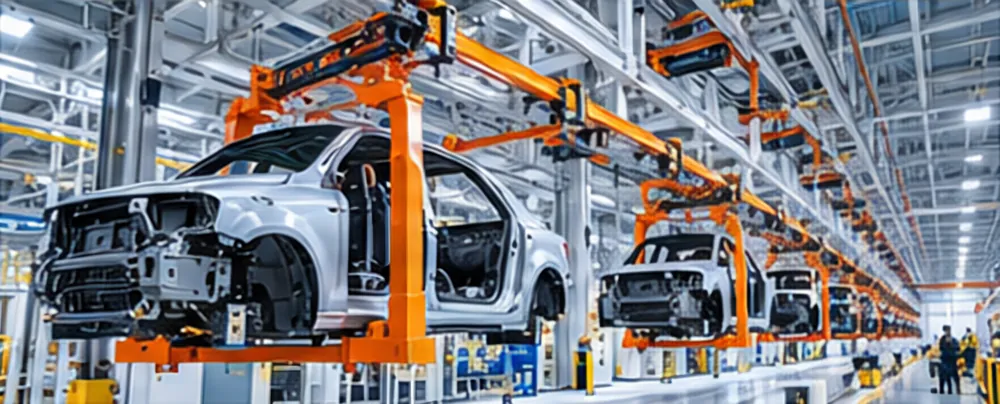
Individually driven carriers on an electrified rail. Each carrier accelerates, stops and positions on its own, giving automated lines the precision and flexibility they need.
How an EMS Conveyor Works
An electrified monorail system runs carriers along a single overhead rail. A conductor rail built into the profile supplies power and control signals to every carrier.
Each carrier has its own drive unit and onboard controller. That means carriers do not depend on a common chain: they can travel at different speeds, stop at exact positions, queue in buffers and take different routes through switches.
The result is a conveyor that behaves like a fleet of small vehicles, coordinated by the line control system.
Why EMS
Key Advantages
Individual control
Every carrier runs independently, so one stopped carrier does not stop the line.
Variable speed
Fast transport between stations and slow, steady speed in work zones.
Precise positioning
Repeatable stop positions for robots, screwdrivers and inspection systems.
Flexible routing
Switches and turntables send carriers to parallel stations, repair loops or buffers.
Integrated lifting
Onboard hoists or lift stations bring products to ergonomic working heights.
Clean, quiet operation
No lubricated chain overhead, which suits assembly halls and clean areas.
Specifications
Typical Configuration
Every EMS line is engineered per project. The table shows the main parameters we define with you during design.
| Parameter | Options |
|---|---|
| Rail profile | Aluminium or steel profiles, selected for load and span |
| Power and data | Conductor rail with integrated power supply and communication |
| Carrier drive | Geared motor with friction or toothed drive, frequency controlled |
| Carrier types | Load bars, C-hooks, car body hangers, product-specific fixtures |
| Lifting | Onboard hoists, lift stations, drop sections |
| Routing elements | Switches, turntables, transfer sections, parallel lanes |
| Controls | PLC line control, carrier identification, HMI, MES interface |
| Safety | Zone control, anti-collision, guarding and emergency stop circuits |
Load capacity, speeds and carrier pitch are calculated from your product weight, takt time and layout.
Where EMS Conveyors Perform Best
- Automotive trim, chassis and final assembly lines
- Body shops linking welding cells and robot stations
- EV battery pack and powertrain assembly
- Appliance and machinery assembly with varying work content
- Lines that need buffers, repair loops or model mix flexibility
FAQ
Frequently Asked Questions
What does EMS stand for in conveyors?
EMS stands for electrified monorail system. It is an overhead conveyor in which each carrier runs on a single rail and has its own electric drive, supplied with power and control signals through a conductor rail.
What loads can an EMS conveyor carry?
EMS carriers are engineered for the product, from light components to complete car bodies. Rail profile, drive size and carrier structure are selected to suit the load and the required speed.
Can EMS carriers lift and lower the product?
Yes. Carriers can be fitted with onboard hoists, or the line can include lift and drop stations, so products are presented at the right working height for operators or robots.
Is an EMS conveyor suitable for a retrofit?
Yes. Because the system is modular and runs overhead, it can often be installed in existing buildings with limited interruption to production.
Planning a New Production Line?
Let our engineers design the right conveyor solution for your application.
WhatsApp Us Discuss Your Project