
Accumulation · Buffering · Routing
Power & Free Conveyor
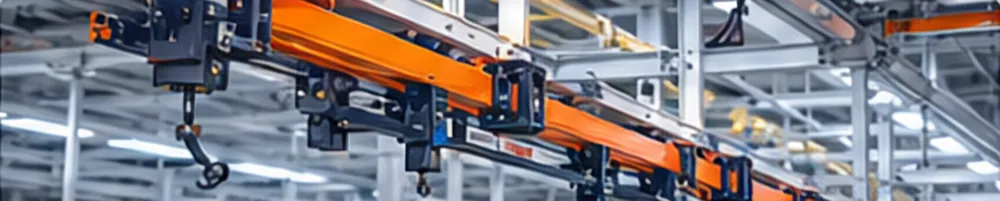
A continuously running power chain pushes trolleys on a separate free track. Trolleys can stop, queue and switch routes while the chain keeps moving, giving you flexible flow at a low cost per carrier.
How Power and Free Works
The system uses two tracks. The upper power track holds a continuously moving chain fitted with pusher dogs. The lower free track carries the load trolleys.
A dog engages the trolley and pushes it along. When a stop is closed, the trolley disengages and waits while the chain continues. Trolleys behind it accumulate in a queue until the stop opens.
Switches send trolleys onto branch lines, so one chain can feed several process routes, storage lanes or repair loops.
Why Power & Free
Key Advantages
Built-in accumulation
Products queue without stopping the chain, absorbing differences between processes.
Low cost per carrier
Trolleys are passive, so long lines with many carriers stay economical.
Heavy loads
Robust chain and track sizes handle heavy parts and large fixtures.
Heat resistant
Suitable for pretreatment, paint booths and curing ovens with the right components.
Multiple routes
Switches create branches, storage lanes and return loops from one drive system.
Proven technology
Simple mechanics that maintenance teams know and can service on site.
Specifications
System Configuration
We size every power and free system to your loads, pitch and throughput.
| Parameter | Options |
|---|---|
| Track type | Overhead power and free, inverted power and free |
| Chain size | 3 in, 4 in and 6 in class enclosed track or I-beam chain, selected by load |
| Trolleys | Single or tandem load trolleys with accumulating front levers |
| Routing | Switches, merges, vertical curves, drop and lift sections |
| Stations | Stops, indexers, load and unload stations, lift and lower units |
| Environment | Ambient, wet pretreatment, paint booth and high-temperature oven zones |
| Drive and take-up | Caterpillar drives, multiple drives on long loops, automatic take-ups |
| Controls | PLC control, carrier tracking, interlocks with process equipment |
Typical Applications
- Paint shops and powder coating lines
- Pretreatment, e-coat and curing ovens
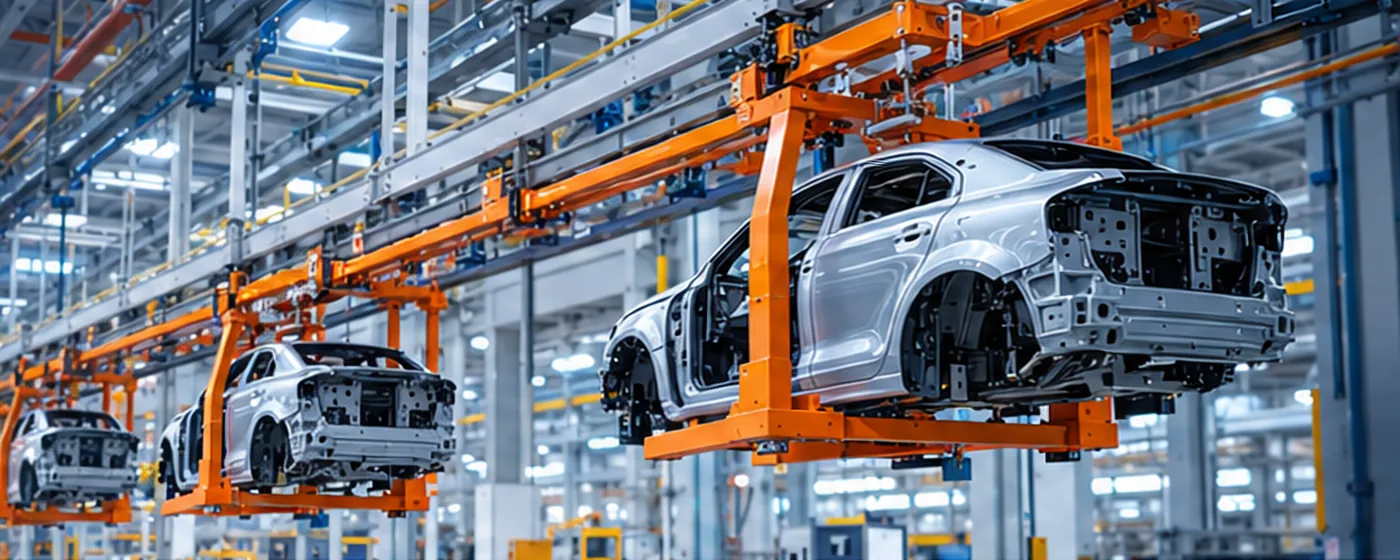
- Automotive body storage and sequencing buffers
- Heavy component assembly such as axles and frames
- Long transport loops linking separate buildings or floors
FAQ
Frequently Asked Questions
How does a power and free conveyor accumulate products?
Trolleys on the free track are pushed by dogs on the moving chain. When a stop blocks a trolley, its dog disengages and the following trolleys queue behind it. Releasing the stop lets the next dog pick the trolley up again.
What is the difference between overhead and inverted power and free?
Overhead power and free hangs the load below the track. Inverted power and free carries the load above the track, which keeps chain lubricant away from the product and suits paint finishing lines.
Can power and free conveyors run through curing ovens?
Yes. With suitable chain, bearings and lubrication, power and free systems are widely used to carry parts through pretreatment, paint booths and high-temperature curing ovens.
How often does the chain need maintenance?
Lubrication intervals depend on duty, temperature and environment. Chain wear and elongation should be checked on a regular schedule; see our maintenance checklist for typical intervals.
Planning a New Production Line?
Let our engineers design the right conveyor solution for your application.
WhatsApp Us Discuss Your Project