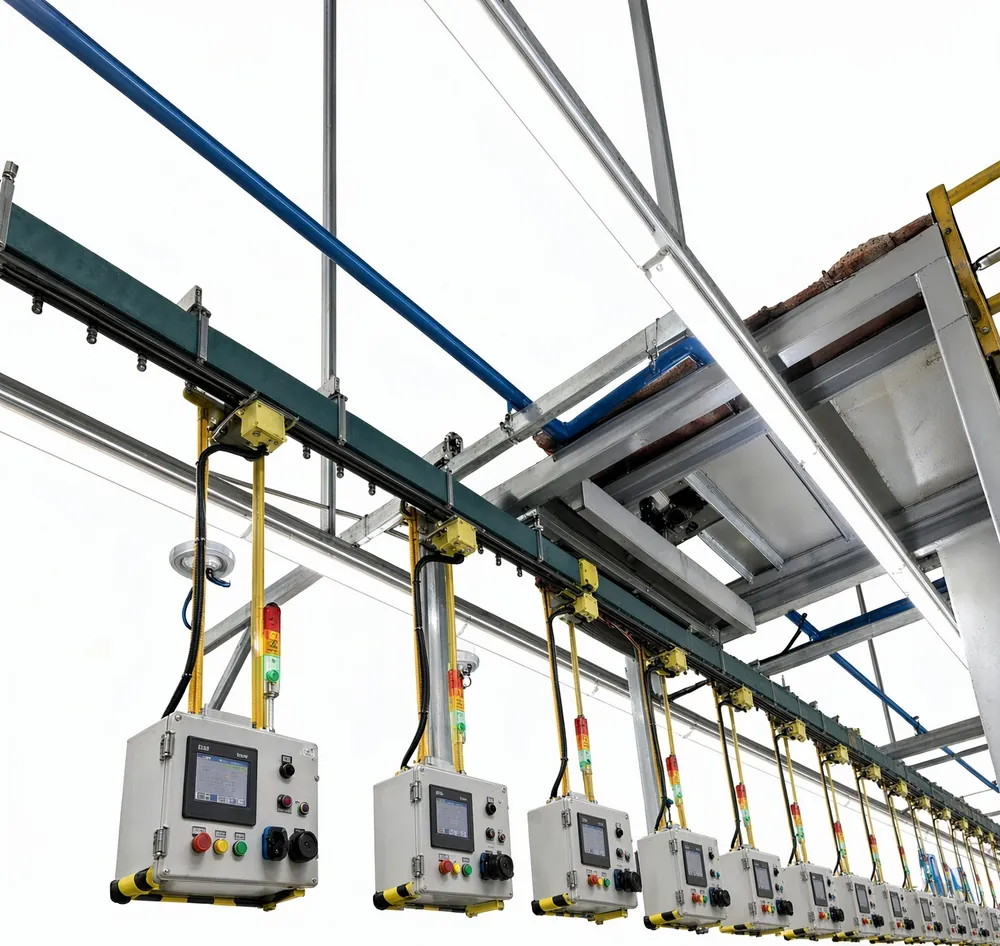
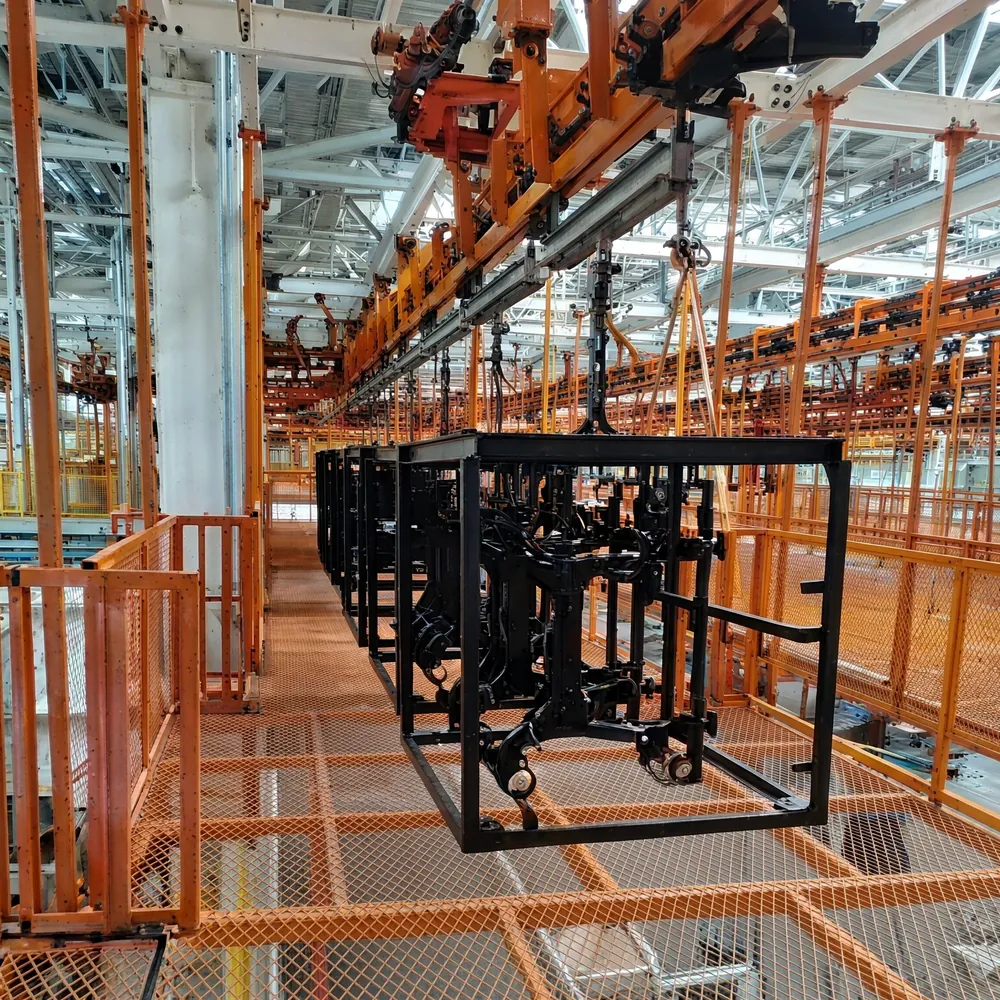
Carrier tracking links each carrier to the product it carries. The conveyor control then uses that information to route the carrier, release it in sequence, trigger station programs and record production data.
What tracking enables
- Automatic routing to the right station, colour, lane or repair loop
- Sequencing in buffers such as painted body storage
- Station programs selected per product or model
- Traceability: which product passed which process, when
- Production counts and data for MES and OEE
Identification technologies
| Method | How it works | Strengths | Limits |
|---|---|---|---|
| RFID tags | Tag on the carrier read by antennas at decision points | Read without line of sight; data can be written | Metal surroundings and heat need suitable tags |
| Barcodes or 2D codes | Code plate read by a scanner | Low cost, simple | Needs a clean code and line of sight |
| Mechanical code plates | Pins or flags read by proximity sensors | Very robust, suits harsh zones | Limited number of codes |
| Software tracking | Control system follows carriers by position | No hardware on carriers | Needs reliable position data; re-sync points |
RFID in conveyor environments
Conveyors are full of steel, which affects radio signals. Use tags designed for mounting on metal, and test read ranges on site. In ovens and paint areas, choose tags rated for the temperatures and chemicals they will see, or mount them where they are protected.
Where to place readers
- Before every switch that makes a routing decision
- At buffer and storage entries and exits
- At stations that select programs by product
- At load and unload stations, to link and unlink product and carrier
- At re-synchronisation points for software tracking
Data flow
The reader passes the carrier ID to the conveyor PLC. The PLC looks up the product data, or asks the MES for it, and decides the route. Station results and timestamps flow back to the MES. Define these interfaces early in the project; see controls and automation.
Adding tracking to an existing conveyor
Tracking can be added in a retrofit: tags on carriers, readers at decision points and a control upgrade. Read more in overhead conveyor retrofit.
HITREE includes tracking in EMS and power and free systems. Contact us to discuss your tracking needs.
Worked example: tracking through a paint shop
Each carrier has an RFID tag. At loading, the operator scans the product and the system links it to the carrier ID. Before the colour switch, a reader identifies the carrier, the PLC looks up the colour and sends the carrier to the right booth. After inspection, a failed product is routed to the repair loop and its result is stored in the MES. At unloading, the link is cleared and the carrier is ready for the next job.
Choosing a tracking method
| Situation | Suitable method |
|---|---|
| Hot ovens and paint zones | Heat-rated RFID tags or mechanical code plates |
| Many products and options | RFID with MES link |
| Simple routing with few destinations | Code plates or barcodes |
| Retrofit on an older line | RFID at decision points plus a control upgrade |
Common pitfalls
- Standard tags mounted directly on steel with poor read rates
- Readers placed too close to the switch, leaving no time to decide
- No procedure for carriers without a valid ID
- Product and carrier links not cleared at unloading
Good conveyor carrier tracking turns the conveyor into a source of reliable production data.