A power and free conveyor is built from a set of standard components combined into a custom layout. This guide lists the main parts, what each one does and which ones wear in service.
Track
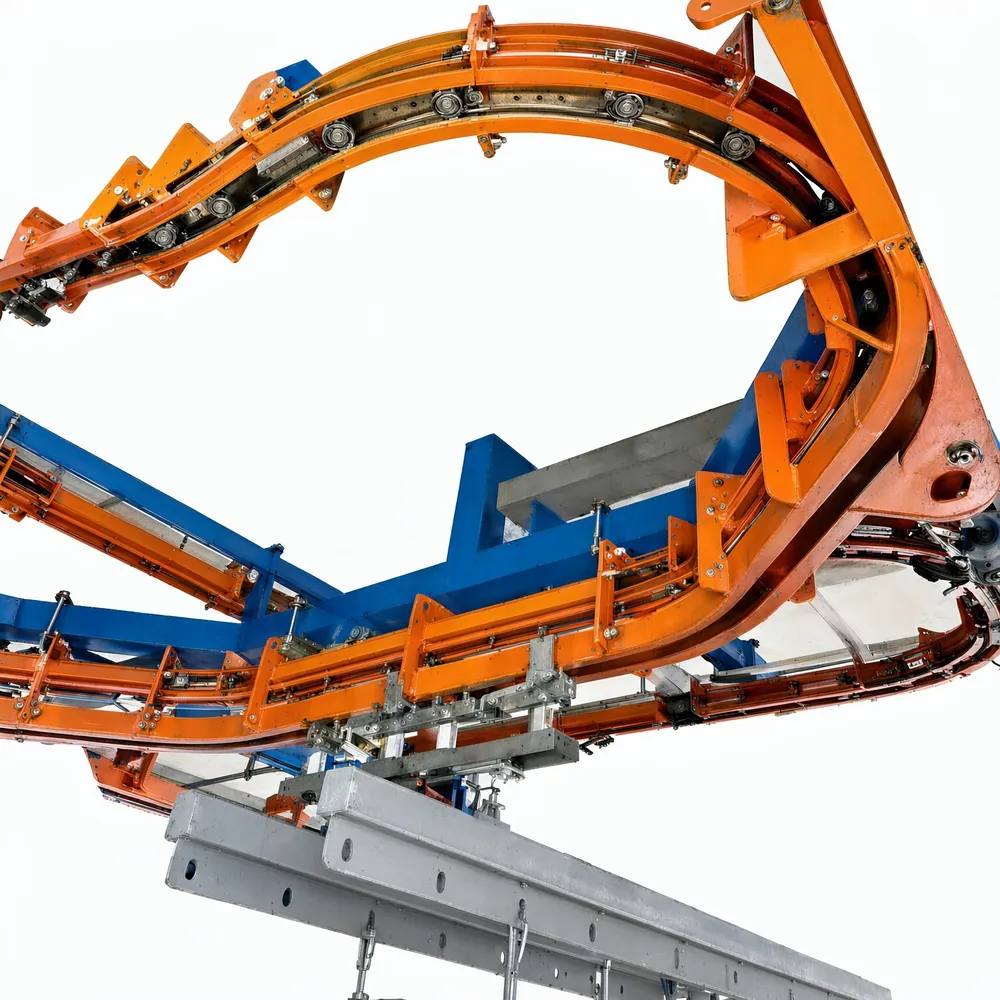
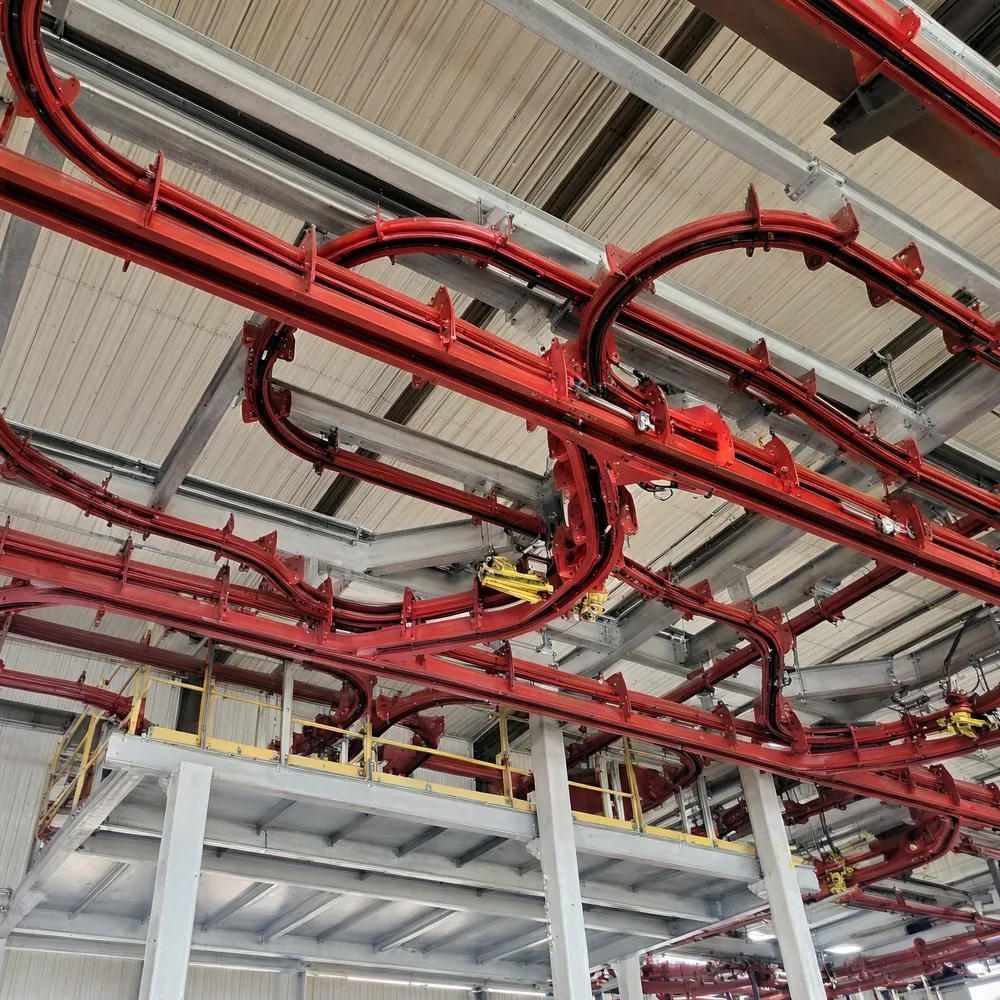
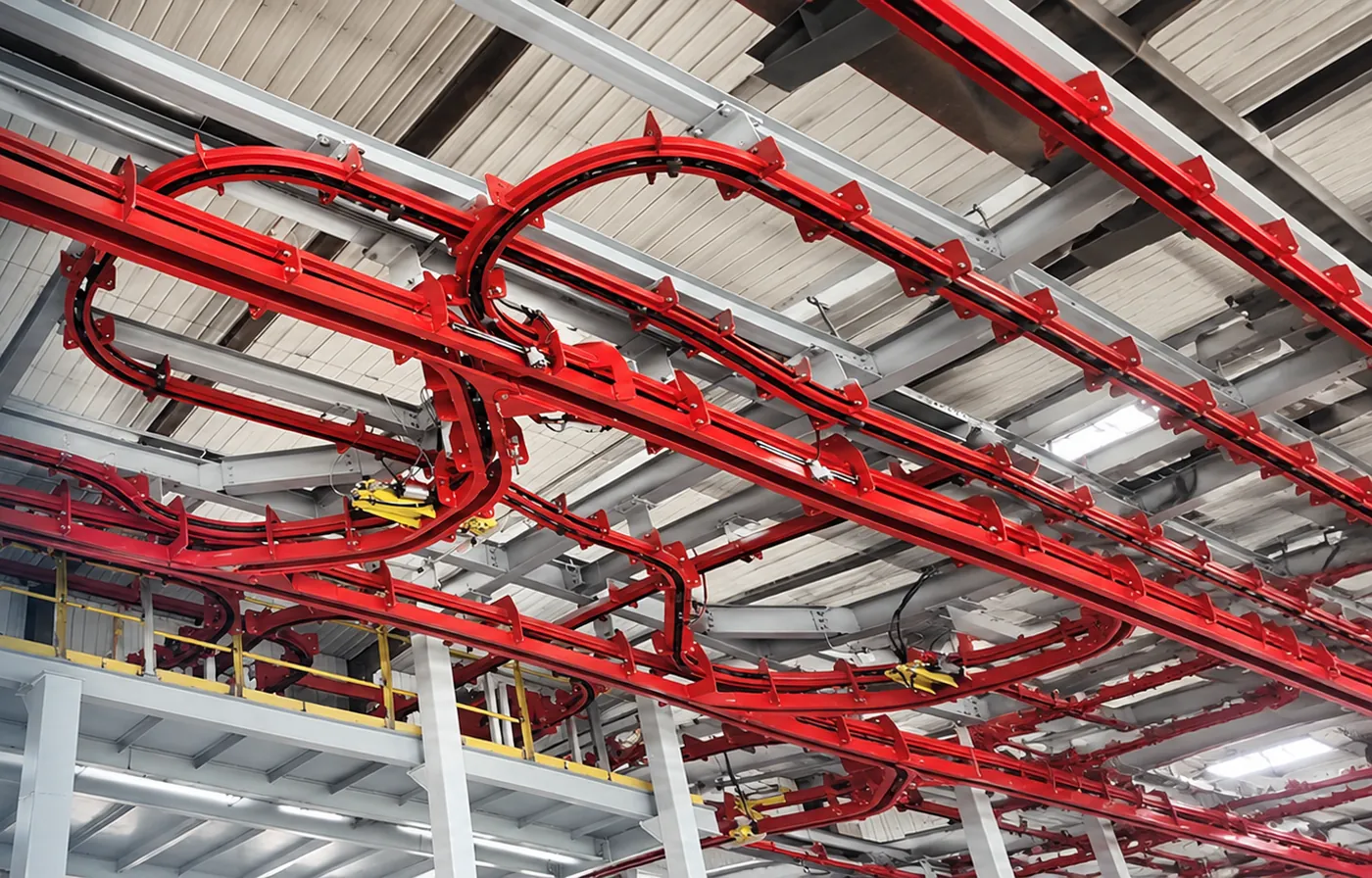
The system has a power track for the chain and a free track for the load trolleys. They are usually joined in one combined profile and hung from support steel with headers and hangers. Track is built in two main styles, enclosed track and I-beam, compared in our enclosed track vs I-beam guide.
- Straight sections, horizontal curves and vertical curves
- Expansion sections where the track passes through ovens
- Inspection and maintenance openings
Chain and pusher dogs
The power chain is commonly a drop-forged rivetless chain in standard classes, often referred to as X-348 (3 in), X-458 (4 in) and X-678 (6 in). The class is chosen from loads, chain pull and line length. Pusher dogs are attached to the chain at a set spacing and push the trolleys.
Load trolleys, load bar and carrier
| Part | Function |
|---|---|
| Front (accumulating) trolley | Carries the driving dog and the lever that disengages it for accumulation |
| Rear trolley | Shares the load; on some designs also carries a dog for inclines |
| Load bar | Connects front and rear trolleys and spreads the load |
| Carrier | Hooks, frames or fixtures that hold the product |
Stops
Stops hold carriers at stations and in queues. A blade, usually actuated pneumatically, moves into the trolley path and causes the trolley to disengage from the chain. Stops are controlled by the conveyor PLC.
Switches and transfers
Switches divert trolleys from one route to another. A moving tongue in the free track sets the direction. Merges bring routes together. Transfers hand carriers between chain loops.
Drives and take-ups
The drive, often a caterpillar drive, moves the chain. Long loops may use several drives with load sharing. The take-up keeps chain tension constant and absorbs chain elongation and thermal expansion, using spring, pneumatic or counterweight systems.
Lubricators and safety devices
- Automatic lubricators for chain and trolley wheels
- Anti-runback devices on inclines
- Overload protection at drives
- Guarding where the conveyor passes over walkways
- Emergency stops and lockout points
Lifts, drops and stations
Drop sections and lifts change carrier height for loading, unloading or transfer to floor conveyors. Indexing stations move carriers precisely through a work zone. See lift and lower stations.
Controls
A PLC controls stops, switches, lifts and drives. Carrier identification by code plates, sensors or RFID lets the system route each carrier to the right destination; see our carrier tracking guide.
Wear parts to keep in stock
| Part | Why it wears |
|---|---|
| Chain links and pins | Elongation over time from load and running hours |
| Trolley wheels and bearings | Rolling wear, heat and contamination |
| Pusher dogs and trolley dogs | Contact wear at engagement |
| Stop blades and cylinders | Repeated impacts and cycling |
| Drive wear parts | Caterpillar chain, dogs and sprockets |
Exact spare parts lists depend on the system; ask your supplier for a recommended list with quantities.
Use our maintenance checklist to plan inspections, or contact HITREE for spare parts for your system.
How to read a power and free conveyor components list
When you compare quotations, the components list tells you more than the total price. Check quantities against your layout:
| Component | Check |
|---|---|
| Track length | Matches the layout, including return runs and storage lanes |
| Carriers and trolleys | Number matches the carrier calculation, plus spares |
| Switches and stops | One for every routing point and station on the layout |
| Drives | Number and size justified by a chain pull calculation |
| Take-ups | One per chain loop, with stroke suited to oven expansion |
| Lubricators | Positioned outside hot and clean zones where possible |
| Controls | Sensors at each stop, switch and lift; carrier identification |
Component quality points
- Forged chain links and dogs from a consistent source
- Sealed or high-temperature bearings in trolleys, depending on the zone
- Hardened wear surfaces on stop blades and dogs
- Corrosion protection matched to wet or chemical zones
- Standard sensors and cylinders that are easy to replace locally
Good power and free conveyor components last longer and make spare parts planning simpler. Ask your supplier which parts they manufacture and which brands they use for bought-in items.