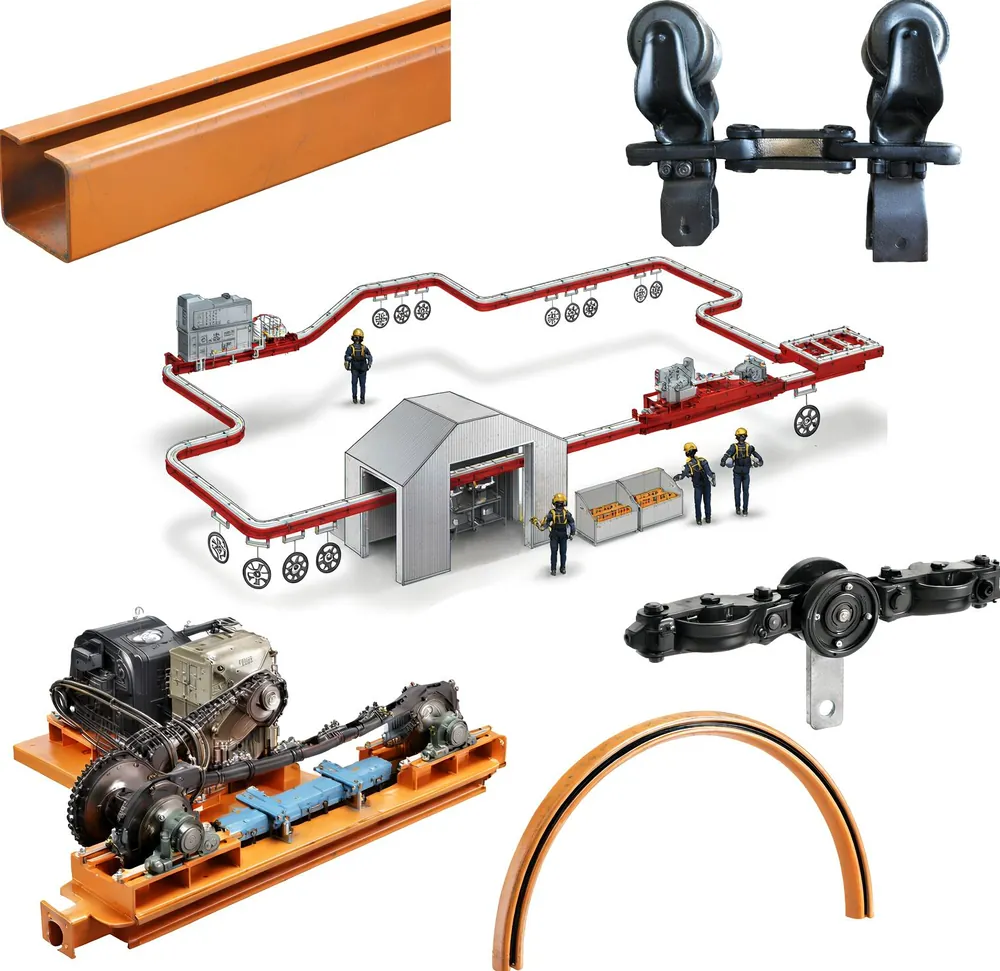
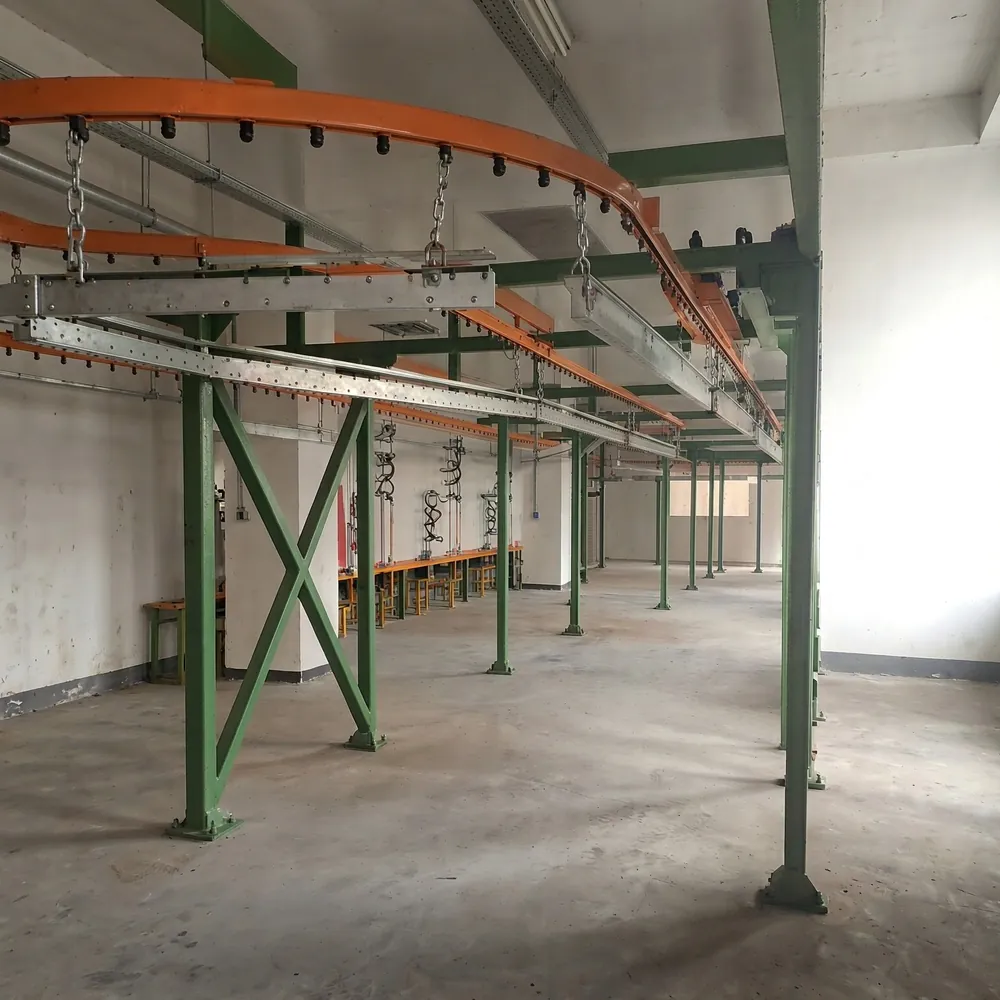
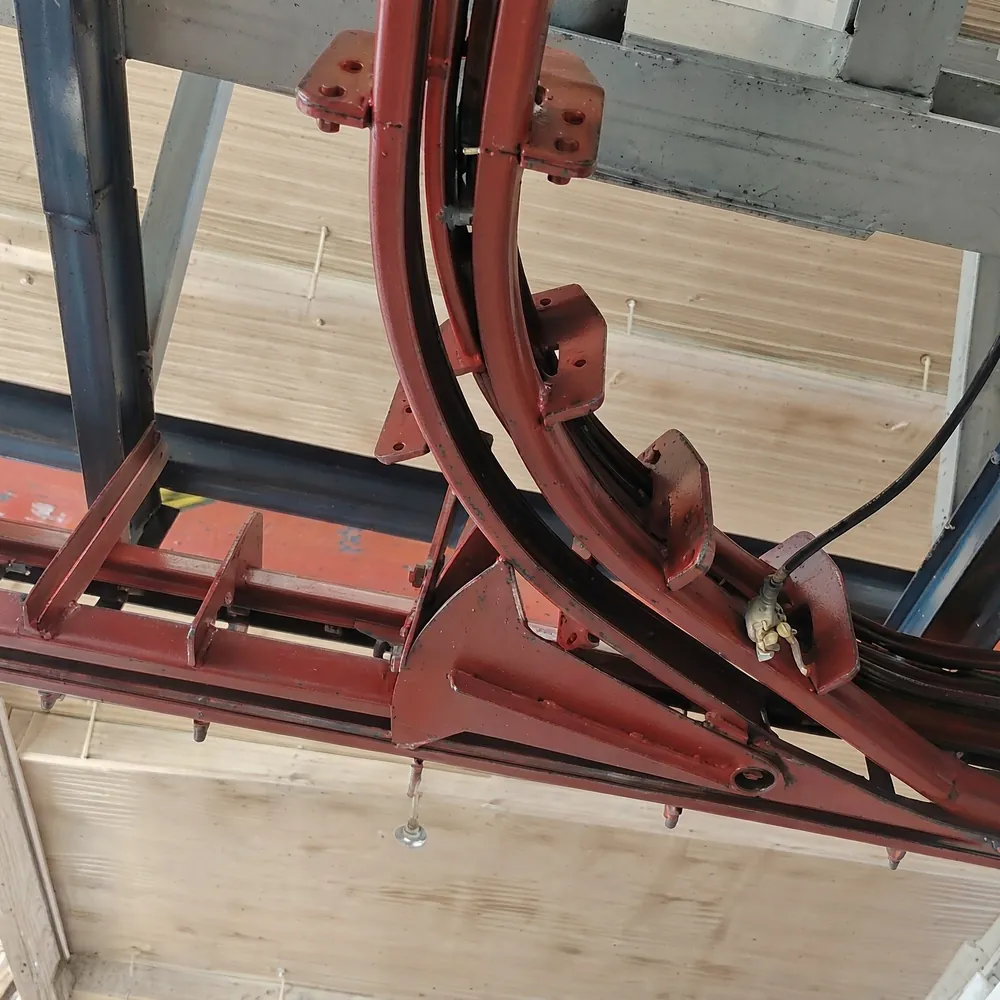
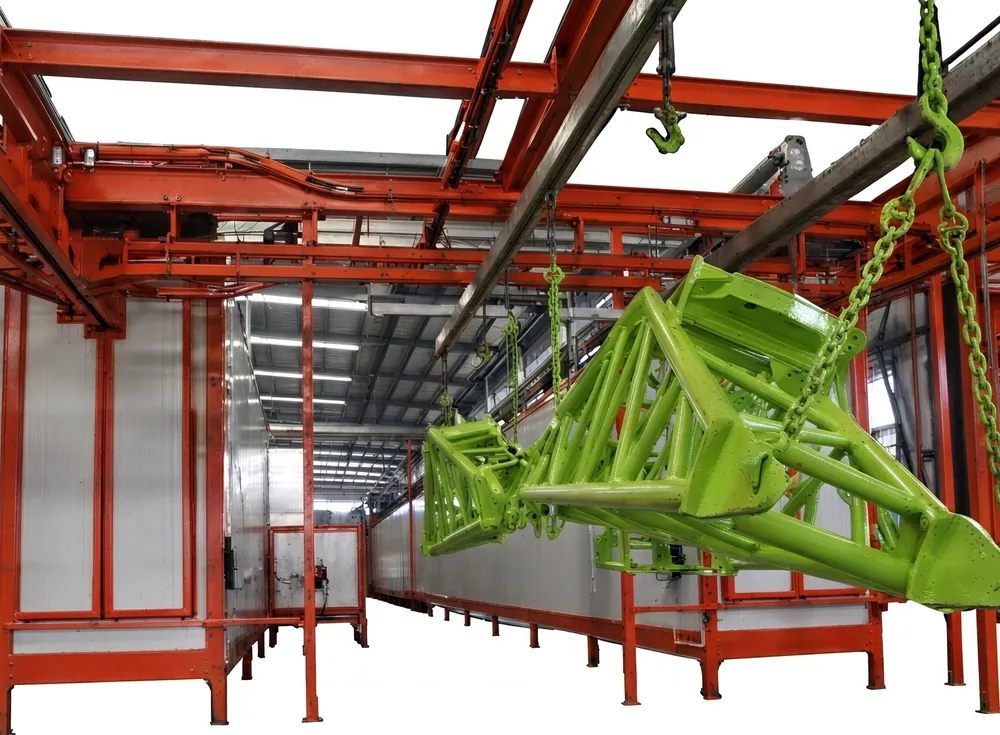
Heavy and bulky parts such as excavator booms, tractor frames, trailer chassis and steel structures are painted and assembled on overhead conveyors just like small parts. The difference is that every component, from chain to support steel, is sized for much higher loads.
What changes for heavy loads
| Element | Heavy duty approach |
|---|---|
| Chain and track | Larger chain class (often 6 in) on I-beam track |
| Trolleys | Several trolleys per carrier joined by load bars to share the load |
| Carrier | Chains, spreader bars or rigid fixtures set to the part centre of gravity |
| Drives | Larger or multiple drives with load sharing on long loops |
| Support steel | Heavier structure, closer hanger spacing, strong bracing |
| Technology | Power and free when parts must stop at stations or queue |
Load bars and multi-trolley carriers
A single trolley has a rated load. For heavy parts, two or four trolleys are joined by load bars so the weight is shared. Load bars must articulate in curves, and the total length must still pass through horizontal and vertical curves without binding.
Hanging large parts safely
- Hang from points that the part design allows, using lifting lugs where possible
- Balance the part so it hangs level and does not swing into neighbours
- Use rated chains, shackles and hooks with a safety margin
- Check clearance through booths, ovens and doors for the full part envelope
- Plan loading with cranes or hoists and clear safe zones
Worked example: sharing the load
A frame weighs 1,200 kg with its fixture. If each trolley is rated for 400 kg, a four-trolley carrier spreads the load to 300 kg per trolley, leaving margin for uneven loading and dynamic effects. On the moving line, carriers hang 6 m apart; in an accumulation zone they may close up, so the support steel is designed for the accumulated load. See support steel design.
Questions to ask your supplier
- Which chain class and trolley rating are proposed, and with what margin?
- How many trolleys per carrier, and how do load bars pass through curves?
- How is the part balanced and secured on the carrier?
- How are accumulated loads handled in the structure design?
- How are parts loaded and unloaded safely?
HITREE builds heavy duty power and free and chain conveyors; read about carrier design or send us your part data.
Common mistakes to avoid
- Sizing for the moving line and forgetting accumulated loads in buffers
- Hanging large parts off-centre so they swing in curves
- Load bars too long to pass vertical curves
- No safe loading zone for crane or hoist work
Heavy duty design checklist
| Topic | What to define |
|---|---|
| Part data | Weight, centre of gravity, lifting points, envelope |
| Carrier | Number of trolleys, load bar length, chains or fixture |
| Route | Curve radii and inclines suited to long carriers |
| Structure | Moving and accumulated loads, bracing at drives |
| Process | Booth and oven openings for the full envelope |