Every chain loop of an overhead chain or power and free conveyor has at least one drive and one take-up. They are among the most important and most stressed parts of the system.
Drive types
| Type | How it works | Typical use |
|---|---|---|
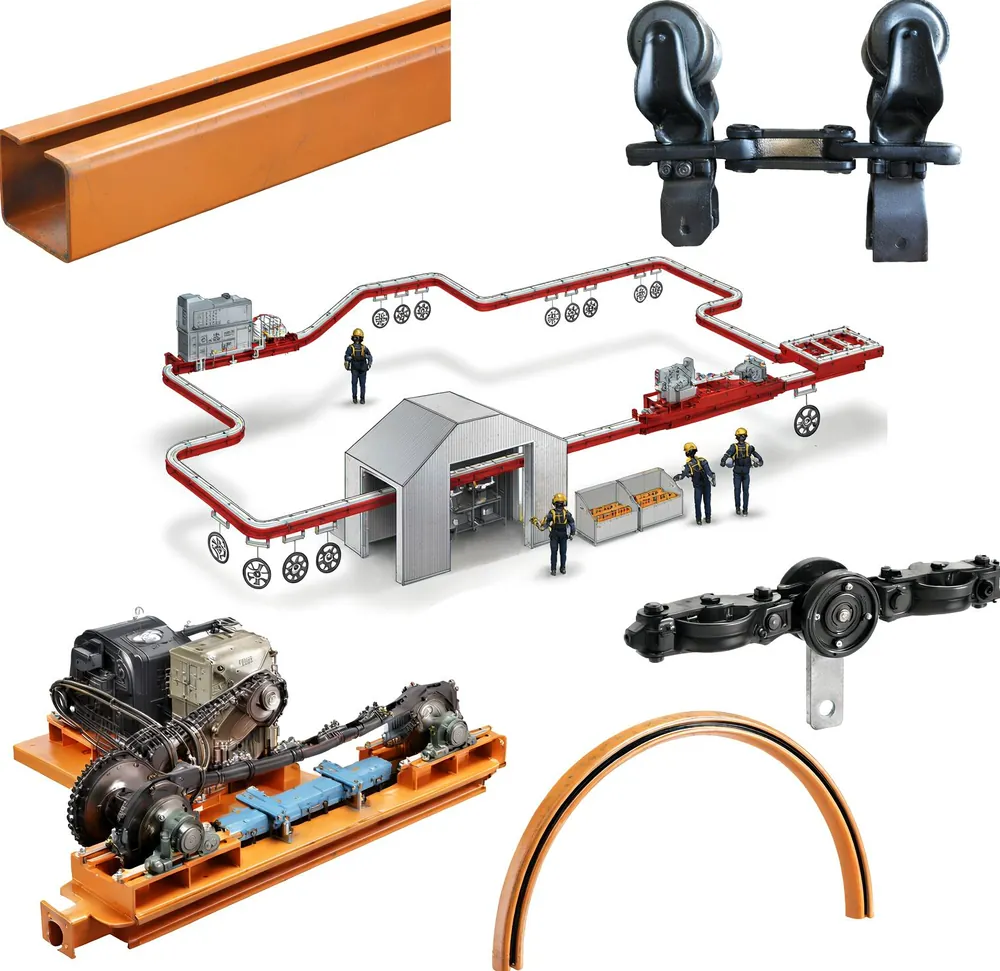
| Caterpillar drive | A short drive chain with dogs engages the conveyor chain on a straight section | Most overhead and power and free conveyors |
| Sprocket (corner) drive | A sprocket drives the chain at a horizontal turn | Smaller, lighter conveyors |
| Multiple drives | Several drives share the load on one loop | Long or heavily loaded loops |
Overload protection and speed control
- A floating drive frame or torque limiter detects overload and stops the drive
- Shear pins or slip clutches protect against jams on some designs
- Frequency inverters give soft start, soft stop and adjustable speed
- Speed monitoring detects a broken chain or slipping drive
Take-up types
| Type | Notes |
|---|---|
| Screw take-up | Manual adjustment; simple, for short and stable lines |
| Spring take-up | Automatic, limited stroke |
| Pneumatic take-up | Constant tension, adjustable by air pressure |
| Counterweight take-up | Constant tension by weight; needs vertical space |
Where to place them
The drive sits where the chain pull is highest, usually after the most heavily loaded section. The take-up sits just after the drive, where chain tension is lowest, so it can absorb slack. Keep both outside ovens and wet zones and reachable from a platform.
Sizing
Drive size follows from the chain pull calculation: the weight of chain, trolleys, carriers and products, friction on straights and in curves, and the force to lift loads on inclines. When pull exceeds the chain or drive rating, the loop is split or extra drives are added. Take-up stroke must cover chain elongation and thermal expansion through ovens; see curing oven conveyors.
Questions to ask your supplier
- How was the chain pull calculated, and what margin was used?
- What overload protection does the drive have?
- Which take-up type is used, and how long is its stroke?
- How are drive and take-up reached for maintenance?
Related: curve design and rivetless chain.
Common mistakes to avoid
- One drive on a loop whose chain pull calls for two
- Take-up stroke too short for oven expansion and chain elongation
- Drive placed inside an oven or wet zone
- Overload protection disabled after nuisance trips instead of finding the cause
Drive and take-up maintenance
| Interval | Check |
|---|---|
| Weekly | Drive noise, caterpillar chain and dogs, take-up position |
| Monthly | Gearbox oil, couplings, overload switch function |
| Yearly | Sprockets and drive wear parts; alignment of drive frame |