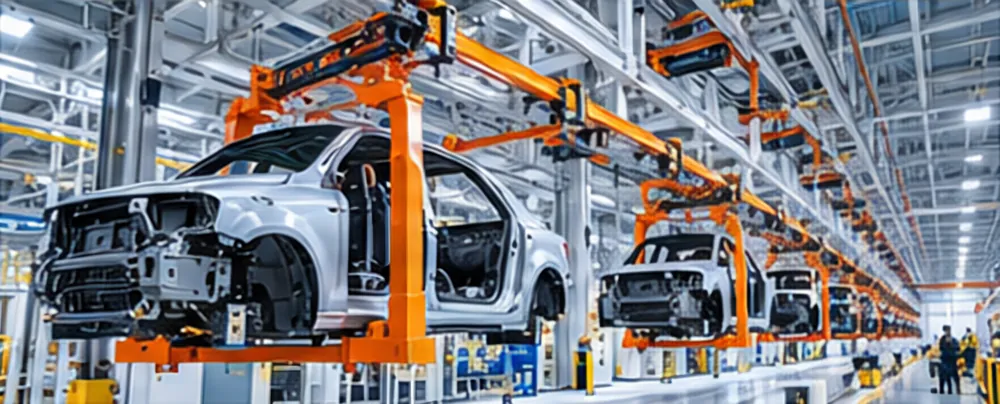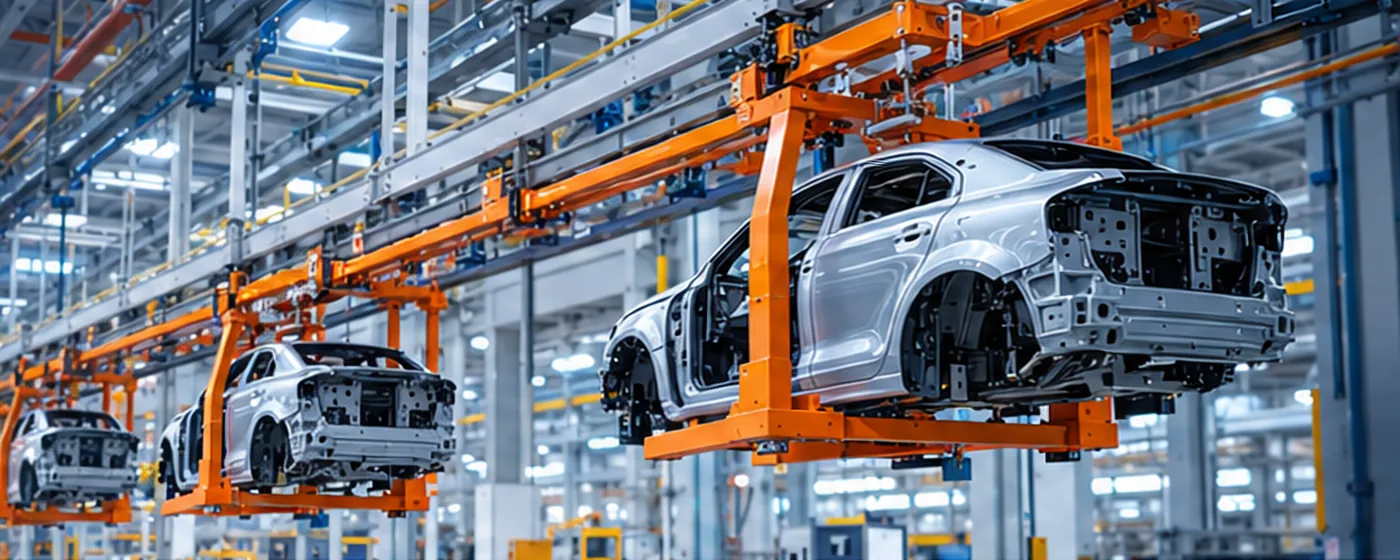
In electrocoating (e-coat), parts are immersed in a paint bath and coated by an electric current. The conveyor has to dip each part into the tank, hold it there for the deposition time, lift it out cleanly and keep electrical contact throughout.
What the conveyor must do
- Lower parts into the tank at a controlled angle and speed to avoid air pockets
- Keep parts fully immersed for the required coating time
- Provide a reliable electrical path from the part to the rectifier circuit
- Lift parts out and allow them to drain before rinsing
- Carry parts through post-rinses and on to the curing oven
Conveyor options for e-coat lines
| Type | How it dips | Typical use |
|---|---|---|
| Overhead chain conveyor with dip profile | Vertical curves take the track down into and out of the tank | Continuous lines with similar parts |
| Power and free with drop sections | Carriers are lowered and raised by lift units over the tank | Mixed parts, batch control, variable immersion |
| Hoist or gantry systems | Carriers are lifted and dipped by hoists | Low to medium volumes, large parts |
| Rotational and specialised dip systems | Parts are rotated through the bath | High-volume automotive body lines |
Sizing the tank pass
For a continuous line, the conveyor length under the bath surface must give the required immersion time:
Immersed length = line speed × immersion time
Example: at 3 m/min and 3 minutes of immersion, about 9 m of conveyor must be under the bath surface, plus the entry and exit slopes. The dipping angle is limited by the part shape and by the need to let air escape on entry and liquid drain on exit.
Electrical contact
Parts are part of the electrical circuit. Contact usually runs through the hanger or carrier. Paint deposits on hooks insulate them over time, so:
- Design hangers with defined, cleanable contact points
- Strip or clean hangers regularly
- Include contact checks in maintenance routines
Keeping the bath clean
- Keep chain lubricant and debris away from the tank with covers and drip pans
- Use corrosion-protected conveyor parts in the wet zone
- Allow drain time before rinsing to reduce drag-out
After the e-coat tank
Parts go through ultrafiltration rinses and then to the curing oven. The conveyor through the oven needs heat-rated components; see our curing oven conveyor guide and the paint shop conveyor guide.
HITREE designs power and free conveyors with drop sections for coating lines. Contact us with your part sizes and output.
Design checklist for an e-coat conveyor
| Topic | What to define |
|---|---|
| Part orientation | Angle that lets air escape on entry and liquid drain on exit |
| Immersion time | Set by the process; defines tank length or dip duration |
| Contact points | Defined, cleanable contact between part and hanger |
| Hanger stripping | Cleaning method and interval for hangers |
| Wet zone protection | Covers, drip pans and corrosion-protected parts |
| Buffers | Before the tank and before the oven |
Common e-coat conveyor problems
- Air pockets in cavities from a too-steep entry angle
- Uncoated areas from poor contact on dirty hangers
- Drag-out of paint from parts lifted out too fast
- Bath contamination from lubricant or debris above the tank
Most of these are design decisions made when the e-coat conveyor is specified, so involve the paint process supplier and the conveyor supplier together from the start.