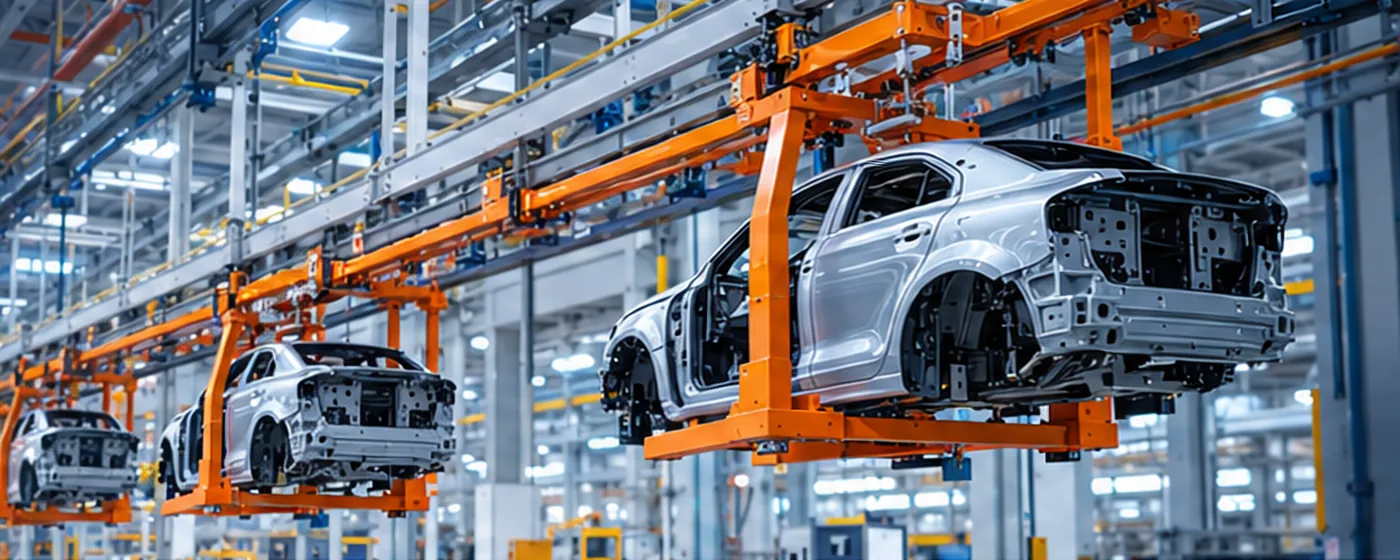
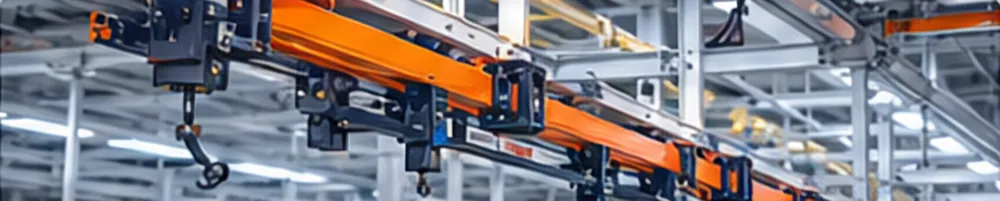
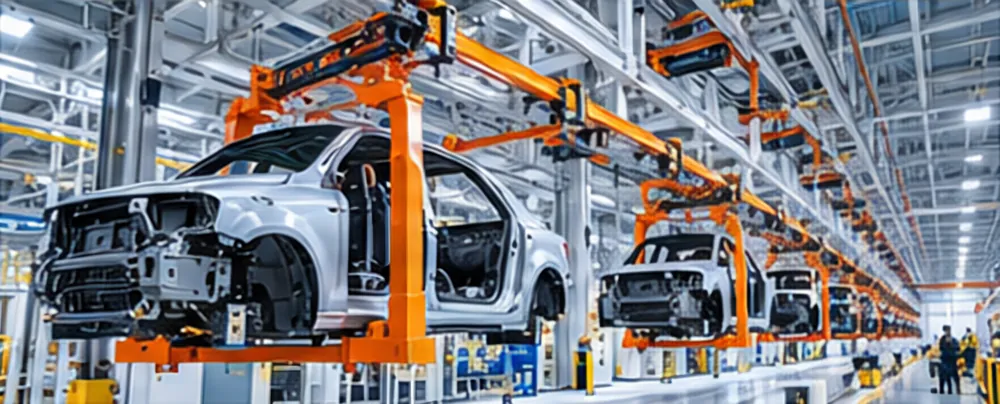
A powder coating line typically includes loading, pretreatment, dry-off, powder booth, curing oven, cooling and unloading. The conveyor links them all, so its type and speed decide the capacity and quality of the whole line.
Conveyor types for powder coating
| Type | Best for | Limits |
|---|---|---|
| Overhead chain conveyor | Continuous lines, high volumes of similar parts | No accumulation; one speed for all zones |
| Power and free conveyor | Batches, colour changes, manual stations, heavy parts | Higher cost and more components |
| Inverted power and free | Parts needing a clean top surface or top access | Uses floor space |
| Batch or box systems | Low volumes, large or varied parts | Manual handling, lower throughput |
See the full comparison in overhead chain conveyor vs power and free.
Sizing: line speed and oven length
Start from the area or number of parts to coat per hour and the hanging density. Line speed follows from how many parts fit per metre of conveyor:
Line speed (m/min) = parts per minute ÷ parts per metre
The curing oven must hold each part for the cure time given by the powder manufacturer at the required metal temperature:
Conveyor length in oven = line speed × dwell time
Example: at 2 m/min and a 20-minute dwell, the oven must contain 40 m of conveyor, usually arranged in several passes to keep the oven compact. Allow extra time for the part to heat up, especially for thick or heavy parts.
Hanging and grounding
Electrostatic powder needs a good electrical path from the part through the hook and conveyor to ground. Poor grounding causes thin coverage, back-ionisation and powder waste. A ground resistance at or below 1 megohm is a common guideline.
- Design hooks and racks to give a firm contact point on each part
- Clean or strip hooks regularly; cured powder build-up insulates them
- Keep trolley wheels and track contact paths clean
- Check ground resistance as part of routine maintenance
Colour changes and batching
Frequent colour changes favour power and free, because carriers for each colour can be grouped and held while the booth is cleaned. With an overhead chain conveyor, colour changes need gaps in the hanging pattern or a stop of the line.
Keeping the coating clean
- Use drip pans or covered track over pretreatment and the booth where needed
- Choose high-temperature lubricants and lubricate sparingly in oven zones
- Consider inverted designs when top surfaces must be perfect
- Keep the conveyor out of the booth's air stream where possible
More on oven duty in our curing oven conveyor guide.
Layout tips
- Place loading and unloading close together to save labour and floor space
- Add a small buffer before the booth so loading variations do not reach the gun settings
- Leave enough cooling time before unloading
- Plan maintenance access to drives and take-ups outside hot zones
HITREE supplies conveyors for surface treatment lines. Send us your part data and output for a conveyor proposal.
Worked example: sizing a powder coating conveyor system
A plant must coat 240 brackets per hour. Each carrier holds 4 brackets and carriers hang 0.6 m apart, so the line needs 60 carriers per hour, or one per minute:
Line speed = 1 carrier/min × 0.6 m = 0.6 m/min
With a cure time of 20 minutes including heat-up, the oven would need 0.6 × 20 = 12 m of conveyor. To shorten the oven, the plant packs more parts per carrier: 8 brackets per carrier at 0.8 m spacing gives 30 carriers per hour and 0.4 m/min, so the oven only needs 0.4 × 20 = 8 m of conveyor, which fits a compact single-pass oven.
Hanging density is often the most powerful lever in a powder coating conveyor system: more parts per metre means a slower line, a shorter oven and a smaller booth.
Common mistakes
- Sizing the oven for cure time but forgetting heat-up time for heavy parts
- Hooks that are hard to clean, leading to poor grounding
- No buffer at loading, so operator breaks stop the line
- Drives and lubricators placed inside the oven
- Too little cooling length before unloading