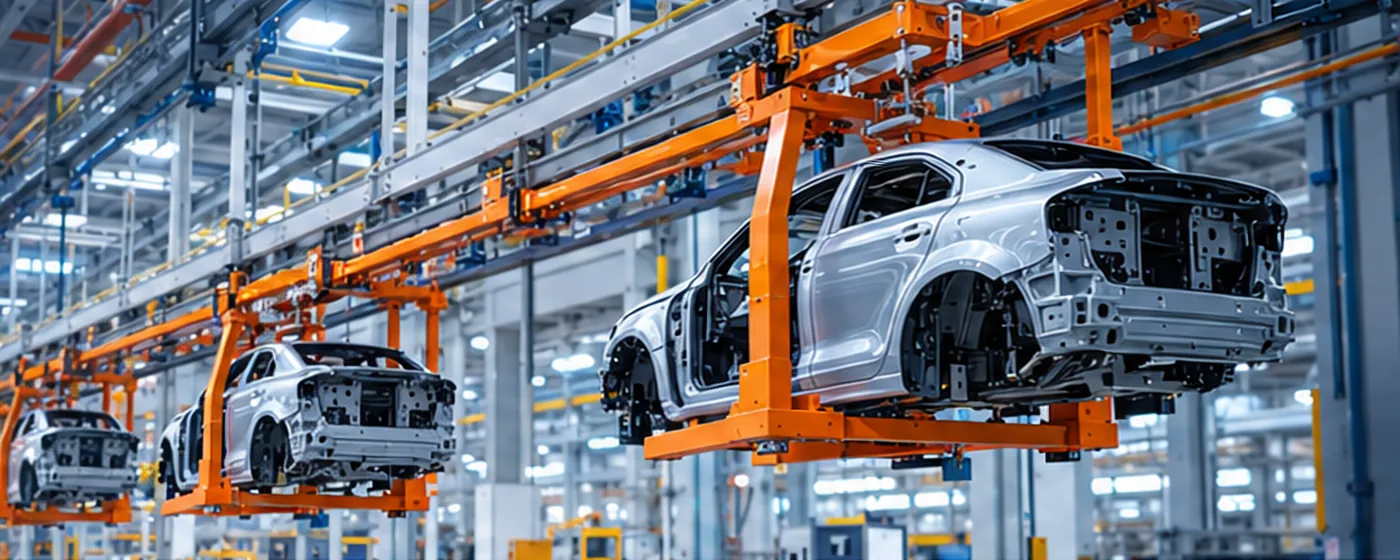
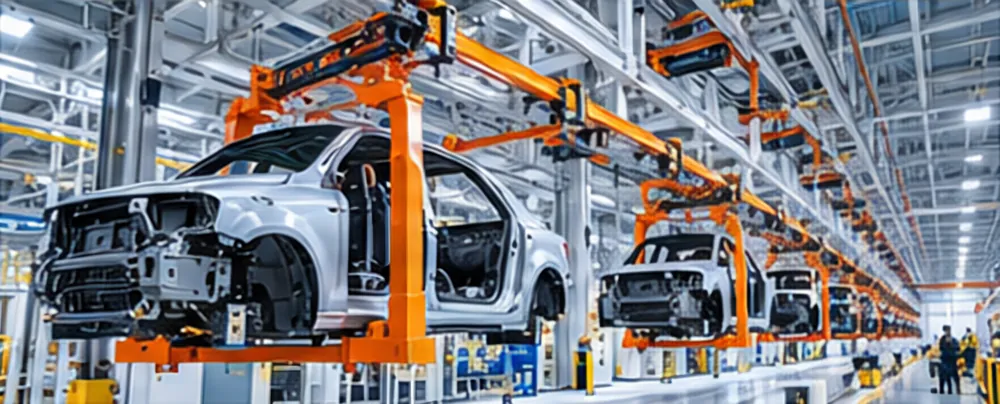
Battery pack assembly combines cell or module stacking, wiring, cooling system installation, sealing and end-of-line testing. Packs grow heavier and more valuable at every step, and every pack must be traceable.
What makes battery lines different
- Heavy loads: complete packs can weigh several hundred kilograms
- Precise positioning: robots and screwdrivers need repeatable positions
- Cleanliness: metal particles and dirt must stay out of the pack
- Traceability: every module and pack is tracked with process data
- Safety: packs carry stored energy; damaged packs need a defined quarantine route
- Testing: long test cycles at end of line need buffers
Conveyor options
| Technology | Strengths | Typical use |
|---|---|---|
| Roller or pallet conveyors | Precise positioning on fixtures, easy station integration | Module assembly, pack sub-assembly |
| EMS overhead conveyor | Floor stays free, height adjustment, individual control | Pack transport, assembly over long distances, buffers |
| AGVs and AMRs | Flexible routing, easy layout changes | Pack assembly cells, transport between areas |
| Lift stations | Change levels and transfer between systems | Interfaces between overhead and floor systems |
An electrified monorail system is a strong fit where packs travel long distances, need buffering before test, or must pass over floor-level workstations.
Design points
| Topic | What to define |
|---|---|
| Carrier | Locating pins and support points that match the pack design |
| Positioning | Repeatability needed at each automated station |
| Cleanliness | Lubrication-free or enclosed drives above open packs |
| Tracking | RFID or code reading at each station, data to MES |
| Buffers | Capacity before end-of-line test and rework |
| Safety | Quarantine route and area for suspect packs, emergency procedures |
For tracking, see RFID carrier tracking for conveyors.
Planning for model changes
Battery designs change faster than vehicle bodies. Choose carriers with exchangeable fixtures and a conveyor layout that can be extended, so the line can follow new pack generations.
HITREE designs EMS conveyors and customized systems for automotive and EV production. Contact us with your pack data and output.
Typical battery pack assembly flow
- Module or cell stack delivery and inspection
- Placing modules into the housing
- Electrical connection and busbar installation
- Cooling system installation and leak test
- Battery management system and wiring
- Cover fitting and sealing
- End-of-line electrical and functional test
- Packing or transfer to vehicle assembly
Each step has different cycle times. End-of-line testing often takes longer than assembly steps, so parallel test stations and a buffer in front of them are common.
Questions to ask a battery pack assembly conveyor supplier
- What positioning accuracy can you guarantee at each station?
- How do you keep lubricants and particles away from open packs?
- How is each pack identified and its data passed to MES?
- How is a suspect pack removed from the line safely?
- How easily can carriers be adapted to the next pack design?
A battery pack assembly conveyor is part of the quality system: every station result must be linked to the right pack.