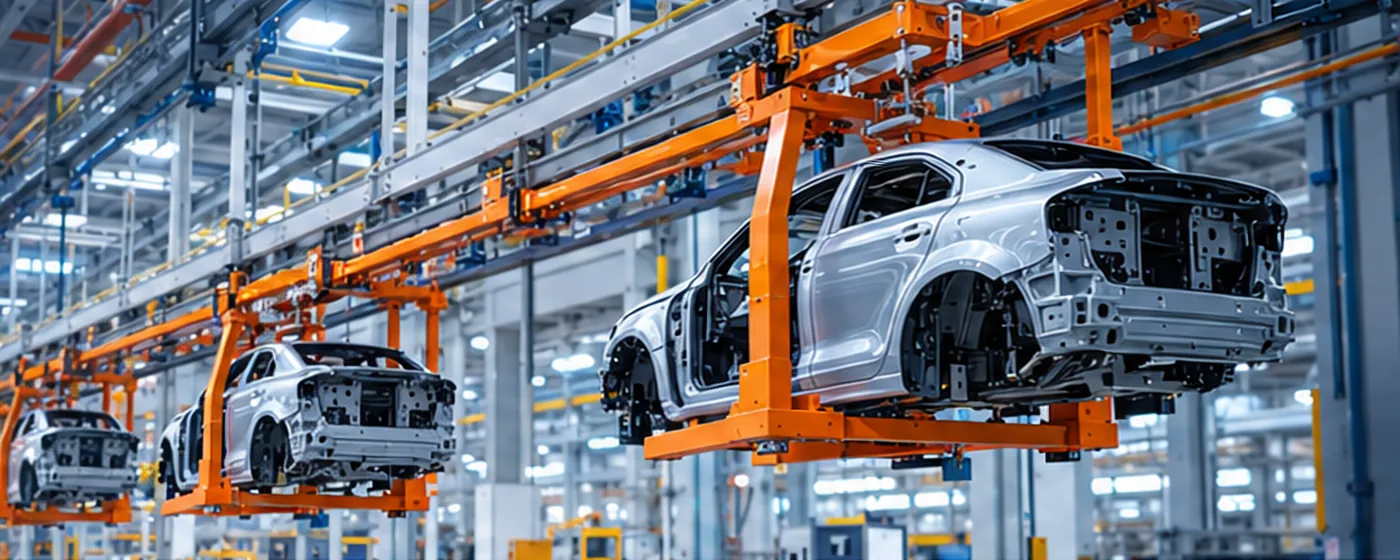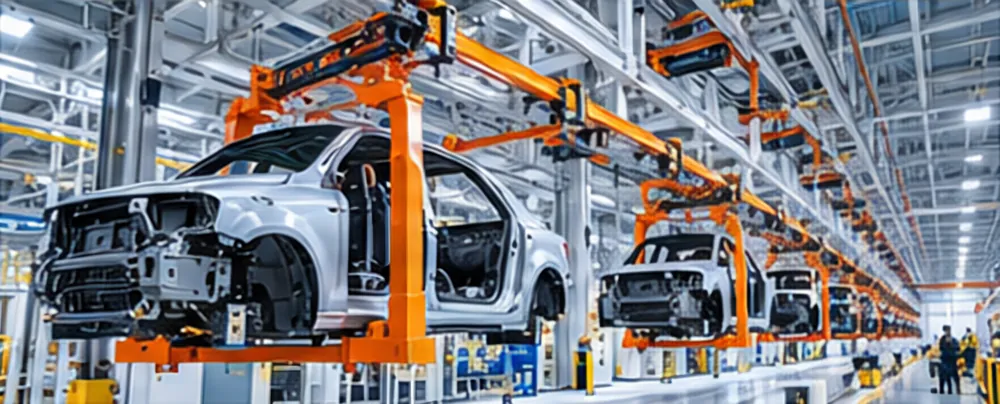
Car plants run their body shop, paint shop and final assembly as linked but separate systems. Storage buffers between them keep a stoppage in one shop from stopping the others, and they put bodies back into the order assembly needs.
WBS and PBS
| Buffer | Position | Main purpose |
|---|---|---|
| White body storage (WBS) | Between body shop and paint shop | Decouple shops; batch bodies by colour |
| Painted body storage (PBS) | Between paint shop and final assembly | Decouple shops; restore the assembly sequence |
Why sequence matters
Final assembly builds vehicles in a planned sequence, matched to parts deliveries from suppliers. In the paint shop, bodies leave that order: some are grouped by colour, some go to repair and come back later. The PBS holds enough bodies to pick the next one in the planned sequence.
How a PBS works
- Bodies enter the storage and are assigned to a lane
- The control system knows the identity, colour and options of every body
- Bodies are released in the sequence assembly requires
- Repaired bodies are inserted at the right point
Conveyor technologies for body storage
| Technology | Strengths | Limits |
|---|---|---|
| Power and free lanes | Built-in accumulation, overhead floor savings | Access is first-in, first-out per lane |
| Skid conveyor lanes | Stable support, common in skid-based paint shops | Floor or mezzanine space |
| Automated storage and retrieval | Random access to any body | Higher investment and complexity |
With lane storage, the number of lanes and their length decide how freely the system can resequence. More, shorter lanes give more choice; fewer, longer lanes give more capacity per metre.
Sizing the buffer
A first estimate comes from the stoppages to bridge and the takt time:
Buffer bodies ≈ stoppage time ÷ takt time + resequencing reserve
Example: to bridge a 20-minute stop at a 60-second takt, plan for around 20 bodies, plus the extra bodies needed to choose from when restoring sequence. A flow simulation then confirms the size. Read more in accumulation and buffering.
Tracking and control
A body buffer only works if the control system knows where every body is. Carrier identification at lane entries and exits, linked to the plant MES, is essential; see RFID carrier tracking.
HITREE designs power and free storage systems for automotive plants. Contact us to size your buffer.
Lane storage logic explained
Imagine a painted body storage with 8 lanes of 6 bodies. Each lane works first-in, first-out. When assembly needs a specific body, the control system can only take the front body of a lane. With 8 lanes, it can choose from 8 bodies at any moment. More lanes mean more choice; a body buried at the back of a lane has to wait until those in front are released.
Smart lane assignment helps: bodies that will be needed soon go to lanes where they will be near the front, and lanes can be dedicated to colours or option groups.
Design checklist for painted body storage
| Topic | What to define |
|---|---|
| Capacity | Stoppages to bridge and resequencing reserve |
| Lanes | Number and length, set by the choice needed |
| Access | First-in, first-out lanes or random access |
| Identification | Readers at every lane entry and exit |
| Control | Assignment and release rules linked to the assembly sequence |
| Building | Floor, mezzanine or overhead space available |
Painted body storage is one of the highest-value conveyor investments in a car plant, because it protects the output of final assembly.