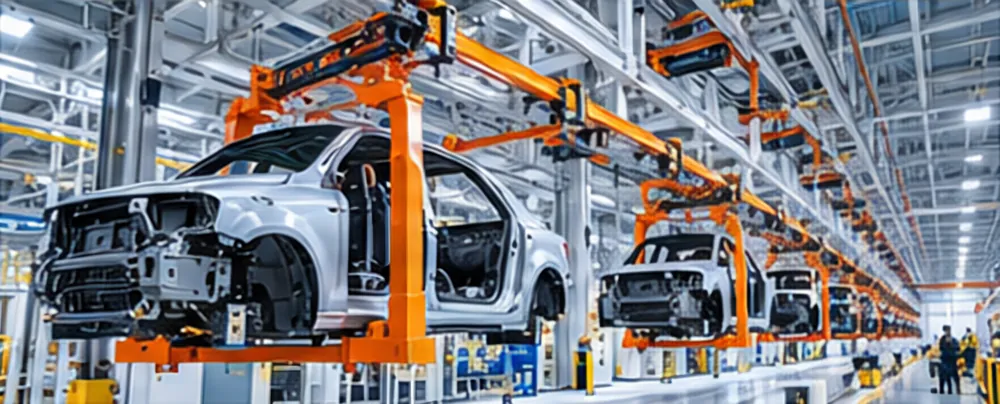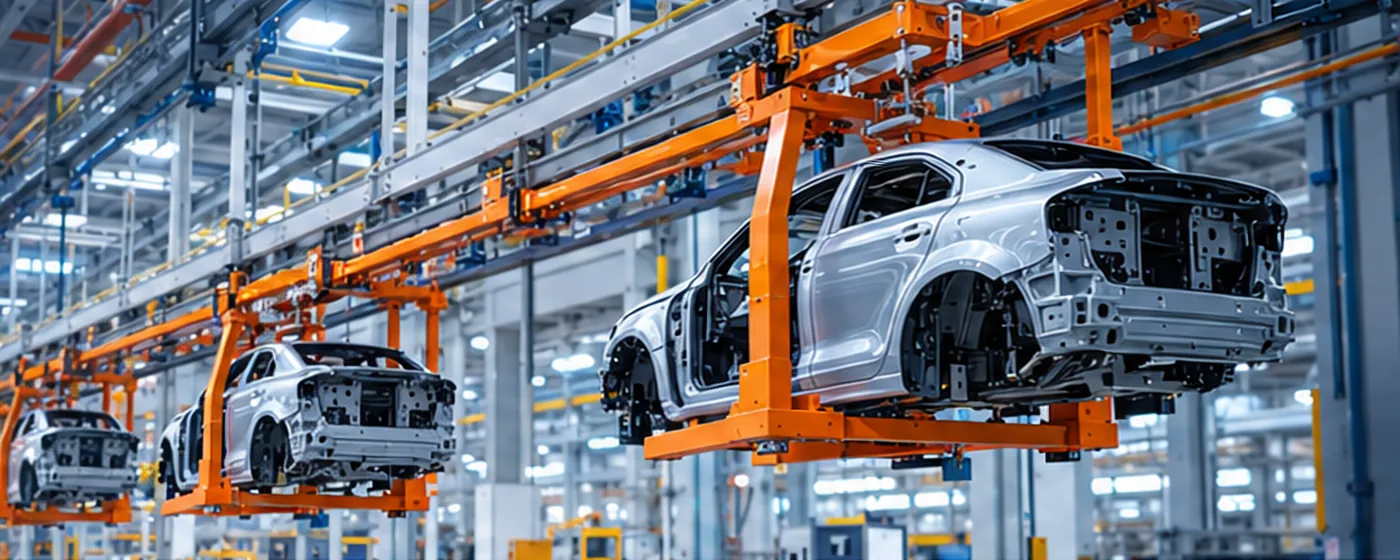
A skid is a steel frame that carries the body over roller beds, lifts and turntables. An overhead conveyor carries the body on hangers from a rail or track above. Many plants use both, each where it fits best.
How each system works
Skid conveyors move skids on driven roller beds. Lifts change level, turntables and transfer cars change direction, and stops position the skid at stations.
Overhead conveyors carry bodies on hangers: EMS with individually driven carriers, or power and free with chain-driven trolleys.
Comparison
| Criteria | Skid conveyor | Overhead conveyor |
|---|---|---|
| Floor space | Uses floor or mezzanine area | Floor stays free |
| Access to the body | Top and sides open; underbody covered by skid | Underbody and sides open; top partly covered by hanger |
| Positioning | Very precise at stations | Precise with EMS; station-based with power and free |
| Height adjustment | Lifts at fixed points | EMS hoists can adjust height continuously |
| Cleanliness | No chain above the body | Chain or drives above the body (inverted designs avoid this) |
| Layout changes | Modular, but floor work needed | Changes overhead, floor unaffected |
| Building | Needs floor load capacity | Needs roof or support steel capacity |
Where each fits
| Shop | Often skid | Often overhead |
|---|---|---|
| Body shop | Lines between robot cells | Transfers and storage above cells |
| Paint shop | Booths and ovens in skid-based plants | Power and free and inverted lines, ovens |
| Body storage | Skid lanes | Power and free lanes |
| Final assembly | Less common | EMS with hoists for height-adjusted work |
Questions to decide
- Does the operation need access to the underbody (favours overhead) or the roof (favours skid)?
- Is floor space or roof capacity the tighter constraint in your building?
- Do operators need the body at different heights along the line?
- Must the conveyor pass over aisles, existing equipment or other lines?
- What does the rest of the plant use, for spare parts and maintenance skills?
HITREE supplies overhead systems for automotive plants and integrates them with skid and floor systems. Read the automotive conveyor systems overview or contact our engineers.
Worked example: underbody work
An assembly line includes underbody sealing and fastening. On a skid, the underbody is covered, so the body must be transferred to an overhead carrier or lifted for access. On an EMS carrier with a hoist, the body is raised so operators can work underneath at a comfortable height, then lowered again for interior work.
The same plant uses skids in the paint shop, where bodies need a stable, clean platform through booths and ovens. A transfer station between paint and assembly moves each body from its skid to an overhead carrier.
Cost and maintenance considerations
- Skid systems have many roller beds and motors at floor level; maintenance is easy to reach
- Overhead systems need access platforms for maintenance but keep the floor clear
- Skids are a recurring part cost; carriers are the equivalent for overhead systems
- Building structure cost differs: floor loads for skids, roof or support steel for overhead
When comparing a skid conveyor with an overhead conveyor, look at the whole shop, not one station: the transfers between systems often decide the layout.