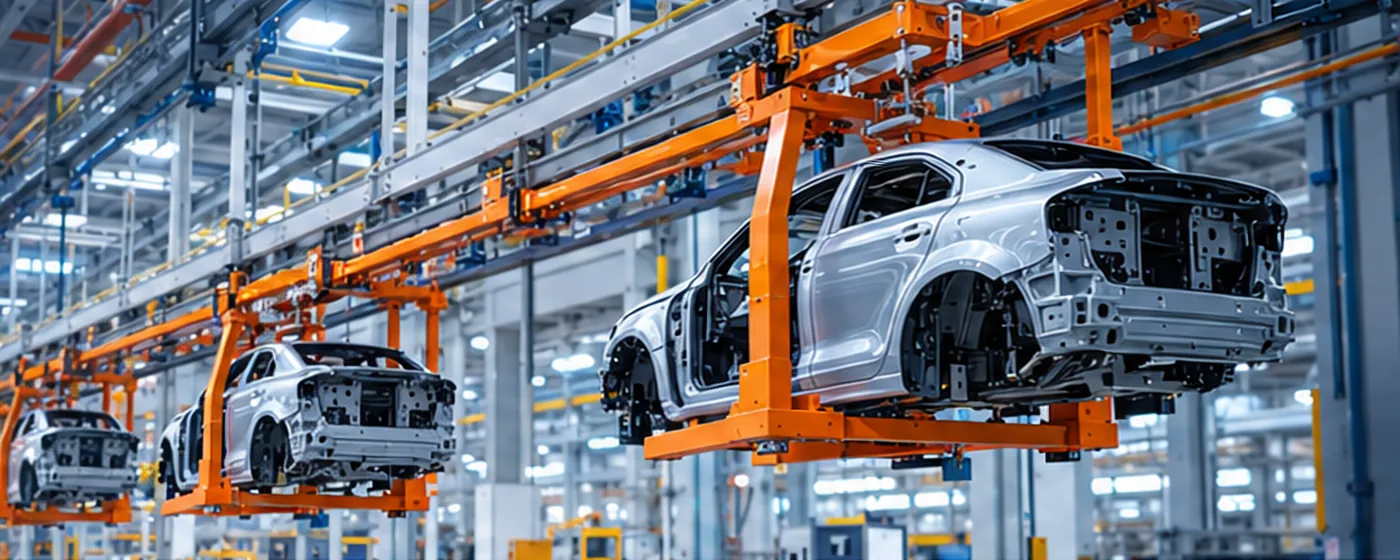
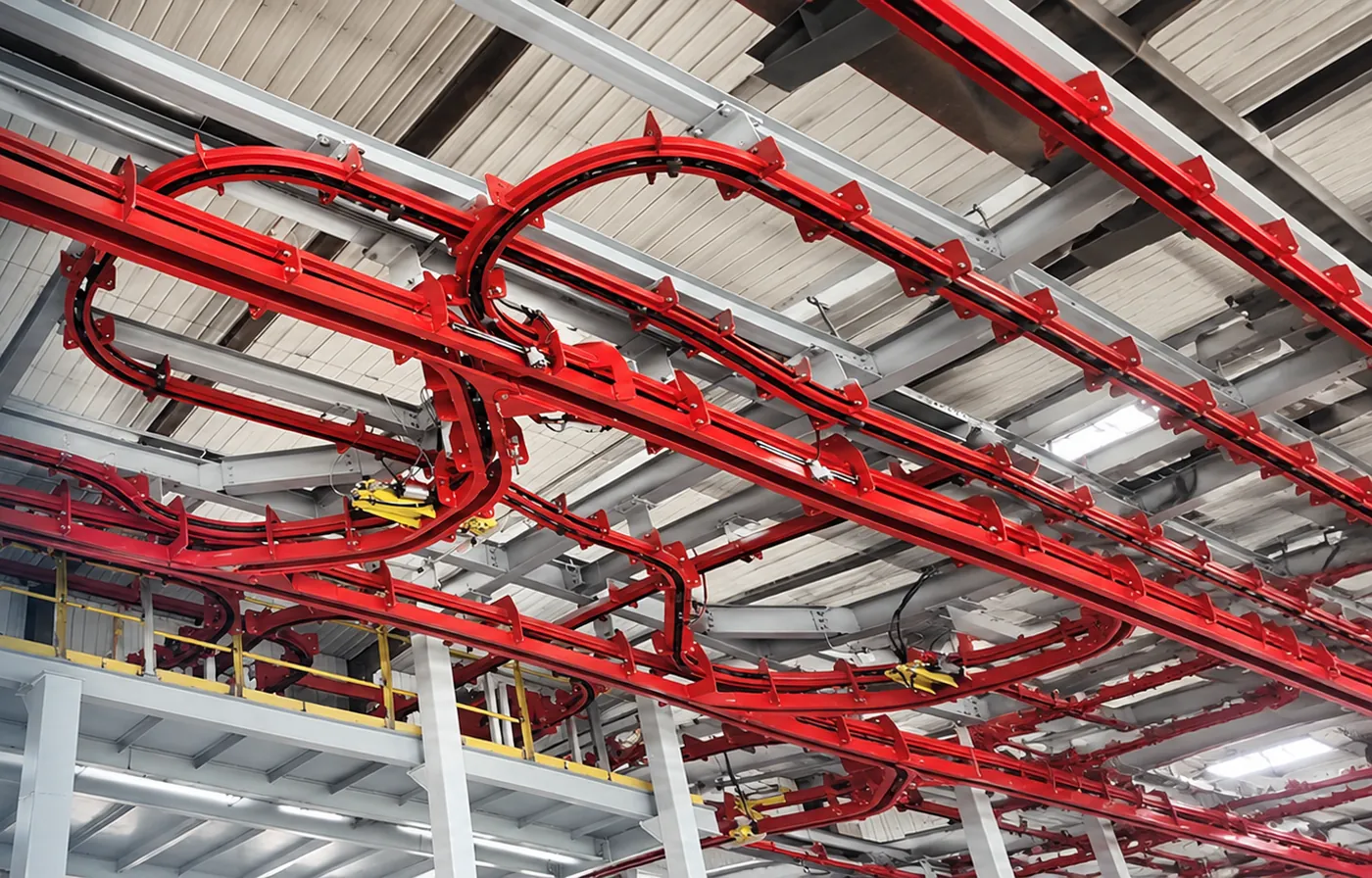
An overhead chain conveyor is the simplest overhead system: products hang from attachments fixed to a moving chain. A power and free conveyor adds a second track so products can stop and accumulate while the chain keeps running.
How each works
Overhead chain conveyor (also called a monorail chain conveyor or hanging chain conveyor): an endless chain runs in a single track. Hooks or carriers hang directly from the chain, so every product moves at the same speed and stops when the chain stops.
Power and free conveyor: the chain runs in a power track and pushes independent trolleys in a free track. Carriers can be stopped, queued and switched to other routes without stopping the chain. See how power and free works.
Side-by-side comparison
| Criteria | Overhead chain conveyor | Power and free conveyor |
|---|---|---|
| Carrier movement | All carriers move together | Carriers can stop independently |
| Accumulation | No | Yes, built in |
| Routing | Single fixed loop | Switches to branches, lanes and loops |
| Stations | Work on moving parts | Parts can stop at stations |
| Equipment cost | Lower | Higher |
| Maintenance | Simpler | More components to maintain |
| Typical loads | Light to medium parts on hooks | Light to heavy loads, including car bodies |
| Typical uses | Continuous powder coating, washing, drying | Paint shops, assembly, storage, multi-route lines |
Choose an overhead chain conveyor when
- The process is continuous and every part follows the same path
- Parts are light to medium and can be worked on while moving
- You do not need buffers between process steps
- Budget and simplicity matter most
Choose power and free when
- Parts must stop at stations for loading, inspection or manual work
- Processes run at different speeds and need buffers between them
- Products follow different routes, colours or process steps
- Loads are heavy or the line is long with many carriers
- You want to store products or resequence them
A common upgrade path
Many coating plants start with an overhead chain conveyor and later need more flexibility for colour changes or batch processing. Parts of the line can be converted to power and free, or a power and free section can be added for loading and storage. Read about overhead conveyor retrofits.
What about EMS?
When carriers need individual speed control, precise positioning or onboard lifting, an electrified monorail system may fit better than either chain-based system.
Not sure which conveyor fits your process? Send us your layout and HITREE engineers will recommend a solution.
Worked example: one line, two options
A plant coats 300 parts per hour, all the same colour, on hooks that hold two parts each. Every part follows the same route through washer, dryer, booth and oven. An overhead chain conveyor is the obvious choice: simple, reliable and lower in cost.
A second plant coats 120 parts per hour in eight colours, in batches of 10 to 40 parts, with manual masking at loading. Here power and free pays off: carriers can be grouped by colour, held at the masking station without stopping the line, and released in batches to the booth.
| Your situation | Points to |
|---|---|
| One product family, one route, steady flow | Overhead chain conveyor |
| Many colours or batches | Power and free |
| Manual work on stationary parts | Power and free |
| Need buffers between processes | Power and free |
| Lowest investment, simple maintenance | Overhead chain conveyor |
Hybrid layouts
Some lines combine both: an overhead chain conveyor through the continuous process section, and a power and free loop for loading, masking and unloading. Transfer points link the two. This gives flexibility where people work and simplicity where the process runs continuously.