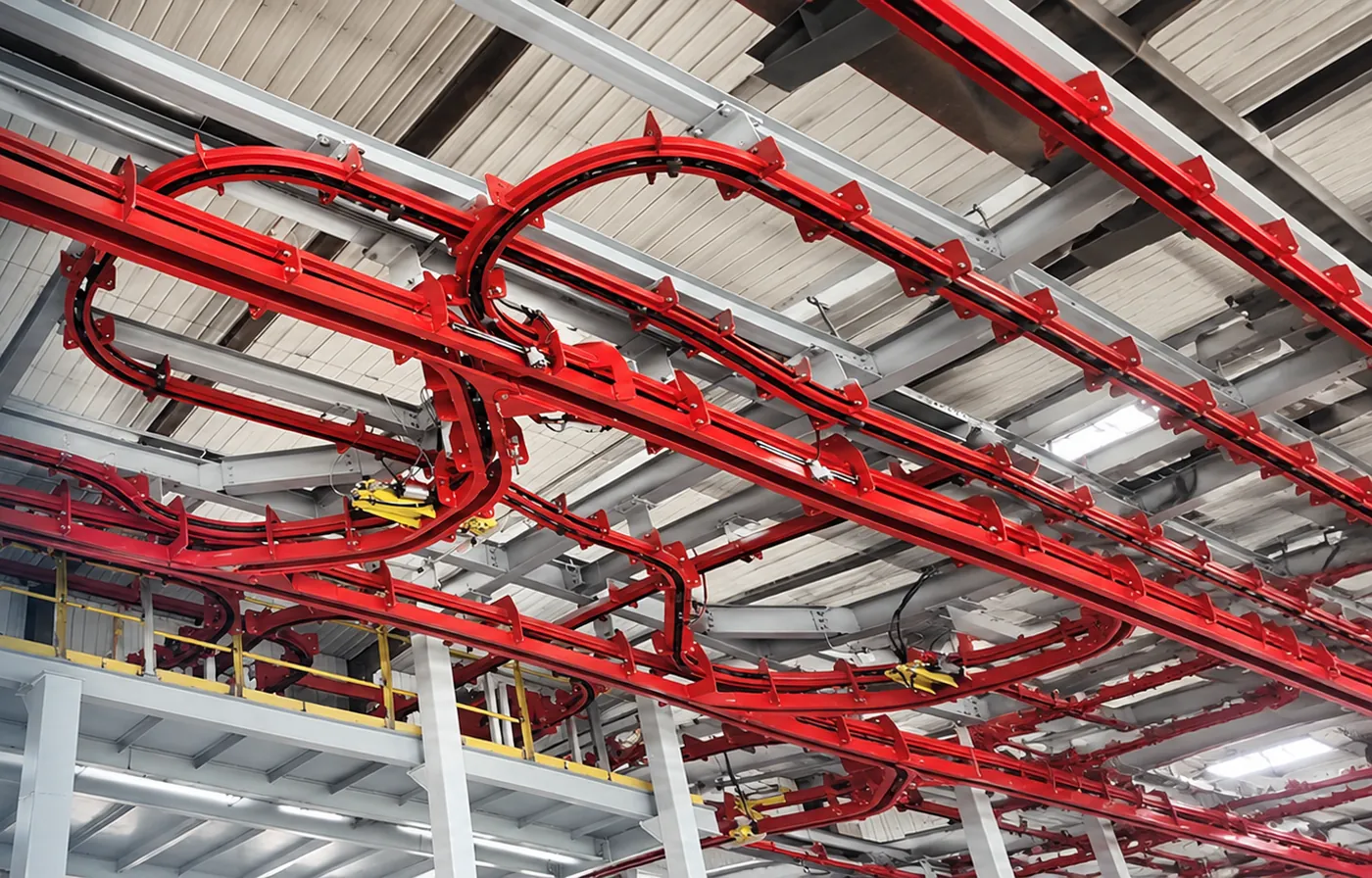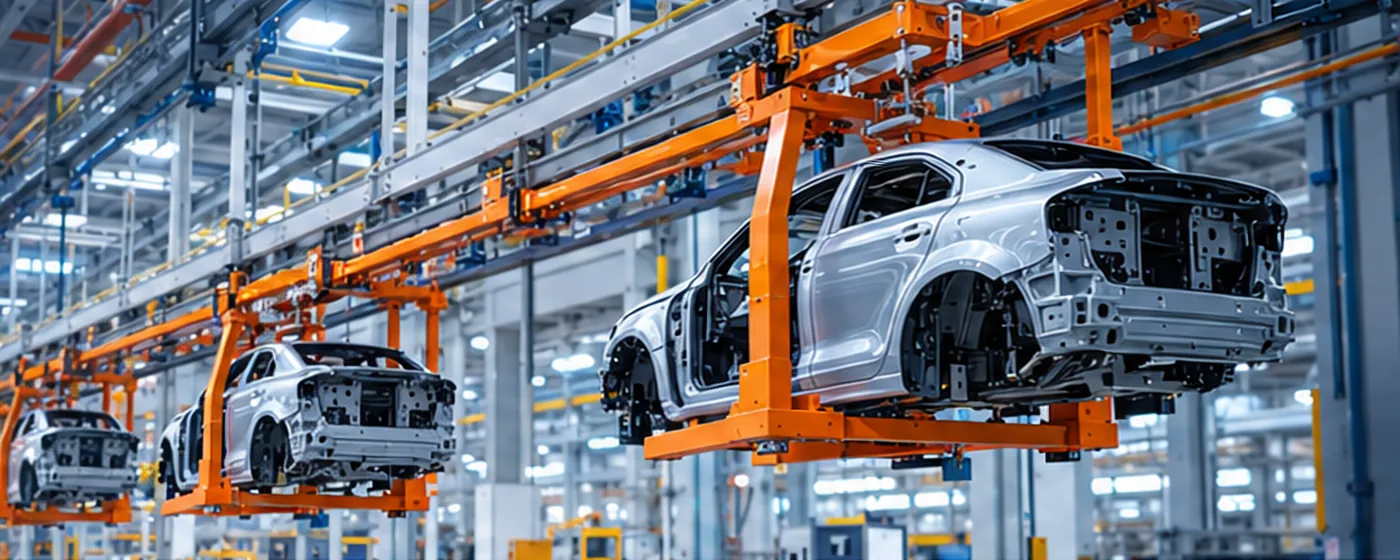
Buyers often ask for a power and free conveyor price per metre before anything else. It is a fair question, but the answer depends on what each metre carries: how heavy the load is, how many switches and lifts sit along the route, whether the line runs through an oven, and how much of the work the supplier does on site.
Read on for the cost structure of a power and free conveyor, the factors that change the price most, the costs buyers often miss, and how to move from a first budget to a firm quotation. Use the calculator below to estimate the quantities that drive your price.
How much does a power and free conveyor cost?
The price of a power and free conveyor is set by four quantities more than anything else:
- Track length, including vertical curves, return runs and storage lanes
- Number of carriers, which depends on loop length, pitch and buffer size
- Number of routing and lifting points: switches, stops, drop and lift sections
- Load class, which sets the chain size, trolleys, drives and support steel
Because these quantities differ from plant to plant, two lines of the same length can differ widely in price. A short line with many switches and lifts can cost more than a long, simple loop.
Estimate your quantities
Takt time, chain speed and carrier count come straight from your production target. The calculator uses the same formulas our engineers use in the concept phase, explained in our layout planning guide.
Power and free sizing calculator
Enter your line data to estimate the quantities that drive the price. Results update as you type.
- Takt time
- 120 s
- Chain speed
- 2.0 m/min
- Carriers on the loop
- 75
- Buffer carriers
- 5
- Buffer lane length
- 12.5 m
- Total carriers (estimate)
- 80
For early budgeting only. Final values come from layout engineering, curves, switches and process zones.
Takt time = 3,600 s ÷ jobs per hour · Chain speed = pitch ÷ takt time
What you are paying for: cost breakdown
A complete quotation should list each of these items. If one is missing, ask whether it is excluded or included elsewhere.
| Item | What it includes |
|---|---|
| Engineering | Layout, throughput calculation, structural and control design, drawings |
| Track and support steel | Power track, free track, curves, hangers, headers and support structure |
| Chain and trolleys | Power chain with pusher dogs, load trolleys, accumulating front trolleys |
| Carriers | Load bars, hooks or fixtures designed for your product |
| Drives and take-ups | Caterpillar drives, take-up units, lubricators |
| Routing and lifting | Switches, stops, vertical curves, drop and lift sections |
| Electrical and controls | Panels, PLC, HMI, sensors, carrier tracking, safety circuits |
| Installation and commissioning | Site installation or supervision, start-up and ramp-up support |
| Logistics | Export packing, freight, insurance and import costs, depending on Incoterms |
| Training, documents, spares | Operator and maintenance training, manuals, first spare parts set |
8 factors that change the price most
1. Load weight and chain class
Heavier products need a larger chain class, stronger trolleys, larger drives and heavier support steel. Power and free systems commonly use 3 in, 4 in or 6 in chain (often referred to as X-348, X-458 and X-678). Choosing the smallest class that safely carries your load, with margin, is one of the biggest cost levers.
2. Track length and elevation changes
Every metre of track needs chain, structure and installation labour. Vertical curves add special track sections and may need extra drive capacity. A compact route that avoids unnecessary climbs saves both equipment and energy.
3. Number of carriers
Carriers and trolleys repeat across the line, so their unit cost multiplies quickly. Carrier count comes from loop length, carrier pitch and buffer size, which is why the calculator above is a useful first step.
4. Switches, stops and lifts
Each switch, stop station, drop section or lift adds mechanics, sensors and control logic. They are also what make power and free flexible, so the goal is the right number, not the lowest number.
5. Ovens, wet zones and paint areas
Lines that run through pretreatment, paint booths and curing ovens need heat-rated bearings and lubricants, corrosion protection and drip protection. An inverted power and free design keeps lubricant away from painted parts but changes the structure and cost.
6. Carrier design
Simple hooks are inexpensive. Product-specific fixtures with locating points, rotation or tilting can become one of the largest items in the budget. Standardising carriers across a product family keeps this under control.
7. Controls and tracking
A basic line needs drive control and safety circuits. Carrier identification, automatic routing, MES data exchange and remote diagnostics add hardware and programming. See conveyor controls and automation.
8. Installation scope and location
Installation by the supplier, supervision of a local contractor, or parts only: each option shifts cost between the quotation and your own budget. Working at height, night shifts in a running plant and remote locations all add to installation cost.
Costs buyers often miss
- Building checks or reinforcement so the roof or a support structure can carry the conveyor
- Crossings with fire shutters, doors, cranes and existing services
- Power supply and compressed air to drives and stations
- Lifting equipment and access platforms during installation
- Production downtime or night and weekend work during a retrofit
- Guarding and fall protection under carriers over walkways
- First set of spare parts and wear parts
- Training for operators and maintenance staff
Total cost of ownership
The purchase price is only part of the cost. Over a service life of many years, these items add up:
| Cost item | What to plan for |
|---|---|
| Energy | Chain drives run continuously while the line operates; drive sizing and route design affect consumption |
| Lubrication | Lubricant and lubricator maintenance, especially in oven zones |
| Chain and wear parts | Chain elongation, trolley wheels, dogs and stops wear and need replacement over time |
| Inspection and maintenance | Daily, weekly and monthly checks; see our maintenance checklist |
| Downtime risk | Spare parts on site and fast support reduce the cost of a stoppage |
Our overhead conveyor maintenance checklist lists the routine tasks that keep these costs predictable.
Power and free vs EMS vs overhead chain: relative cost
| Overhead chain conveyor | Power and free conveyor | EMS conveyor | |
|---|---|---|---|
| Equipment cost per metre | Lowest | Medium | Highest per carrier |
| Accumulation | None, line moves as one | Built in, mechanical | Software controlled |
| Cost per carrier | Low | Low to medium (passive trolleys) | High (drive on every carrier) |
| Oven and paint duty | Yes | Yes | Limited |
| Best value when | Simple continuous process | Long lines, buffers, ovens, heavy loads | Fewer carriers, precise automation |
Relative comparison for typical industrial lines. Actual costs depend on the project.
If you are deciding between technologies, read EMS vs power and free conveyor.
9 ways to reduce cost without hurting performance
- Size the chain class to the real load plus a sensible margin, not the largest option
- Calculate buffer size from real stoppage data instead of guessing high
- Standardise carriers across products where possible
- Use inverted designs and oven-rated parts only in the zones that need them
- Shorten the route and avoid unnecessary elevation changes
- Reuse existing track, drives or structures when chain class and condition allow
- Install in phases if output will grow over several years
- Use local installers under the manufacturer's supervision
- Specify motor, bearing and PLC brands that are stocked locally to cut spare parts cost
Importing from China: understanding landed cost
When you compare a quotation from China with a local offer, compare landed cost, not ex-works price. The delivery term (Incoterm) decides which costs are in the quotation:
| Incoterm | Seller covers | Buyer still pays |
|---|---|---|
| EXW (Ex Works) | Goods ready at the factory | Export clearance, freight, insurance, import duty, local delivery |
| FOB (Free On Board) | Delivery onto the vessel at the port of export | Sea freight, insurance, import duty, local delivery |
| CIF (Cost, Insurance and Freight) | Sea freight and insurance to the destination port | Import duty, port charges, local delivery |
| DAP (Delivered At Place) | Delivery to your site, not unloaded | Import duty and taxes, unloading |
Conveyors are generally classified under HS heading 8428; confirm the exact code and duty rate for your country with your customs broker. Add installation, supervisor travel and any local compliance work to get the full picture. Our buyer's checklist for choosing a manufacturer covers the other questions to ask a Chinese supplier.
From budget estimate to firm price
- Budget estimate: based on a layout sketch, product data and target output. Good enough to decide whether to proceed.
- Technical proposal: after the concept layout, throughput calculation and technology choice. Scope and main quantities are defined.
- Firm quotation: after site data, detailed scope and specifications are agreed. This is the price you can approve.
Payment terms for engineered conveyors are usually split into milestones, for example a deposit on order, a payment before shipment and a final payment after acceptance. Agree the milestones and the acceptance test in the contract.
What to send for a fast, accurate quote
- Plant layout (DWG or PDF) with column grid and clear heights
- Product dimensions, weight and hanging points
- Target jobs per hour and shift pattern
- Process zones, including oven temperatures and wet areas
- Buffer requirements and loading and unloading heights
- Preferred delivery term (for example FOB or DAP) and installation scope
Send it to sale@hitreeconveyor.com, message us on WhatsApp, or use our project inquiry form. Our engineers reply within one working day with questions or a first budget estimate for your power and free conveyor.