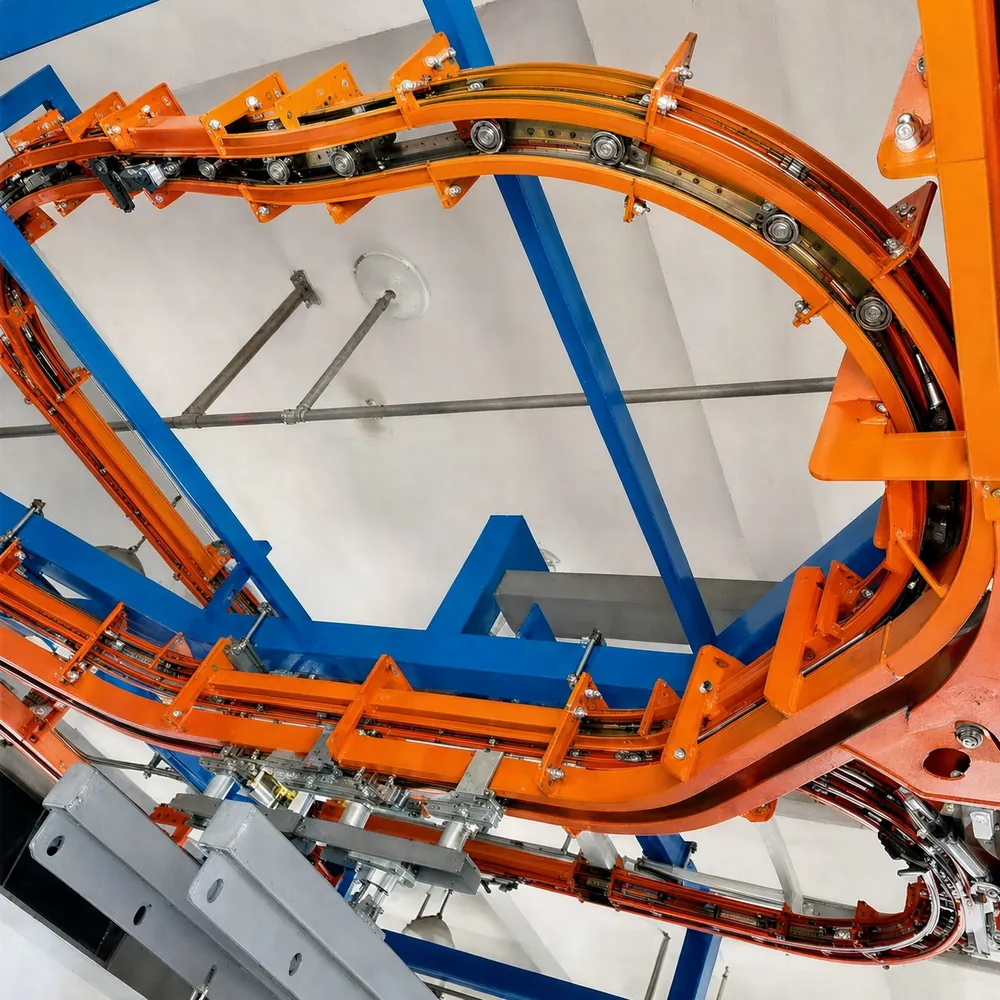
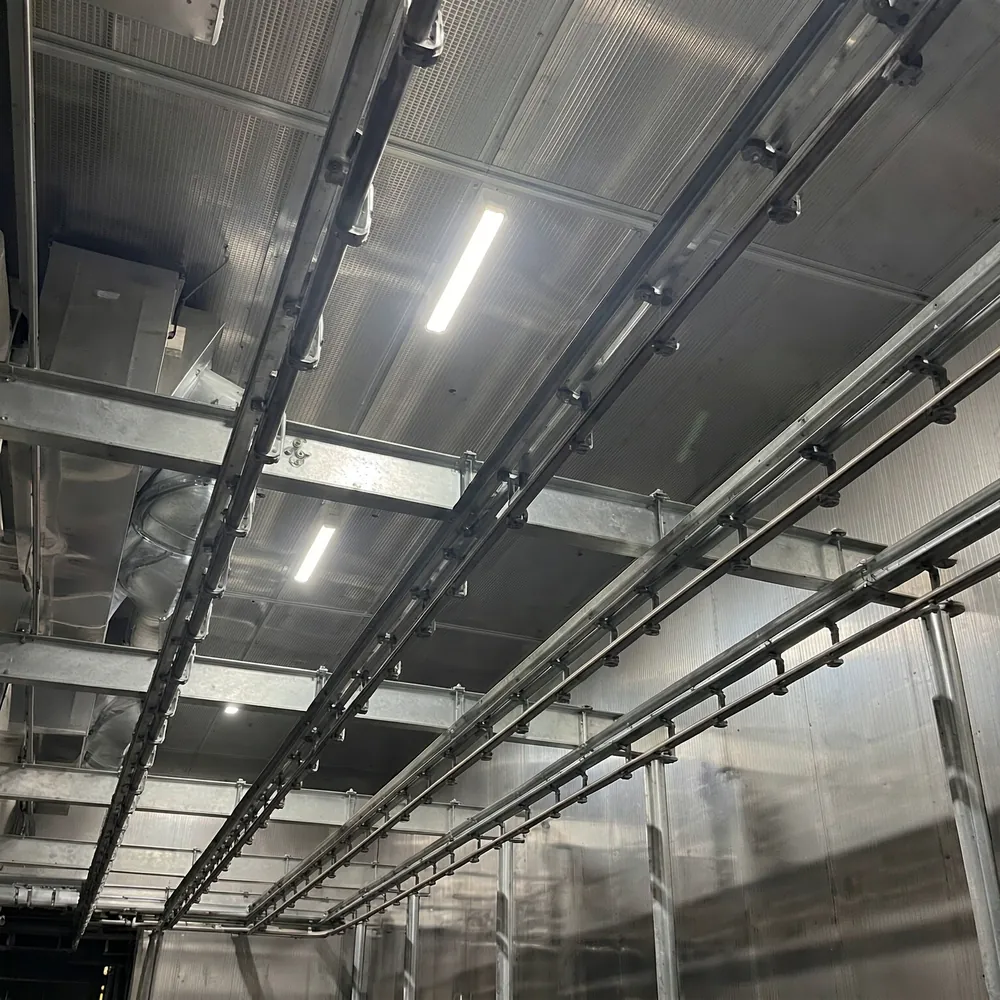
Warehouses and distribution centres move thousands of cartons, totes and hanging goods every day. An overhead conveyor carries them above the floor, freeing space for picking, packing, storage and vehicles.
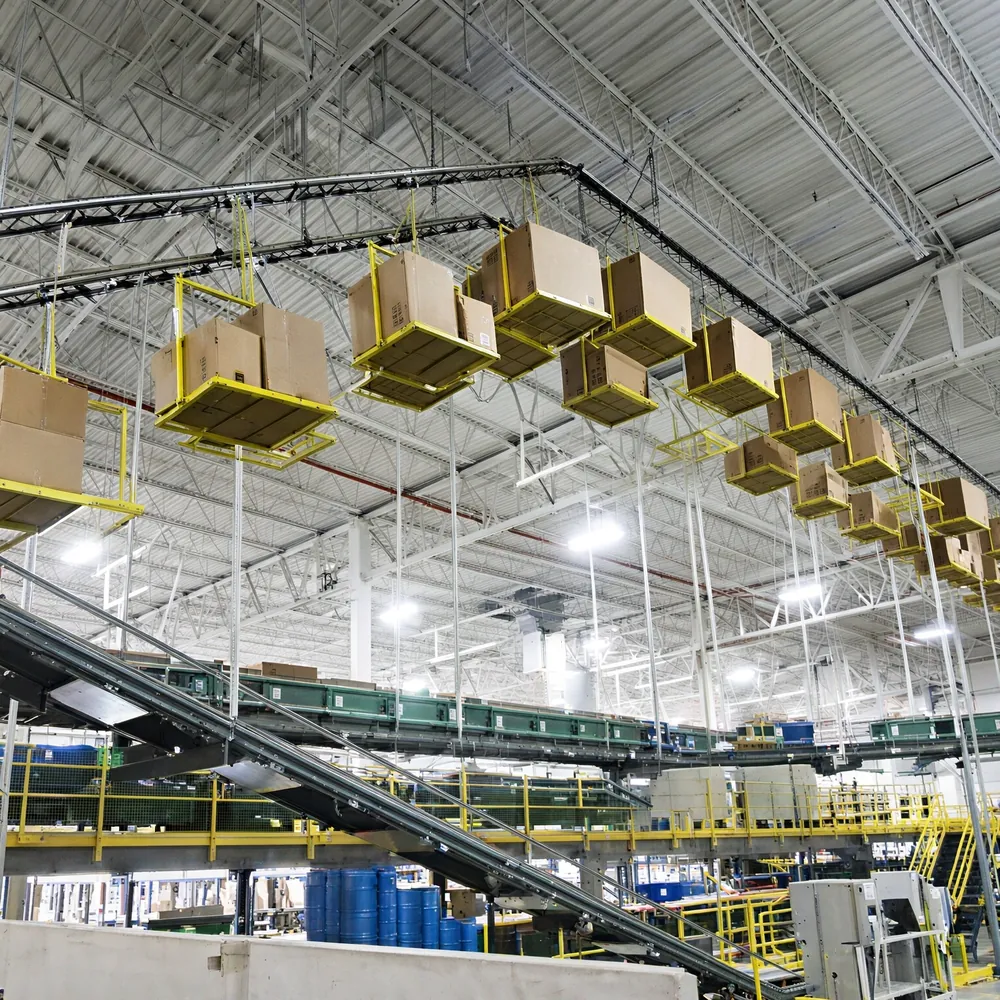
What overhead conveyors do in a warehouse
| Function | Example |
|---|---|
| Transport | Link receiving, storage, picking, packing and shipping |
| Buffering | Hold goods until an order is complete or a dock is ready |
| Sorting | Route loads to zones, lanes or docks by order or destination |
| Hanging goods | Garments and products on hangers |
| Level changes | Connect mezzanines and floors |
Choosing the technology
| Technology | Best for |
|---|---|
| Overhead chain conveyor | Continuous transport on a fixed route |
| Power and free conveyor | Buffering and sorting with many carriers at low cost per carrier |
| Electrified monorail (EMS) | Individually controlled carriers, flexible routing, precise hand-over |
See what an electrified monorail system is and how power and free works.
Integration with floor systems
- Lifts and drop stations to load and unload carriers from floor conveyors
- Automatic transfer where cartons move from carrier to belt or roller conveyor
- Manual load stations with ergonomic heights for mixed goods
- Identification at every hand-over point for order tracking
Safety in warehouses
Goods travelling above people need protection against falling loads. Use carriers that hold loads securely, guards or nets where the conveyor passes over walkways and work areas, and clearly marked zones at lifts. Our overhead conveyor safety guide covers the standards.
Building checks
- Roof structure capacity, or space for a freestanding support structure
- Clear heights for the load envelope above aisles and equipment
- Fire protection: keep sprinkler coverage and clearances agreed with your fire engineer
- Crossings with doors, fire shutters and forklift routes
Sizing
Start from peak loads per hour, the mix of load sizes, the number of destinations and the buffer each destination needs. These numbers set the carrier count, routing and control concept.
HITREE designs overhead systems for warehousing and logistics. Send us your flows for a concept.
Worked example: buffering outbound orders
A distribution centre ships 600 orders per hour through 8 docks. Orders are picked in waves and must wait until each truck is ready. An overhead power and free conveyor with 8 storage lanes, one per dock, holds completed orders above the packing area. When a truck arrives, its lane is released to the dock in loading sequence.
Because the lanes are overhead, the packing area below keeps its full floor space, and forklifts and people work underneath protected by guards.
Questions to ask before choosing a warehouse overhead conveyor
- What are the peak loads per hour, not only the average?
- How many destinations and how much buffer per destination?
- Which load types: cartons, totes, hanging goods, mixed?
- How will the conveyor exchange data with the WMS?
- Where can loads be transferred to and from floor conveyors?