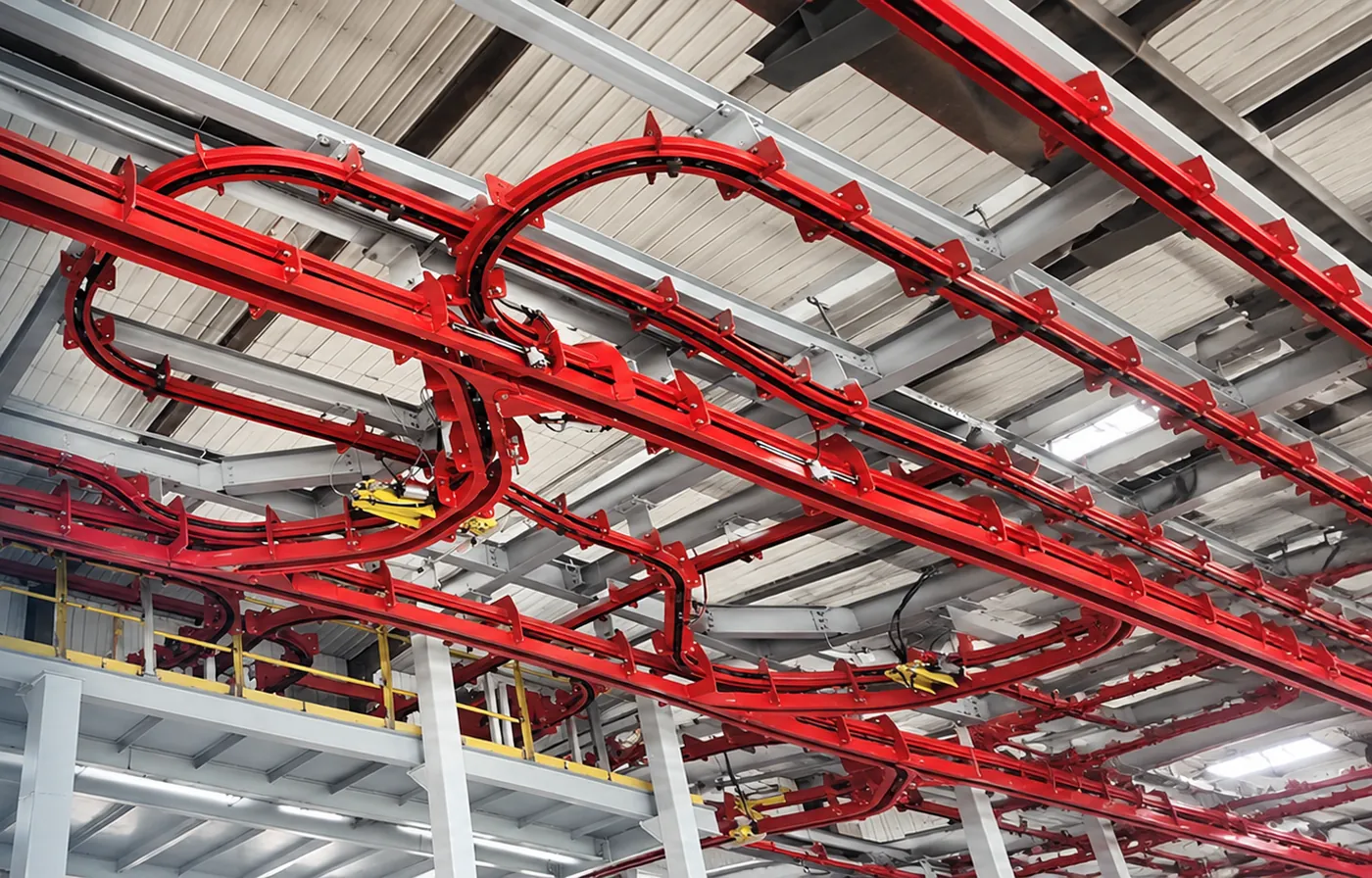
In a standard power and free conveyor, the load hangs below the track. In an inverted power and free conveyor, the track runs below the product and the load sits on top of the carrier.
The mechanism is the same: a continuously moving chain, pusher dogs, free trolleys, stops and switches. What changes is where the track sits and how the product is presented. If you are new to the mechanism, start with how a power and free conveyor works.
Overhead vs inverted power and free
| Overhead power and free | Inverted power and free | |
|---|---|---|
| Load position | Hangs below the track | Sits above the track |
| Track location | Suspended from roof or support steel | On floor stands, low structure or in a pit |
| Product cleanliness | Lubricant and debris can fall on parts | Chain and lubricant are below the product |
| Access to the product | Top of part partly blocked by hanger | Top and sides open |
| Floor space | Floor stays free | Uses floor area or needs pits and crossovers |
| Typical uses | General finishing, assembly, long transport | Paint finishing, heavy parts, automotive bodies |
Advantages
- Clean surfaces: no lubricant or debris drips onto freshly painted parts
- Open access: robots and operators can reach the top and sides of the product
- Stable support: parts sit on fixtures instead of swinging on hooks
- Heavy loads: loads are supported from below, close to the track
Disadvantages
- Uses floor space; walkways and forklift routes need crossovers or pits
- Track at floor level needs guarding and protection from damage
- Usually a higher structure and installation cost than a simple overhead line
Where inverted power and free is used
- Automotive paint shops, carrying bodies through booths and ovens
- Liquid paint and powder coating lines where surface quality is critical
- Heavy parts such as frames, axles and machinery housings
- Lines where robots work from above
See how conveyors are chosen for each zone in our paint shop conveyor guide.
Design considerations
| Topic | What to decide |
|---|---|
| Carrier and fixture | Locating points, product support, masking, and cleaning of fixtures |
| Oven passages | Heat-rated trolleys, bearings and lubricants; track expansion |
| Floor crossings | Pits, bridges or lift sections where people and vehicles cross |
| Guarding | Covers over the track and protection from pinch points |
| Lubrication | Lubricant type and placement that keep the product side clean |
| Maintenance access | Space to inspect the chain, trolleys and drives |
Is inverted right for your line?
Choose inverted power and free when product cleanliness or top access matters more than free floor space. For general transport, an overhead system is usually simpler. Send us your layout and process data and we will recommend the right configuration for your power and free conveyor.
Worked example: a paint finishing line
A manufacturer of machine housings wants a flawless top surface. On their old overhead chain conveyor, lubricant spots and dust from the track caused rework on the top panels. Moving the booth and oven section to an inverted power and free conveyor puts the chain below the parts, so nothing can fall onto the painted surfaces. Robots can also reach the top of each housing without a hanger in the way.
The trade-off is floor space: walkways crossing the line need bridges or a short pit section. In many plants the inverted section covers only the critical coating zones, while loading, unloading and transport stay overhead.
Questions to ask before choosing inverted power and free
- Which surfaces must stay free of contamination, and in which zones?
- Do robots or operators need access from above?
- Where must people and vehicles cross the line?
- Can the inverted section be limited to the critical zones?
- How will the track and chain be inspected and lubricated at floor level?
Mixing overhead and inverted sections
Overhead and inverted power and free sections can be linked with transfer and lift stations, so each zone gets the most suitable design. This is common in automotive and appliance finishing plants.